

Did you know that Jockey products in India aren’t actually made by Jockey?
In 1993, the American innerwear brand Jockey sought to enter India.
It wasn’t Jockey’s first foray into the Indian market. The brand had made an attempt back in 1962 through a local partner, but things didn’t go as planned.
Government regulations in the 1970s and a few issues with its partner made it impossible for Jockey to sustain operations, and the brand eventually exited India.
What made the attempt successful in 1993 in India was the timing and the right partner. The regulatory environment in India had improved post the 1991 liberalisation reforms, and Jockey found a different collaborator — the Genomal family.
The British-Indian Genomal family had a proven track record, having managed Jockey successfully in the Philippines for three decades since 1959.
In 1994, this partnership gave birth to a new company: Page Industries.
Page Industries got the right to manufacture, distribute, and market Jockey products across India. It gave the company end-to-end control over the Jockey brand. In effect, Page Industries would operate as Jockey India.
Fast forward to today, Jockey is one of the top innerwear brands in the country, and the credit for this market dominance belongs to Page Industries. When consumers buy Jockey products, it is Page Industries that produces and delivers them.
Globally, Jockey usually enters new markets through trusted local partners rather than operating directly on its own. So unlike a subsidiary or parent company relationship, Page Industries operates independently. It is an independent retail manufacturer of clothes.
With this partnership, Page Industries became an exclusive licensee of the Jockey brand in India.
That exclusivity means that no one else — not even Jockey itself — can manufacture or sell Jockey products in India.
And this exclusivity forms the foundation of Page Industries’ economic moat.
An economic moat is a competitive advantage that protects a business from rivals.
For Page Industries, the moat starts with this exclusive license — a legal safeguard that keeps other companies out of the Jockey business.
But the moat doesn’t stop there.
Understanding the Moat
The Exclusive, Perpetual, and Ever-Expanding License
The exclusive licensing agreement is indeed the company’s most visible and powerful moat. It’s a legally protected moat that ensures Page Industries is the only company that can officially produce and sell Jockey products in the licensed territory, i.e. India.
What makes this license particularly strong is its longevity and trust. It started in 1994 and has now been extended until 2040, giving the company decades of operational clarity and stability.
The company’s strong track record also earned Jockey’s trust beyond India. It holds exclusive rights for Jockey in Sri Lanka, Bangladesh, Nepal, Maldives, Bhutan, Oman, Qatar, Bahrain, Kuwait, UAE and Saudi Arabia too.
The royalty that the company has to pay to Jockey is around 5% of net sales, though the most recent rate hasn’t been officially disclosed.
Even so, this deal lets Page Industries benefit from Jockey’s global name while keeping most of the profit. And because no one else can make or sell Jockey products in these countries, competitors can’t just waltz in and copy what Page Industries has built over the last 30 years.
Apart from Jockey, Page Industries also holds an exclusive licensing for Speedo in India, although this contributes a small portion to the total revenue.
Operations: Vertical Integration
Having the license gives Page Industries the right to sell Jockey in India. But rights alone don’t make a powerful company. Consumers can easily switch brands, and rivals can operate freely.
What matters more is what the company does after that.
Unlike many competitors, Page controls almost the entire production process. The company produces 70% to 80% of its garments in-house, which allows them to ensure consistent quality and efficiency.
The company’s factories act like mini production systems. This setup allows them to respond quickly to sudden demand spikes or new product launches, without delays from external suppliers.
They have big factories, mostly in Karnataka, and are now expanding to Odisha with a new, modern facility.
This vertical integration is also a huge barrier to entry. Building factories, training staff, and maintaining quality takes tonnes of money, years of experience, and serious effort. For newer players, it becomes hard to build this kind of system.
The Brand and Distribution
Even the best product doesn’t sell itself. Page Industries knows that, which is why Jockey is everywhere. From small neighbourhood stores to big malls, and now online, they’ve built a distribution network that’s hard to beat.
Jockey is available in over 1 lakh retail stores across thousands of cities and towns. This includes around 1,500 exclusive brand outlets, plus the small neighbourhood shops seen everywhere (multi-brand outlets) and large stores in malls.
On top of that, their online presence is growing rapidly, making Jockey easy to find wherever you shop.
Around 2022–23, Page Industries added a tech edge with its Auto-Replenishment System (ARS). This AI-driven system tracks stock at every store and automatically triggers refills, keeping shelves full, minimising stockouts, and improving inventory turnover.
Retailers love it because Jockey sells fast and keeps customers coming back. Even if Jockey is priced slightly higher than local brands, retailers earn more in absolute terms because Jockey sells quickly.
That makes store owners want to stock it, giving Jockey an almost permanent spot on the best shelves.
Not just that, Jockey doesn’t just sell to one group. It is a brand for everyone: men, women, and kids. This ‘blanket’ approach makes it appealing to entire households, not just one person. This is something most local brands don’t have. Even if other premium brands try, unlike Jockey, innerwear isn’t usually their main product.
The Intangible Moat
Innerwear in India was something people bought quietly. Page Industries’ advertising turned it into a confident, aspirational purchase for both men and women.
This ‘brand pull’ keeps customers coming back. Page Industries can charge a bit more without hurting profits, while maintaining the brand’s premium feel.
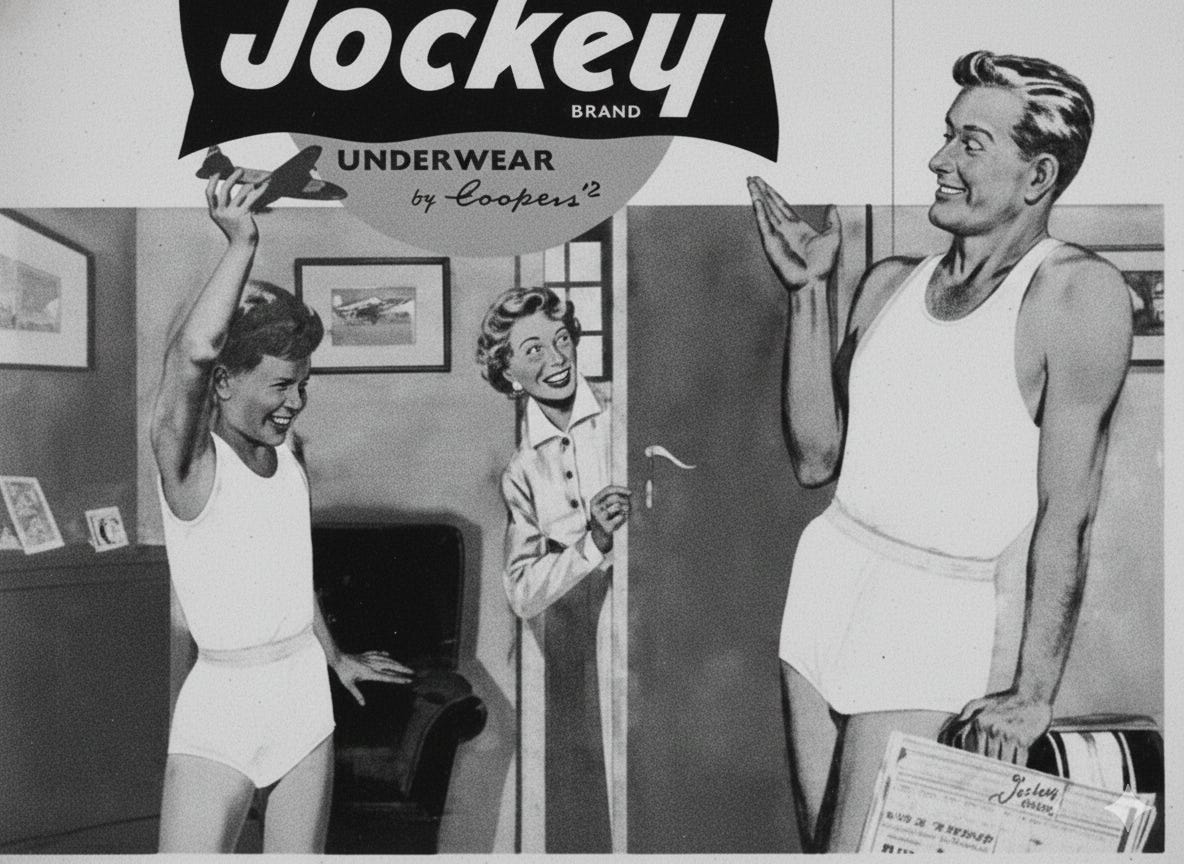
Old Jockey advertisement
Page Industries got a head start with an exclusive deal from Jockey, but its market position today has evolved to be more than just the license.
That said, the company isn’t immune to risks. Competition is also evolving, with established lifestyle brands and D2C challengers targeting similar segments.
Yet, Page Industries continues to scale quietly. It remains one of Jockey’s largest licensees globally and the backbone of the brand’s success in India.
The average buyer may never notice Page Industries. But the brands it manages reach everywhere.
And that, perhaps, says the most about its moat. The company’s strength lies beyond the brand, in the systems and execution that bring the product to the consumer.
Love this new Economic moat. I want to know more about this. Other companies which are been benefited by this kind of MOAT.