

Wars are expensive.
In 1713, Britain’s war with Spain and France came to an end.
The war had been an expensive affair and Britain was drowning in debt.
The dues ran into many tens of millions of pounds, which in those days was a staggering amount.
For Britain, the debt problem was an ongoing worry throughout the war period.
Britain’s revenues were going towards servicing debt and creditors were growing anxious.
During the war, the British Treasurer, Robert Harley, along with a financier named John Blunt, came up with an idea to deal with this debt.
In 1711, they created the South Sea Company.
South Sea Company
The South Sea Company was created to trade with what is now known as South America.
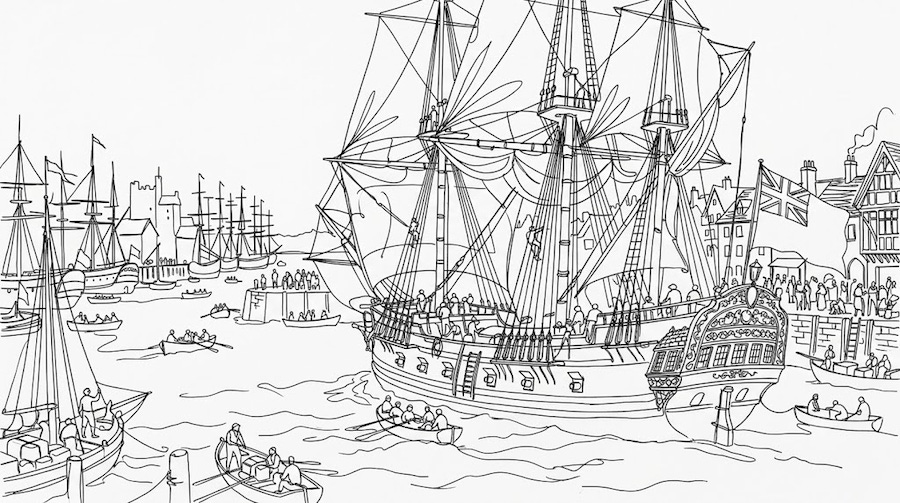
It was believed that all of South America was a frontier with endless wealth and trade opportunities (and lots of gold & silver).
The South Sea Company was granted a monopoly on British trade with this region.
According to this grant, only the South Sea Company would have access to all the vast riches from trading with South America.
But why was the company given this grant?
Because the company promised the British government that it would take on a large portion of its national debt. In exchange, the creditors who were owed money by the British government would be given shares in the company.
Essentially, the lenders would become shareholders.
Investors were promised steady income (guaranteed interest of 6% per annum), along with a stake in a future multi-bagger company.
Everyone was satisfied and the idea was executed without much opposition.
Word Spreads
People got to know about the new company with a monopolistic grip over all trade from the faraway land with great wealth.
More investors wanted in on the action. They purchased shares.
The South Sea Company had immense political power since it was partly the idea of the government itself.
The investment idea spread through the elite circles among aristocrats, lawyers, financiers, and the like.
South America was mostly controlled by Spain (the very country the British had been warring with).
When the war ended in 1713, the company could start sending its ships and trading with South America.
The first goods ship voyage finally took place in 1717. The treaty signed at the end of the war in 1713 was very restrictive for the British.
To make matters worse, the two countries went to war again in 1718.
The trade was not earning anywhere near enough to justify the hype around it.
While the trade hadn’t caught up, the larger audience of investors was incredibly optimistic about its future.
So well-connected was this company that the King himself became the governor of the South Sea Company in 1718, adding to its prestige and legitimacy.
Seeing the continuous frenzy for the stock, even lower-income citizens who could not afford to take risks sold other assets to buy the stock.
Eventually, people even started taking loans to fund their purchase of the stock.
Unsustainable
Towards the end of 1719, the stock price was around £100.
But the masses were talking about the stock even more. It was hotter than it had ever been before based purely on hopes of a future rise.
By this point, investors didn’t seem to care about the company and its trade. The company’s share price was enough to draw everyone in.
The frenzy was so mad that many other companies felt like they could take advantage of this situation. It was too tempting for others to stay away.
Some promised similarly vague results — trades with South American entities, silver mining, selling commodities, etc.
Some went so far as to not reveal what they would actually do, keeping it for “later”.
Money started pouring into those companies’ stocks too.
The South Sea Company felt this was money being diverted away from it. Using its political power, it got laws passed to have such companies banned.
This gave investors an even clearer signal.
The signal was that the South Sea Company was the only real company that could trade with South America.
The South Sea Company had taken on even more national debt, and issued more shares to the public. Free shares were given to certain politicians.
The South Sea Company even started giving out loans to investors to buy shares of itself!
The price of the stock rose further.
January: £128
May: £550
June: £1050
The stock had risen by 10 times in less than 1 year.
Many investors were surprised by how far their investment had already grown in a short period. Some booked profits and sold.
Some stayed. Some doubled down and increased their investments further.
Mind you, the actual trade had still not picked up enough.
The Expected
From this point on, what was expected happened.
The bubble burst.
Some selling started, others caught wind, more selling happened.
The ones who were most on the line — the ones who had taken loans to buy stocks — panicked the most and sold.
Seeing the stock price fall sharply, everyone else tried to sell before it was too late. That only made matters worse.
The crash was so severe that it pulled down other stocks as well.
Mid-Sept: £520
Oct: £200
End of 1720: £100
Some company insiders sold at the peak and were able to leave with fat wallets. Some were stripped of their wealth and jailed.
The damage was so large that it threatened the entire financial system of the country.
The situation was similar to what we saw in 2008.
The government had to step in to restore public trust in the system. The general public was badly bruised, and so were the bigwigs.
This episode came to be known as the South Sea Bubble.
It is widely regarded as one of the first stock market crashes of the world.
Between then and the 2008 Great Recession, we have seen many other crises come and go.
The avatars change.
The patterns are often strikingly similar.
Speculative bubbles always start with a promise of a good investment.
Then the gains come from others joining the fray, not from the investment’s original promise.
It becomes a speculative bubble. And bubbles only go out one way — by bursting.
Quick Takes
+NSE and BSE announced that the special one hour trading session called Muhurat Trading will take place between 02:20 pm and 03:30 pm on 08 Nov.
+The India- New Zealand Free Trade Agreement (FTA) will come into effect from tomorrow, 20 Oct. It will provide duty free access for 100% of Indian exports to New Zealand.
+The government directed oil marketing companies to reduce sugar diversion for ethanol production to 0 in 2026-27, as per media reports. This aims to protect sugar supplies and reduce prices.
+Jio Platforms raised Rs 8,109.84 crore from 212 anchor investors ahead of its IPO. LIC, New World Fund, Government of Singapore, received the highest allocation.
+The government clarified that it has no plans to regulate airline ticket prices under the new airfare rules, but will impose caps on airfares in exceptional cases like natural disasters or major disruptions, as per media reports.
+India’s Infrastructure Output rose 7.9% in September compared to 5.9% in August.
+Retail automobile sales fell 6.52% year-on-year to 11.23 lakh units in the Navratri period compared to the previous year, as per provisional data from Federation of Automobile Dealers Associations (FADA).
+The government introduced Form 173A, a new form to claim income-tax exemption on interest and capital gains from government securities under the Income-tax (Seventh Amendment) Rules, 2026.
+India’s crude oil imports rose 47% to $15.4 billion in September while volumes grew 6.8% to 21.7 million tonnes, as per media reports.
+National Commodities and Derivatives Exchange (NCDEX) launched NDEX and FINNDEX, 2 rule based indices and entered the equity and equity derivatives market.
+India’s forex reserves fell $5.01 billion to $721.02 billion for the week ended 16 Oct.
+SEBI relaxed margin rules for cash trades by allowing clients to use value of early delivered shares for subsequent trades as margin, effective from 22 February 2027.
+Commerce Minister Piyush Goyal said that the EU’s carbon tax on steel and other industrial products could increase infrastructure costs, and trigger retaliatory measures from its trading partners.
+SEBI removed the mandatory call recording requirements for research analysts interacting with institutional investors, while keeping the requirements for retail investors.
+BSE invited applications for the post of MD & CEO and announced requirements through a post on X (formerly Twitter). The deadline for applications is 19 Nov.
The information contained in this Groww Digest is purely for knowledge. This Groww Digest does not contain any recommendations or advice.
Team Groww Digest