

In 2019, Three Mile Island Unit 1 in Pennsylvania was shut down. It was not making enough money anymore, and running it cost a lot.
But that view did not last long.
A few years later, demand for electricity started rising again.
The main reason was AI.
Data centres started growing fast, and suddenly old nuclear plants weren’t seen as useless anymore — they became valuable again.
In 2024, Constellation Energy made a 20-year deal with Microsoft to restart the Three Mile Island plant bringing back about 835 MW of nuclear power, enough to power hundreds of thousands of homes.
Around the same time Google also made a nuclear deal with Kairos Power. With the idea to build new small nuclear reactors and reach about 500 MW by 2035. It’s a long-term bet on future power needs.
Amazon Web Services made a similar move. It paid $650 million for a data centre site next to the Susquehanna nuclear plant in Pennsylvania. The plant produces about 2,494 MW of power. Under a 17-year deal, AWS will use around 1,920 MW of that electricity. The total value of the deal is close to $20 billion.
Microsoft, Google and Amazon are technology companies.
But look at what they are doing. They are securing electricity and physical infrastructure.
For years, technology companies were seen as asset-light businesses. Most of their value came from software, intellectual property and network effects rather than factories, power plants or other heavy physical assets. Compared with energy, manufacturing or telecom companies, they spent less on physical infrastructure and focused more on building products, attracting users and expanding digital platforms.
That model is now changing.
These companies are no longer spending only on software, apps and cloud services. They are now investing in the physical infrastructure behind them (land, power, fibre, substations, cooling systems, water and backup generators).
Why?
Because AI may look like software, but it runs on hardware. It needs huge data centres filled with chips and connected to massive amounts of electricity.
Behind every AI model is a physical system, and every part of that system costs money.
So we wanted to understand what it actually takes to build and run this infrastructure, and how those costs add up in practice.
Data-centre investment is already running into hundreds of billions of dollars, and total spending could rise to as much as $3 trillion over the next five years.
What companies are paying for
To understand these costs, it helps to start with the total.
Different industry estimates suggest that meeting AI demand could require more than $5 trillion in data centre investment by 2030 in a typical scenario where demand keeps growing as expected.
That is a huge number.
But the more important question is where all that money goes.
Nearly two-thirds of the total cost is spent on computing hardware. This means things like GPUs (the powerful chips that do the AI calculations), servers (the machines that run the software), storage systems (where data is saved), and networking equipment (which connects everything together so it can communicate quickly).
They also don’t last very long in technology terms. Companies often need to replace or upgrade them every few years as faster and better chips come out. Because of this constant upgrading, they end up taking the biggest share of the spending.
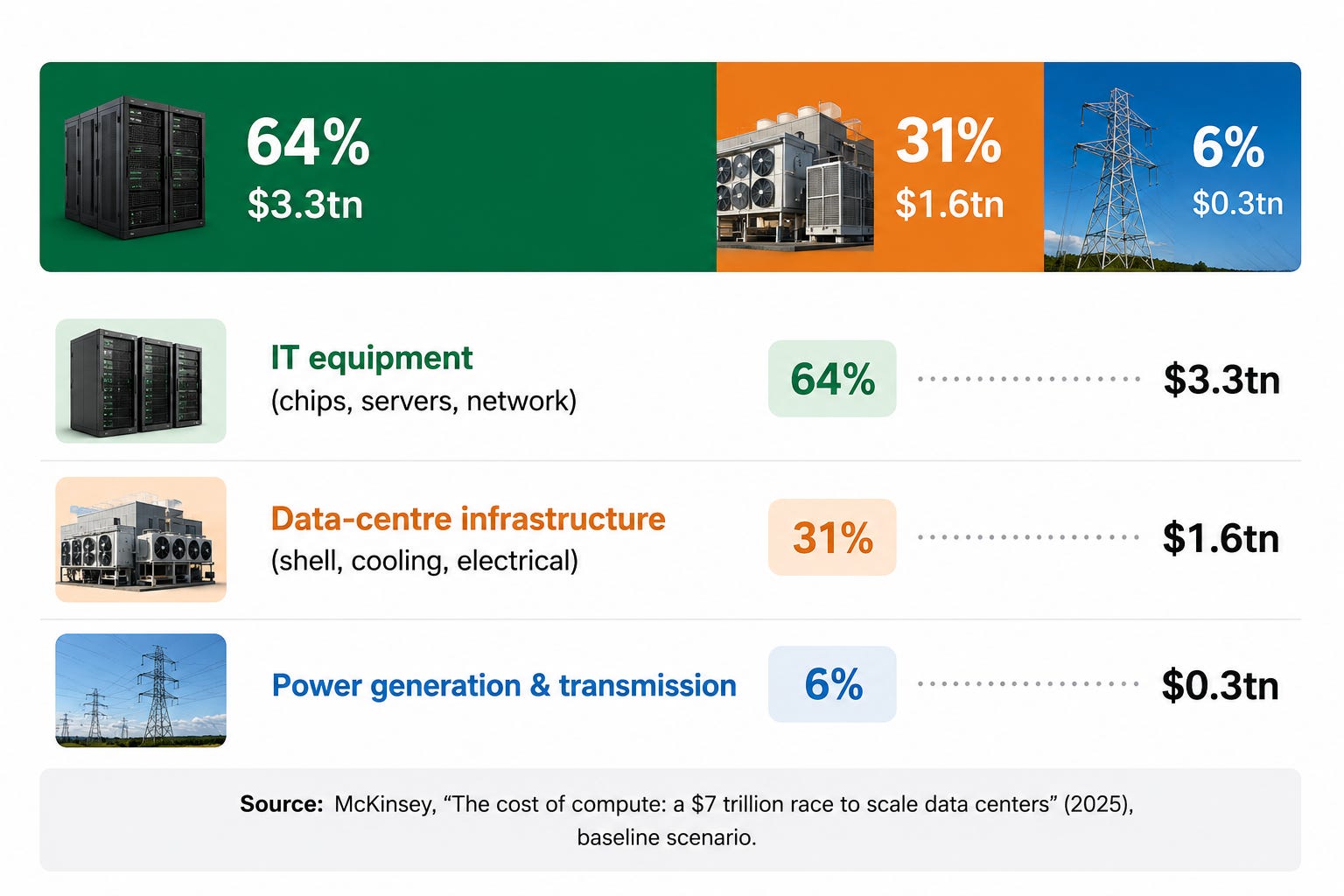
In comparison, less than one-third of the total cost goes into the physical building itself, along with things like cooling systems, electrical wiring, and other infrastructure needed to keep everything running safely and efficiently.
Land and power generation make up only a small part of the total.
This may sound surprising, especially after seeing technology companies secure nuclear plants and large pieces of land. But those things are valuable mainly because they support what sits inside the data centre.
The most important part is the chips.
This is why an AI data centre is not really just a normal building with computers inside it. It is more like a very large warehouse filled with extremely expensive computer parts that do all the thinking and processing.
To understand the cost, we can split everything into two simple groups.
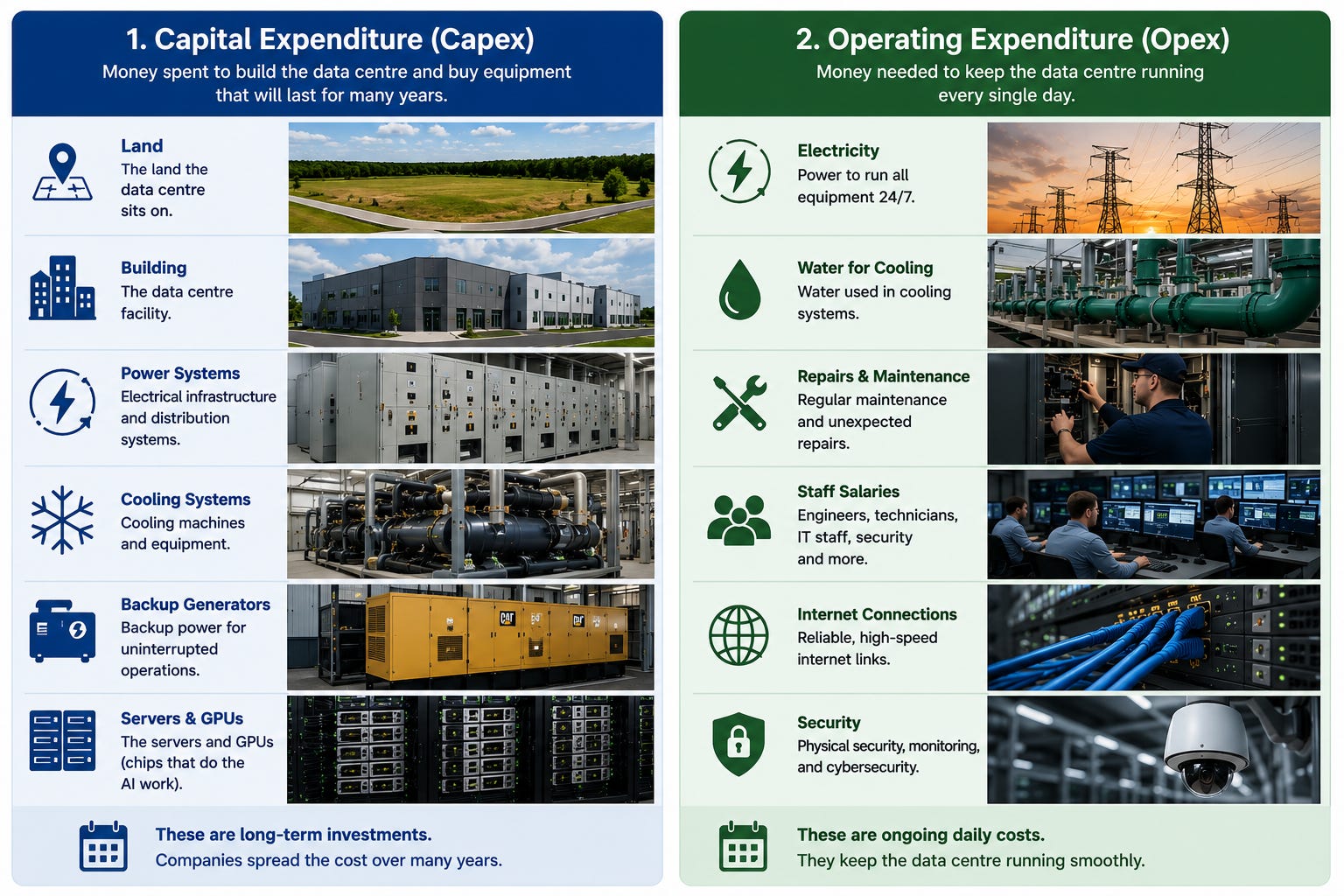
In most cases, the most expensive part of building the data centre is the hardware, especially the chips and servers. And the most expensive part of running it is electricity, because these machines use huge amounts of power.
So to understand what an AI data centre really costs, we need to look at both. We will start with the largest chunk: the chips and servers inside it.
The Biggest Cost: Chips (around 63% of capex)
The biggest cost inside an AI data centre is not the land, the building or even the cooling system.
It is the chips.
A data centre built mainly for heavy AI work can cost around $40,000 per kilowatt of computing capacity it adds. That is very high because AI systems use a lot of power in a very intense way.
Even a small amount of electricity is turned into massive computing work, so everything around it has to be built stronger. The chips, the cooling, and the electrical systems all need to handle nonstop heavy usage.
For comparison, a normal cloud data centre usually costs about $10,000-$15,000 per kilowatt, so AI-focused ones can be around 2 to 4 times more expensive for the same amount of power.
A big reason for this is GPUs. More than half of the total cost often goes into them.
GPUs are not like regular computer chips; they are built to do many calculations at the same time, which is exactly what AI needs.
Each powerful GPU can use around 700 to 1,200 watts of electricity on its own.
When you connect thousands of them together, the power usage adds up very quickly.
Large AI clusters can end up using 10 to 30 megawatts of power, which is about the same as a small town running continuously.
A large AI data centre may need tens of thousands of GPUs working together at the same time, all connected through high-speed networking so they can function as a single system rather than individual machines. At scale, this can mean 20,000-100,000 GPUs inside one facility, linked by networking systems capable of moving data at hundreds of terabits per second to prevent bottlenecks.
And companies do not usually buy these chips one by one.
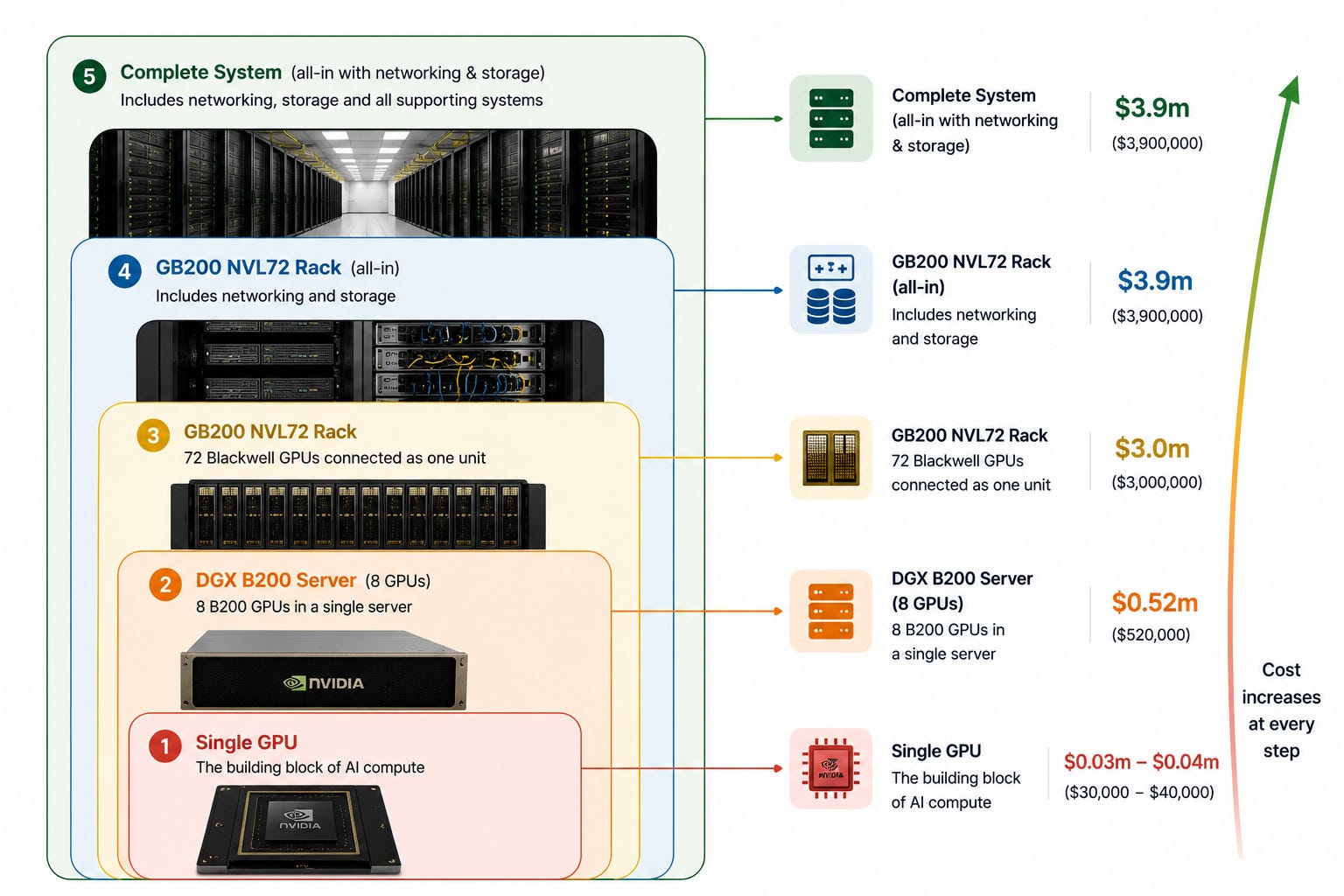
Instead, they are first placed inside servers. A server is like a machine that holds several chips together so they can work as a team. These servers are then grouped into larger units called racks, which are like shelves that hold many servers.
Each rack also needs extra equipment like networking systems (to help all the machines communicate) and storage systems (to save and move data). All of this is necessary for the chips to actually function as one big AI system.
Because all of these layers stack on top of each other, the cost starts to rise very quickly.
GPUs, or graphics processing units, are specialised processors designed to handle huge numbers of calculations in a very short time. They are the core hardware used to train models.
A single Nvidia H100 GPU can cost anywhere between $27,000 and $40,000. The newer B200 is even more expensive, usually in the $30,000 to $50,000 range.
These GPUs are bundled together into much larger systems. For example, a DGX B200 server packs eight B200 GPUs into a single machine, and that alone can cost around $515,000.
And even that is still just one part.
If you make it bigger, you get something like a GB200 NVL72 rack. This is a system that connects 72 powerful Blackwell GPUs together so they can work as one unit. Just one of these racks can cost around $3.1 million.
Then you still need extra equipment like networking and storage so it can connect and communicate with the rest of the data centre. Once you add all of that, the total cost can go up to almost $3.9 million.
The newer GB300 NVL72 system is expected to cost around $3.7 million to $4 million for a single rack.
Now multiply that across hundreds or even thousands of racks.
That is how the computing layer ends up taking nearly two-thirds of the total data-centre budget. The building may look enormous from the outside, but most of the money is sitting inside it in the form of chips, servers and networking equipment.
There is another problem.
These chips do not remain useful for very long.
A substation, cooling system or building may continue operating for decades. But GPUs are often replaced within three to five years as newer and more powerful models become available.
So even though GPUs are officially treated as capital expenditure, the spending starts to behave almost like a recurring cost.
Companies build the data centre once, but the most expensive component inside it( GPUs) has to be replaced every few years as faster generations arrive, meaning tens of thousands of chips, each costing tens of thousands of dollars, are continually cycled out and replaced.
To see why this hurts, it helps to look at who is actually making the money.
In its fiscal 2025 report, NVIDIA said it made $130.5 billion in revenue, more than double the year before. Its gross margin was about 75%, and its operating income was $81.5 billion.
In simple terms, a 75% gross margin means that for every $100 a customer pays for a chip, only about $25 goes toward making it. The other $75 is gross profit.
That is a very high margin, and it shows just how valuable these chips are.
And it is exactly this cost structure that big cloud companies are trying to push down.
This is why large technology companies are now designing their own AI chips.
Google has its TPUs. Amazon has Trainium. Meta is developing MTIA, while Microsoft has Maia.
Why go through the cost and difficulty of building their own chips?
Because when hardware makes up nearly two-thirds of the bill, even a small improvement matters. A chip that uses less electricity, completes tasks faster or reduces the number of servers required can save money across thousands of machines.
And those savings keep adding up every time the company builds another data centre.
This explains why chips take the biggest share of the money.
But buying the GPUs is only the beginning. They still need a building that can deliver enormous amounts of electricity, keep them cool and run continuously without failing.
Next week, we will look at what it costs to build and operate everything around the chips.
Gpu are goat...
Very nice explanation.