

Note: Despite being a Sunday, the markets were open today. This was because of the presentation of the Union Budget.
The Budget is presented on 1 February every year. This year it fell on a Sunday. Hence, you are getting this edition of Daily Groww Digest today.
The Weekly Groww Digest edition for this Sunday was already sent yesterday (on Saturday evening).
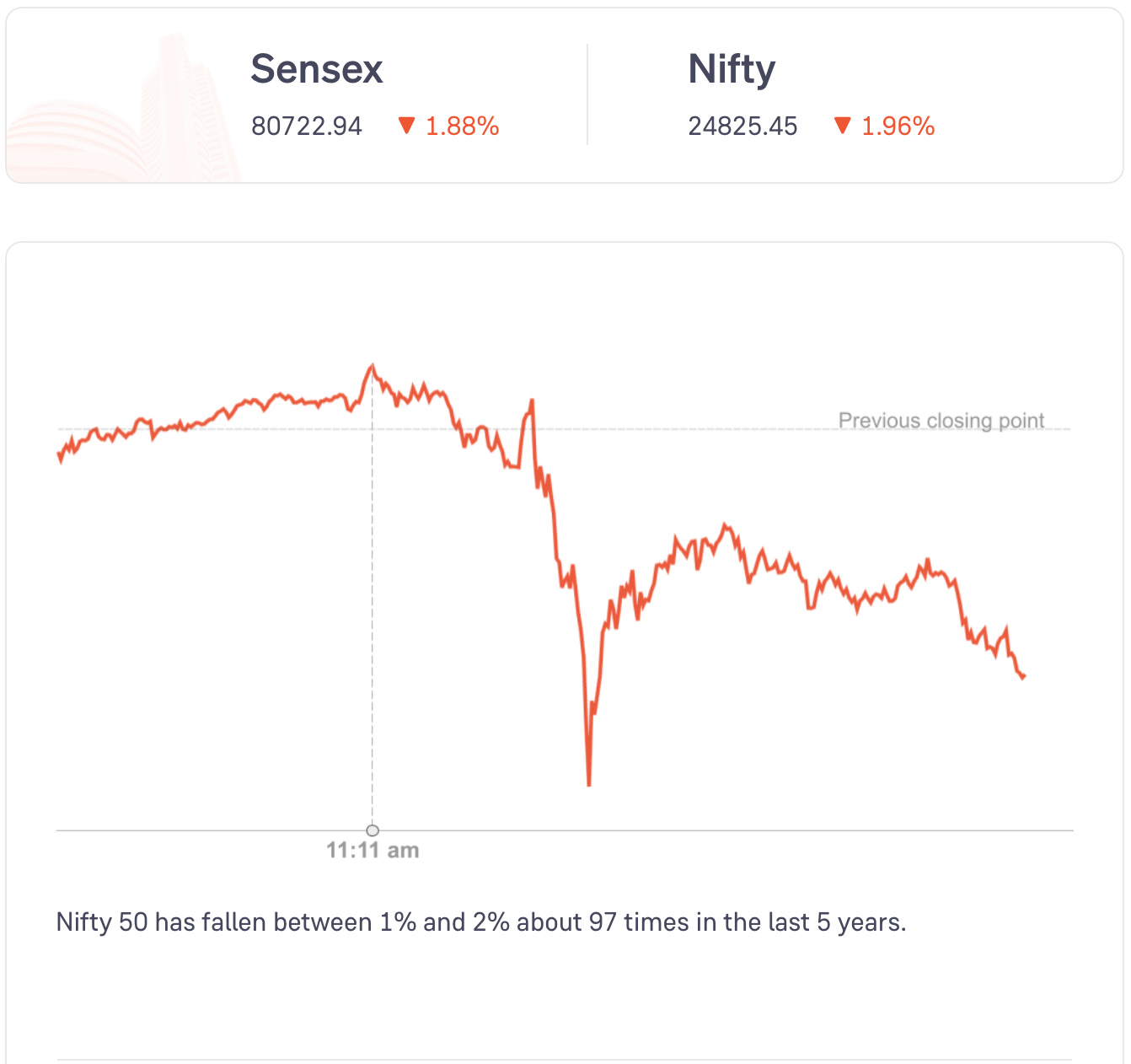
Markets opened below Friday’s closing point.
Nifty 50 was volatile today due to the Union Budget announcement. In the middle of the day, it fell more than 2% in a matter of 20 min.
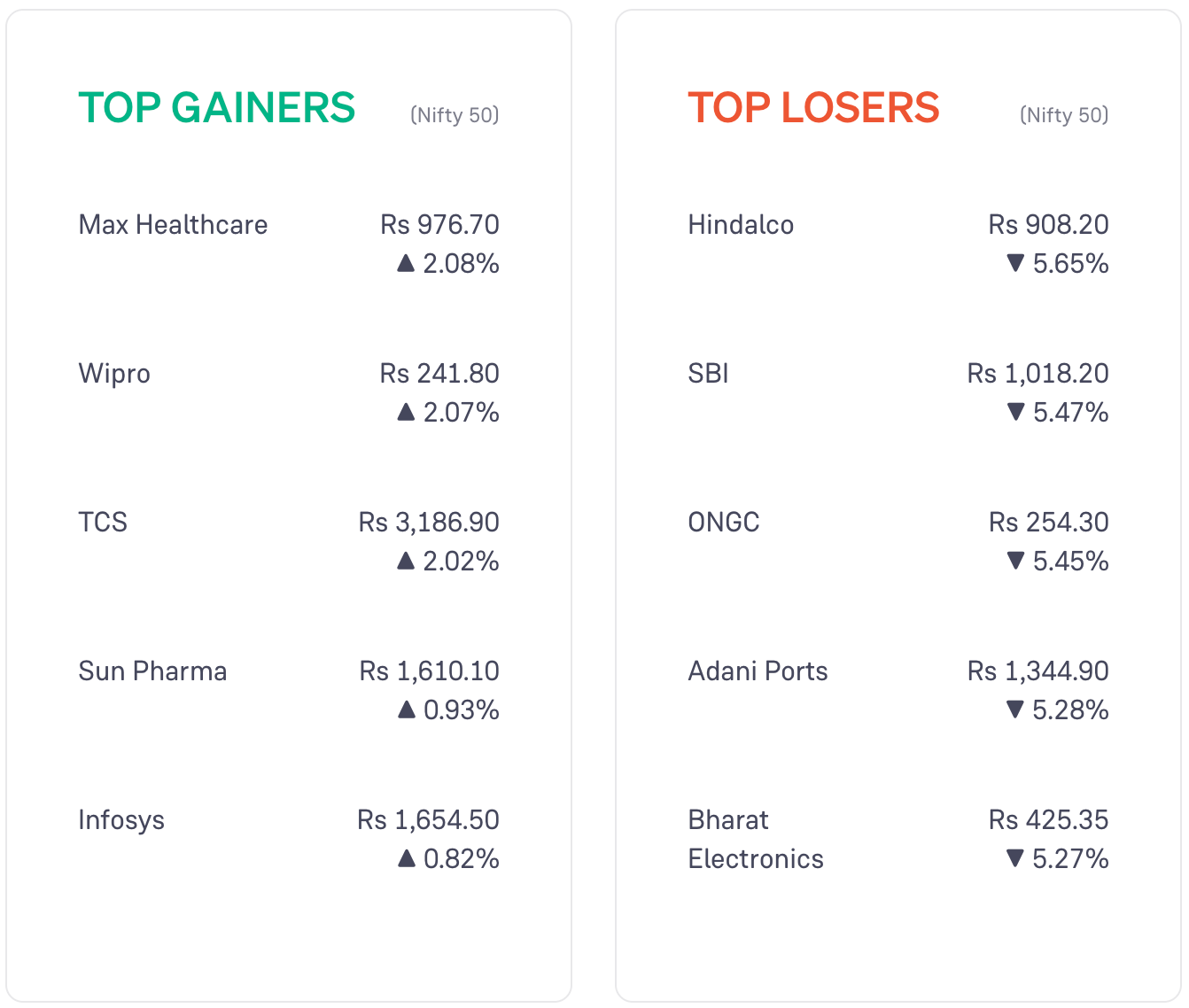
All sectors’ stocks fell today except for the IT stocks. PSU bank stocks and metal stocks fell the most.
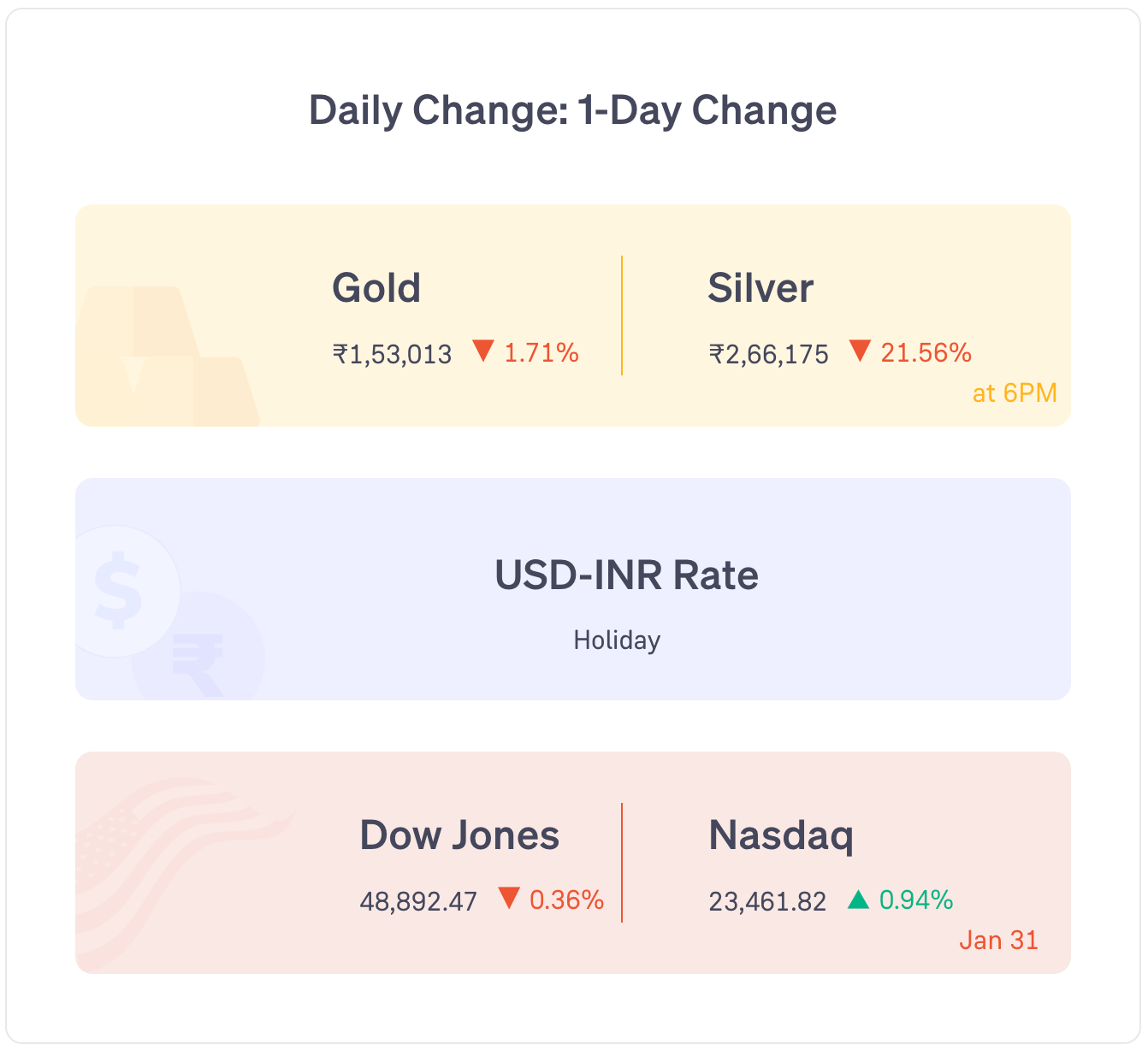
Global markets: US markets closed in red on Friday.
Union Budget
The Finance Minister proposed the Union Budget 2026-27 to the Parliament. Some of its major highlights are:
The government has suggested a change in how share buybacks are taxed. Buybacks will now be treated like capital gains. Under the revised framework:
- Effective tax for corporate promoters: 22%
- Effective tax for non-corporate promoters: 30%
- Effective tax for minority shareholders (retail individual investors): 12.5% (as per capital gains tax)Securities Transaction Tax (STT) on futures raised to 0.05% (from 0.02%), while STT on options premium and exercise has been increased to 0.15% (from 0.1%) and 0.125%, respectively.
Capital gains on Sovereign Gold Bonds will now be tax-free only if the bond is bought directly from the RBI and held till maturity. Gains on SGBs bought from the secondary market will be taxable.
The public capital expenditure budget has been raised to Rs 12.2 lakh crore, up from Rs 11.2 lakh crore last year.
The Biopharma SHAKTI initiative was proposed to build a domestic ecosystem for the production of biologics and biosimilars with an outlay of Rs 10,000 crore over the next five years.
A dedicated Rs 10,000 crore SME Growth Fund has been proposed to help small businesses scale and access capital.
The government proposed multiple custom duty updates:
- Goods imported for personal use: cut tariff rate from 20% to 10%
- Seafood exports: increase the limit for duty-free imports of certain inputs from 1% to 3% of last year’s export value
- Nuclear projects: extend duty exemption till 2035 for nuclear power projects
- Aviation: exemptions on customs duty on components and parts for aircraft manufacturingThe funding for the Electronics Components Manufacturing Scheme has been increased from Rs 22,919 crore to Rs 40,000 crore, reinforcing the electronics manufacturing push.
The government proposed it will support mineral-rich states, including Odisha, Kerala, Andhra Pradesh and Tamil Nadu, to establish dedicated Rare Earth Corridors covering mining, processing, research and manufacturing.
The government proposed to raise the safe harbour limit for IT services from Rs 300 crore to Rs 2,000 crore. This means many more IT and services companies can now face fewer tax hassles.
To attract global talent, the government has proposed to exempt non-resident experts from tax on their global income for five years, with only income earned in India being taxable.
(These were announcements as per the Finance Minister’s speech. Further details and notifications are expected in the coming weeks.)
Stocks Updates
Trent: company’s step-down subsidiary ‘THPL Support Services’ has been amalgamated with Booker India to simplify group structure.
NTPC: transferred the Dulanga and Talaipalli coal mines to its wholly-owned subsidiary NTPC Mining.
GAIL: net profit fell 57% year-on-year to Rs 1,756 crore in the Oct-Dec quarter. Dividend declared: Rs 5 per share. Record date: 5 Feb.
Word of the Day
Finance Bill
It is a bill that contains the government’s tax and financial proposals announced in the Union Budget
It is presented in the Parliament and must be passed by the Lok Sabha to legally enforce the proposals in the budget.
The bill includes changes in income tax, GST, duties, cess, and other taxation measures.
If the government wants to change income tax rates announced in the Budget, those changes are written into the Finance Bill and passed into law.
Featured Question
Q. “An index is usually rule based. The Nifty 50 index is based on the rule that it will be made up of the 50 biggest companies in India, where as Sensex is made up of the 30 biggest companies on the Bombay Stock Exchange (BSE).Then My question is why the current bench mark is one for above 25000 approx and for other is above 82000 approx.”It’s down to an arbitrary calculation system.
In case of indices, the points are not of much importance. It is the relative change that is the main point of importance.
Some colleges grade their students on a 10-point system, while some use a 100-point point system. It is somewhat like that.
Sensex was started much earlier, in 1978. Its starting value is 100.
In comparison, Nifty was introduced in 1995 with a starting value of 1000.
These starting values are called base values.
Despite Sensex starting at 100, it has had many more years to grow. Hence, its value is higher than Nifty at present.
These are arbitrary points. It does not automatically make one system better than the other system.
Did you like this edition?
Leave a feedback here!