
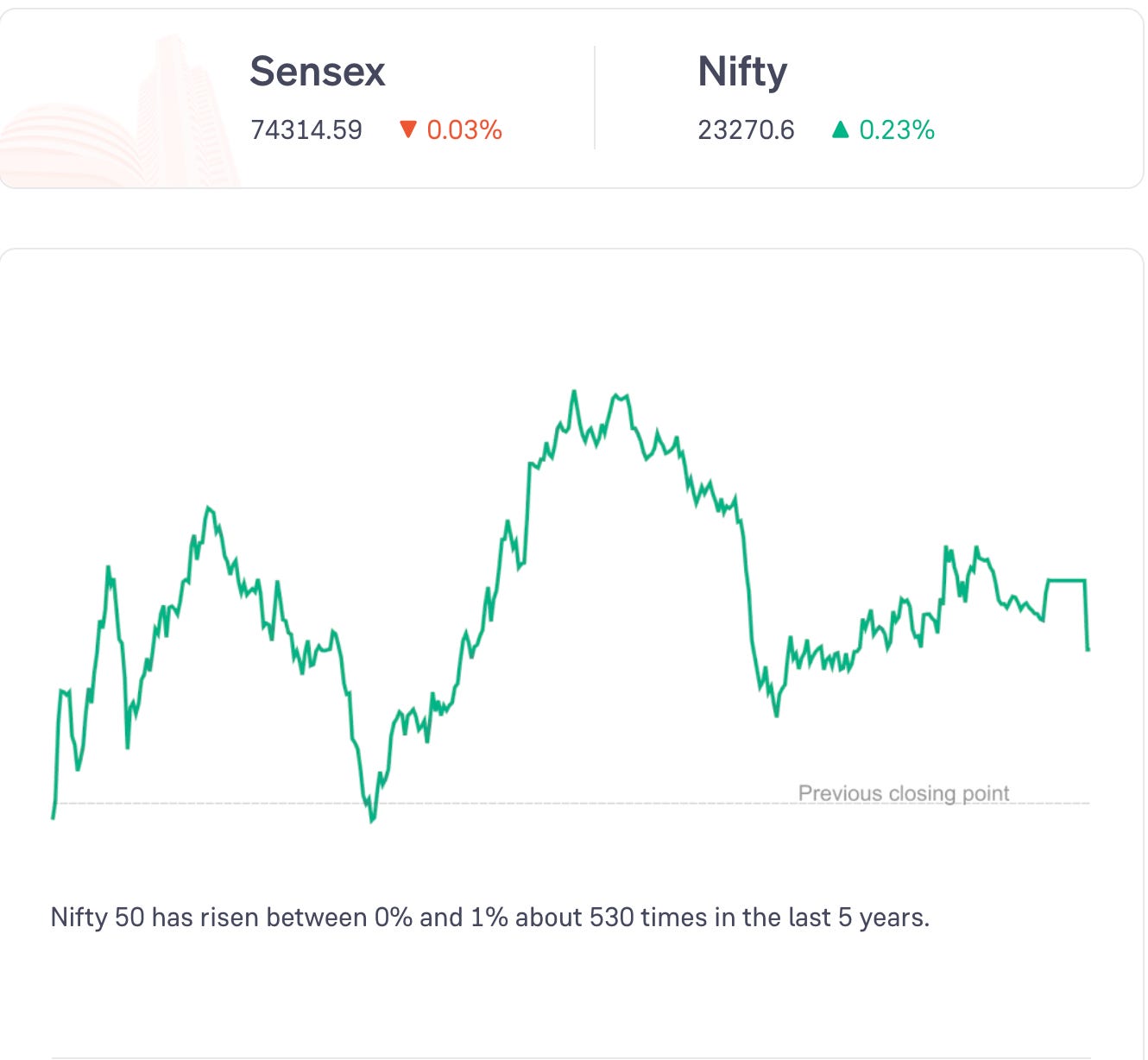
Markets closed flat compared to yesterday’s closing point after the US Fed raised interest rates by 25 basis points to 3.75-4%.
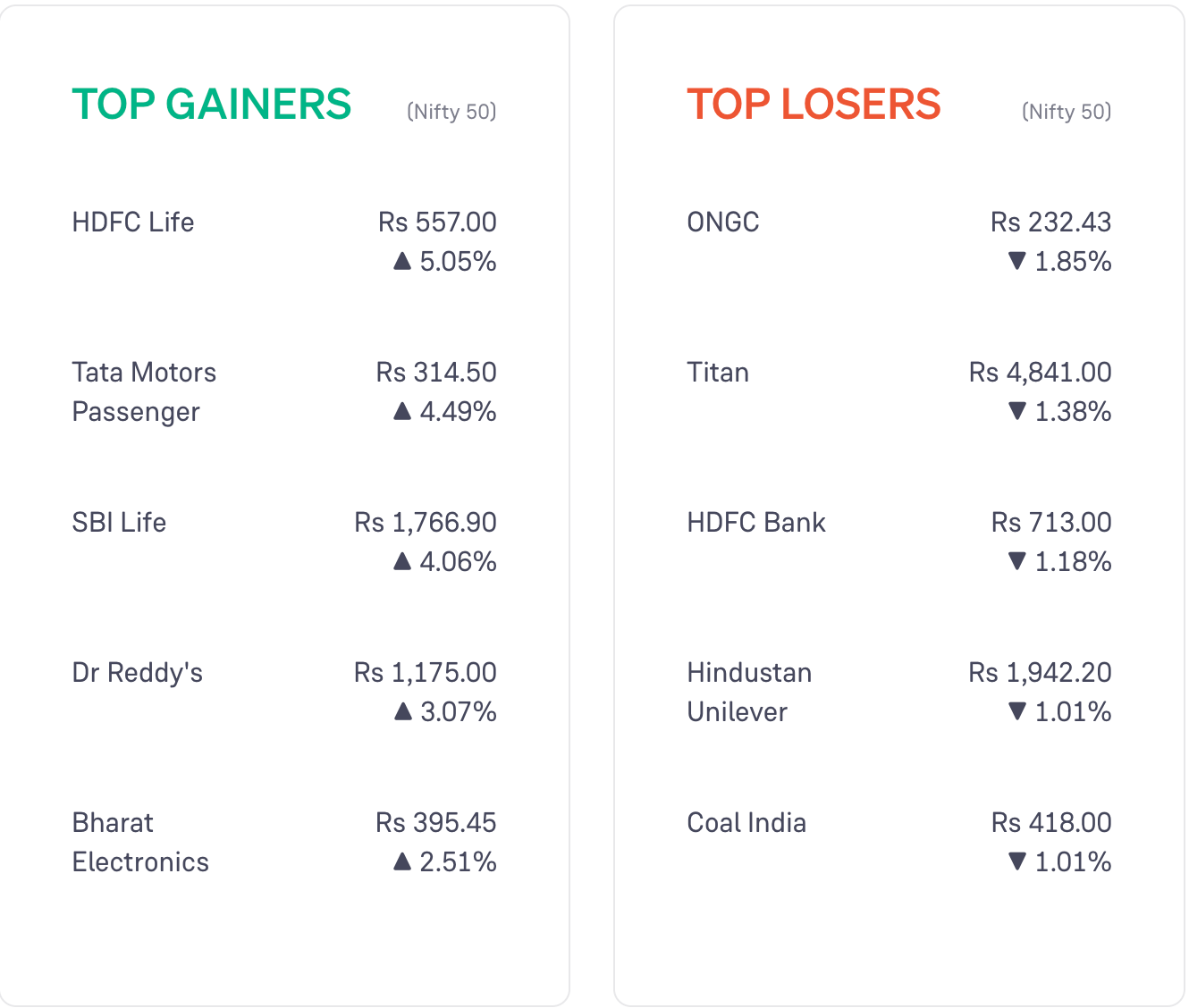
Pharma stocks and healthcare stocks rose the most today. Both private bank and PSU Bank stocks fell the most.
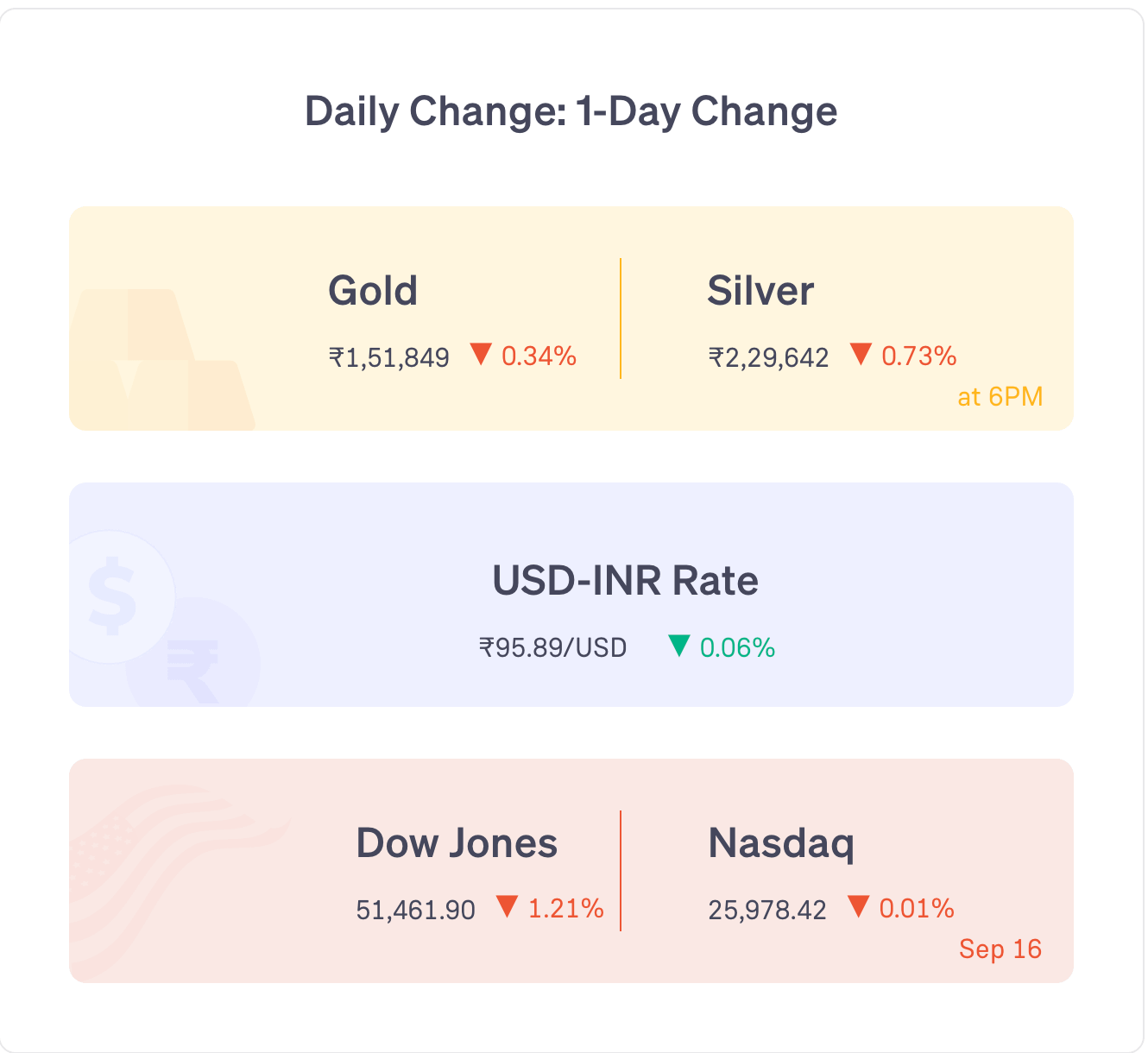
Global markets: US markets fell on Wednesday. Most Asian markets traded mixed on Thursday. Most European markets traded in green (as of 6 pm IST).
News
The government said the possible US tariffs of 100% on Russian oil importing countries, including India, could impact bilateral ties. The bill is yet to be signed into a law.
The government denied media reports alleging that MDR on UPI payments were introduced under any external influence.
The government reduced windfall taxes on petrol exports to Rs 0.5 per liter (vs Rs 1.5 earlier); diesel, Rs 20 (vs Rs 25 earlier); ATF, Rs 15 (vs Rs 19 earlier).
India’s textile sector exports rose 16.10% year-on-year to Rs 29,776 crore in August, from Rs 25,656 crore a year ago.
IPO Corner
NSE’s Rs 22,562 crore IPO was subscribed 0.43 times on day 1. Retail subscription: 0.44 times. The IPO will close for subscription on 21 September.
Hero Motors’ Rs 1,000 crore IPO was subscribed 3.37 times on day 2. Retail subscription: 5.02 times. The IPO will close for subscription on 18 September.
SS Retail’s Rs 500 crore IPO was subscribed 5.78 times on day 2. Retail subscription: 7.55 times. The IPO will close for subscription on 18 September.
Manipal Payment and Identity Solutions listed at Rs 330 on NSE, a discount of 2.65% below its issue price and closed 2.68% higher.
Asset Reconstruction Company (India) listed flat at Rs 139 and closed 1.33% lower.
Rentomojo listed at Rs 482.45 on NSE, a premium of 19.41% over its issue price and closed 35.15% higher.
Karamtara Engineering listed at Rs 320 on NSE, a premium of 25.98% over its issue price and closed 38.58% higher.
Stock Updates
BEL: received additional orders worth Rs 648 crore for defence equipment, cybersecurity solutions, AI software, upgrades, spares and other services.
Tata Motors: will increase prices of its commercial vehicles by up to 1% from 1 Oct due to higher input costs.
PNB: set up a $1.5 billion overseas bond programme, which allows it to raise funds in the future.
Canara Bank: raised Rs 2,042 crore through perpetual Additional Tier-I bonds at an 8.10% interest rate.
Mazagon Dock: signed an MoU to become the main shipyard in a proposed shipbuilding cluster at Dighi, Maharashtra. The project is expected to involve around Rs 27,000 crore of investment and have an annual capacity of at least 1.2 million gross tonnes.
Manipal Health: used part of the money raised from its IPO to repay Rs 5,310 crore of debt taken by subsidiary, Manipal Hospitals Pvt Ltd, along with interest and other charges.
Bharat Forge: opened a Qualified Institutional Placement (QIP) to raise money from institutional investors. The floor price has been set at Rs 1,947.70 per share and the final fund-raise size has not yet been disclosed.
Federal Bank: approved a $500 million overseas bond programme. The bank can raise the money in foreign currencies through branches, including GIFT City.
Word of the Day
Repo Rate
It is the interest rate set by the RBI that affects all other interest rates like loan rates, FD rates, etc
It is the rate at which banks borrow money from the RBI.
Hence, it directly affects all rates offered by banks and lenders (loans and deposits).
The RBI adjusts this repo rate to achieve various economic goals (control inflation, encourage economic growth, etc).
6 Day Course
Theme: finding correct valuation
Day 4: Thursday
The challenge is always estimating future earnings.
The best investors are always trying to estimate what a company’s future earnings would be (and therefore its future share price).
Based on that, they’re trying to compare the share price today.
The wider the difference, the greater the returns earned.
But future earnings are not guaranteed.
In fact, sometimes, even the best CEOs fail to estimate their own future earnings — both negatively and positively.
So the best investors try to keep some margin for error. This is done by underestimating the future earnings (taking a worst case scenario).
Even then, there can be unexpected surprises (positive and negative).
Example:
Let’s say the share price is too high compared to its present earnings. Say, PE ratio is 90.
But compared to its potential earnings and share price 5 years from now, it is extremely low.
Such a company might not be seen overvalued — simply because the share price is very cheap compared to its potential value 5 years from today.
————
Featured Question
Q. “Why isn't the fed rate a single percentage (like 4%) instead it is a bandwidth (3.75%-4%)”
Fed rates (rates announced by the US Federal Reserve) are presented as a range.
This is because the US Fed does not mandate the rate. It tries to encourage the interest rates towards a certain target range.
Why?
Because in the US, there’s a lot of cash that was printed during the 2008 recession.
This means that many banks have cash reserves to lend.
Because of this, banks don’t necessarily have to borrow from the US Fed. They can borrow from other banks as well at negotiated rates.
So by changing its own rates, the US Fed aims to nudge the interest rates in a certain range.
It is unable to keep it at an exact number because of the higher reserves in the banking system.
Did you like this edition?
Leave a feedback here!
Best news thank you