
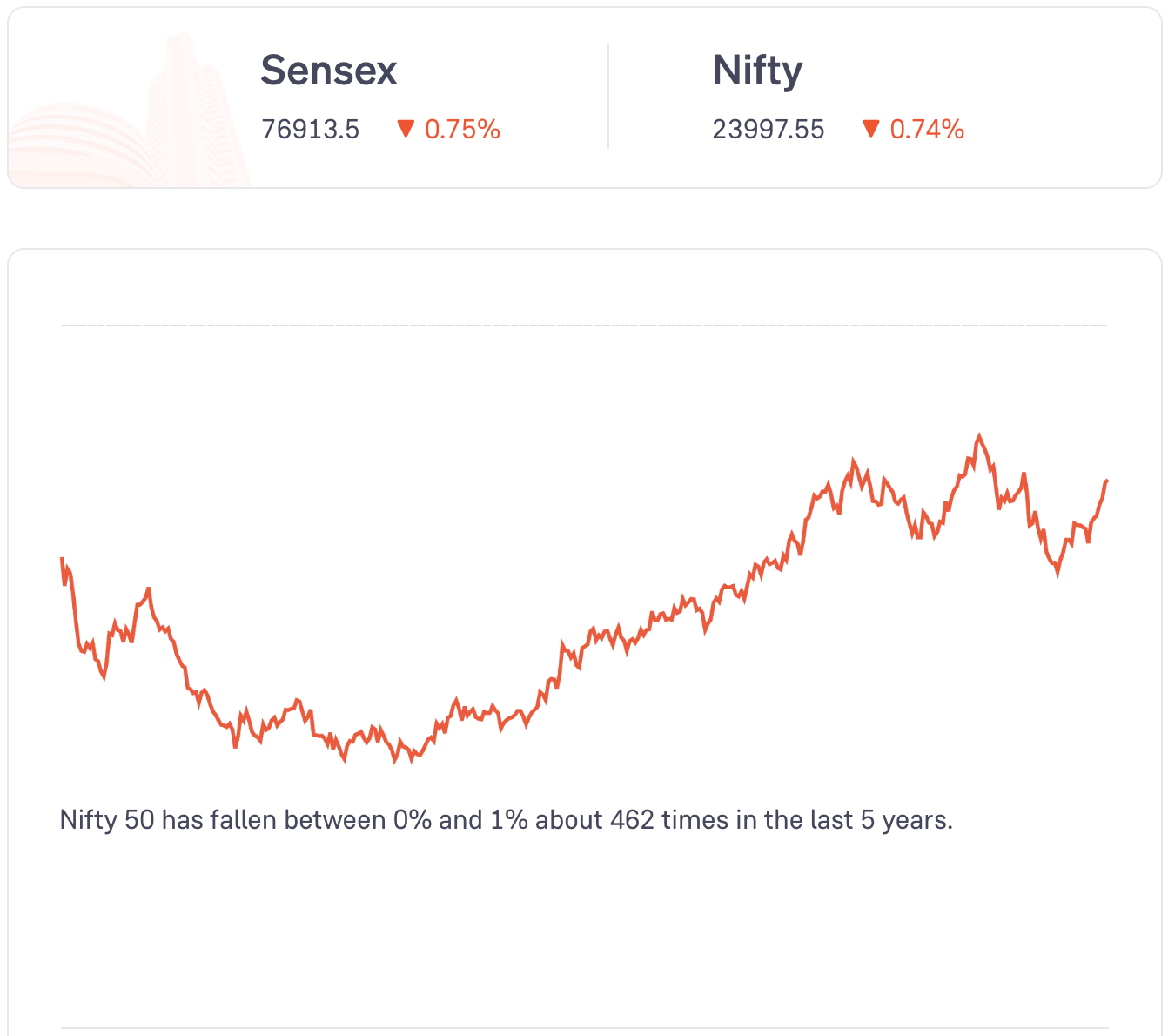
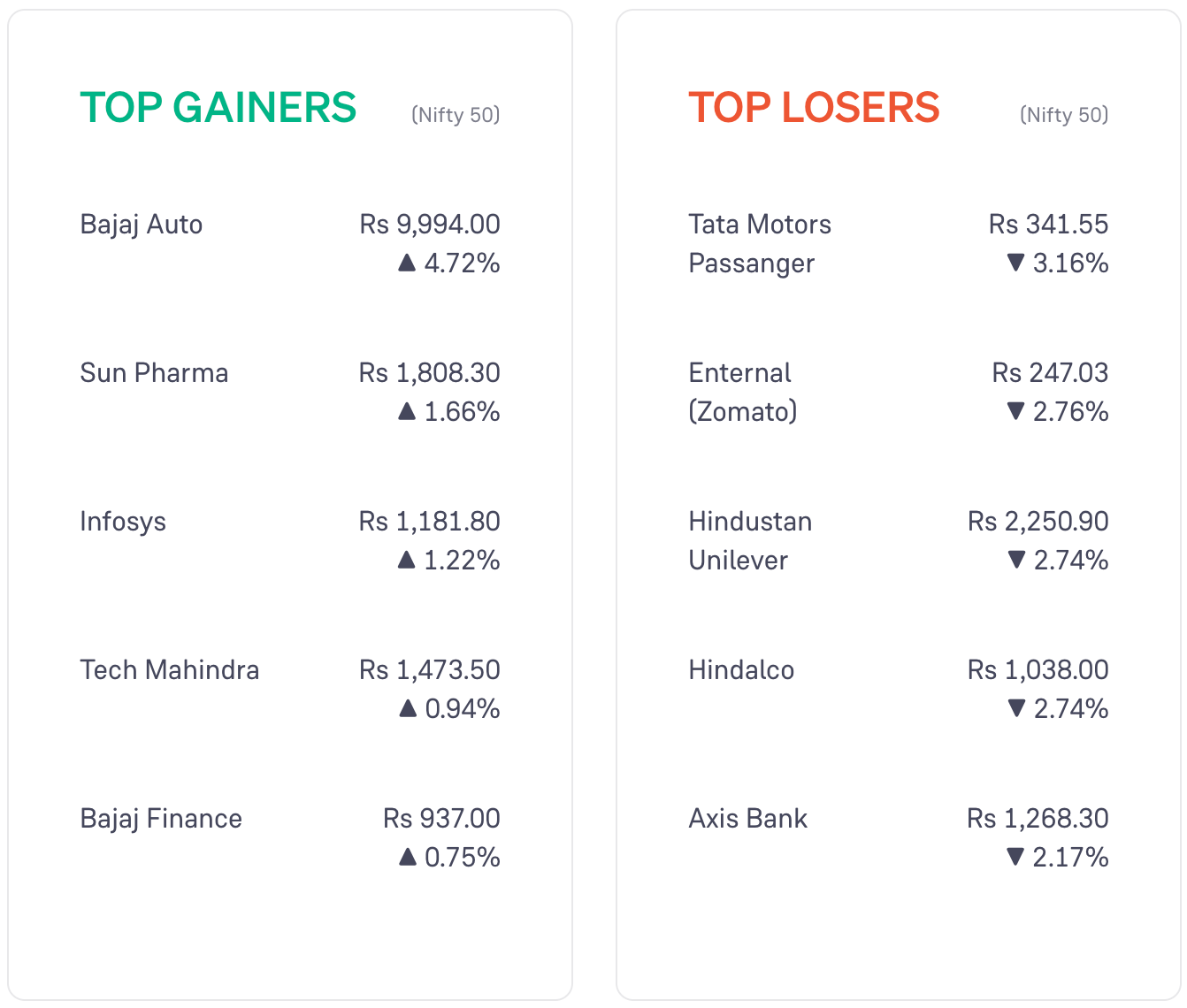
Markets opened below yesterday’s closing point.
All sectors’ stocks fell today except for IT stocks and pharma stocks. Metal stocks and PSU bank stocks fell the most.
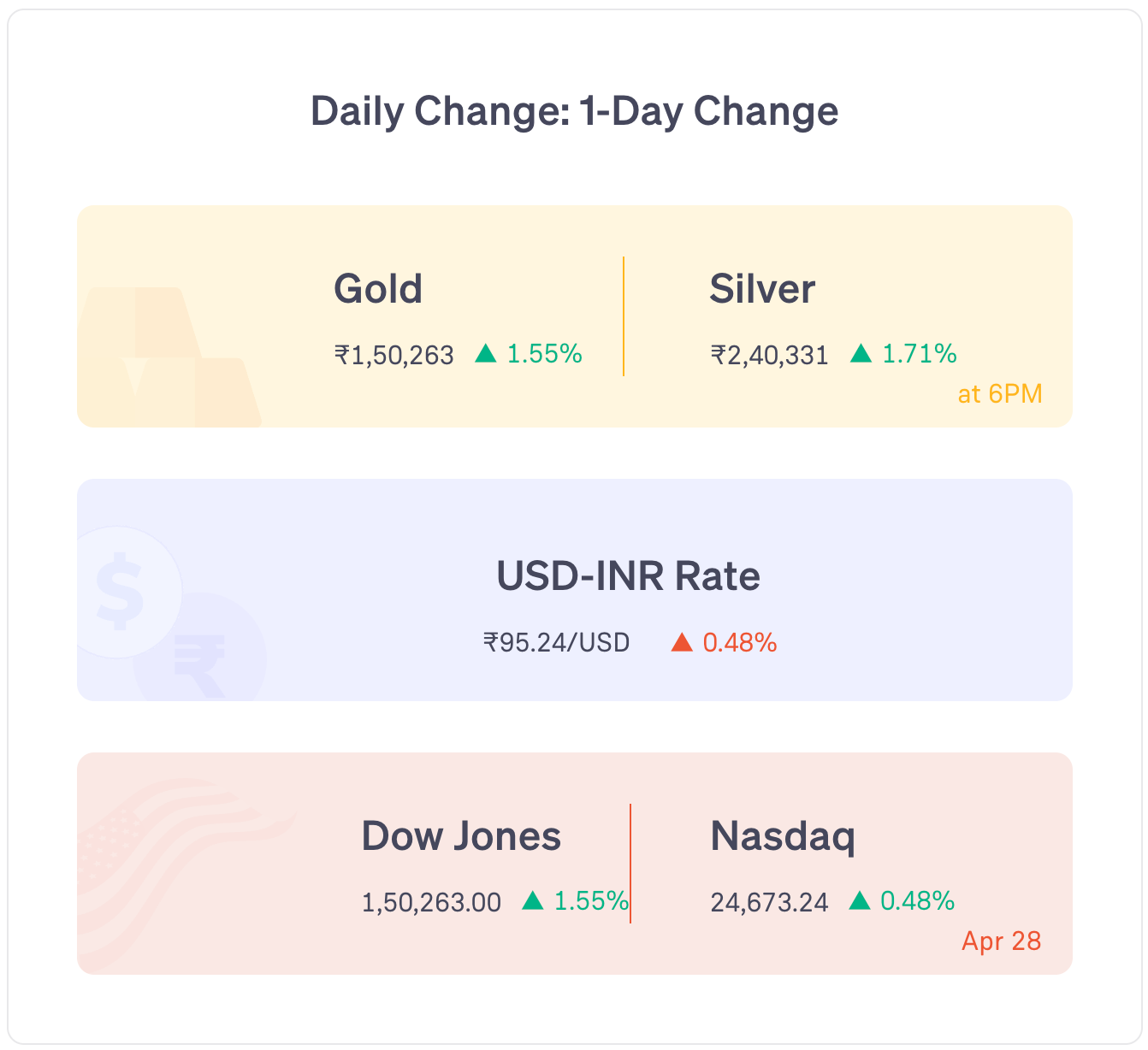
Global markets: most US markets rose. Most Asian markets fell. European markets rose (as of 6 pm IST).
News
The US Fed kept the interest rate unchanged in the 3.5% to 3.75% range for the third consecutive time.
Onemi Technology Solutions (Kissht) IPO has been subscribed 0.24 times. Retail subscription: 0.06 times. IPO closes on 5 May.
Stocks Updates
Bharat Forge: will acquire a 30% stake in Fortuna Engineering for Rs 129.6 crore, with an option to increase the stake to a majority.
Tata Power: subsidiary, Tata Power Renewable Energy approved entry into a new line of business, solar PV ingot and wafer manufacturing, with an investment of around Rs 6,500 crore.
HCL Tech: has partnered with the DP World Tour (a global professional golf tour) as a digital experience partner to drive global platform transformation.
Reliance: subsidiary Reliance Retail acquired Priyanka Chopra’s haircare brand, Anomaly, to expand their beauty portfolio.
Adani Ports: net profit rose 55.64% year-on-year to Rs 4,567.63 crore in the Jan-March quarter. Dividend announced: Rs 7.5 per share.
Hindustan Unilever: net profit rose 32.15% year-on-year to Rs 3,227 crore in the Jan-March quarter. Dividend announced: Rs 22 per share, with 23 June as the record date.
Bajaj Finserv: net profit rose 5.05% year-on-year to Rs 2,538.67 crore in the Jan-March quarter. Dividend announced: Rs 1.50 per share.
Adani Enterprises: incurred a net loss of Rs 166.79 crore, a fall of 104% year-on-year in the Jan-March quarter. Dividend announced: Rs 1.30 per share.
Adani Power: net profit rose 51.59% year-on-year to Rs 4,016.3 crore in the Jan-March quarter.
Indian Bank: net profit rose 6.4% to Rs 3,173.05 crore in the Jan-March quarter. Dividend announced: Rs.18.25 per share, with 10 June as the record date.
Cholamandalam Investment: net profit rose 30.6% year-on-year to Rs 1,645.20 crore in the Jan-March quarter. Dividend announced: Rs 0.70 per share, with 21 July as the record date.
Waaree Energies: net profit rose 71.4% year-on-year to Rs 1,061.10 crore in the Jan-March quarter. Dividend announced Rs 2 per share.
Word of the Day
Public Sector Undertaking (PSU)
It is a company that is owned and controlled by the government (centre or state).
The government usually holds a majority stake, more than 50%, giving it control over decisions.
PSUs operate in sectors like banking, oil, power, and infrastructure.
They are created to serve public interest while also earning profits.
6 Day Course
Theme: fund manager role
Day 4: Thursday
In India, most fund managers lean towards fundamental analysis.
They look at the asset, its fundamentals, future scope, etc to form an opinion.
Now, with the emergence of various kinds of funds, newer kinds of fund managers can be seen in the industry.
For example, there are quant fund managers who specialise in quant and technical analysis based investments.
With the rise of passive funds, many fund managers are starting to manage only passive funds in which the level of decision making required is far lesser. It is more about managing inflows and outflows than about investment choices.
The emergence of passive funds has also led to more pressure on fund managers to perform and give better returns than these passive funds.
Failing to beat the passive funds is often seen as the mutual fund being unable to perform.
If non-performance continues for a long while, a fund manager might be removed from the mutual fund and allocated to lesser important funds only.
For all the stress and hard work they undertake, they are paid well.
Salaries can easily range above Rs 1 crore per annum. Very senior fund managers may also make more than Rs 10 crore per annum.
Featured Question
Q. “What is ‘buy back’ of a stock and what is the effect of this on a share price?”
A buyback is an indirect method used by companies to share profits with investors.
This is opposed to the more direct method of paying dividends.
In case of dividends, the company literally deposits the money in the investors’ accounts.
This could mean you are liable to pay tax if eligible.
The company can instead use this money to do share buybacks.
Companies buy shares from the share markets and destroy/cancel them. This leads to a reduction in the total number of shares in the market.
But since the company is still the same, the earnings per share, revenue per share, etc are all higher now.
This often leads to an increase in the share price.
So, instead of giving dividends, the company uses buybacks to increase the share price.
The share price increase is not guaranteed though. It still depends on the market conditions.
According to the latest regulations, buybacks are also being taxed now. The tax needs to be paid by the companies performing the buyback.
This would prevent immediate taxation for the investor.
In the case of a buyback, the investor would have to pay a tax only when he/she sells the shares.
Did you like this edition?
Leave a feedback here!
Very nice