
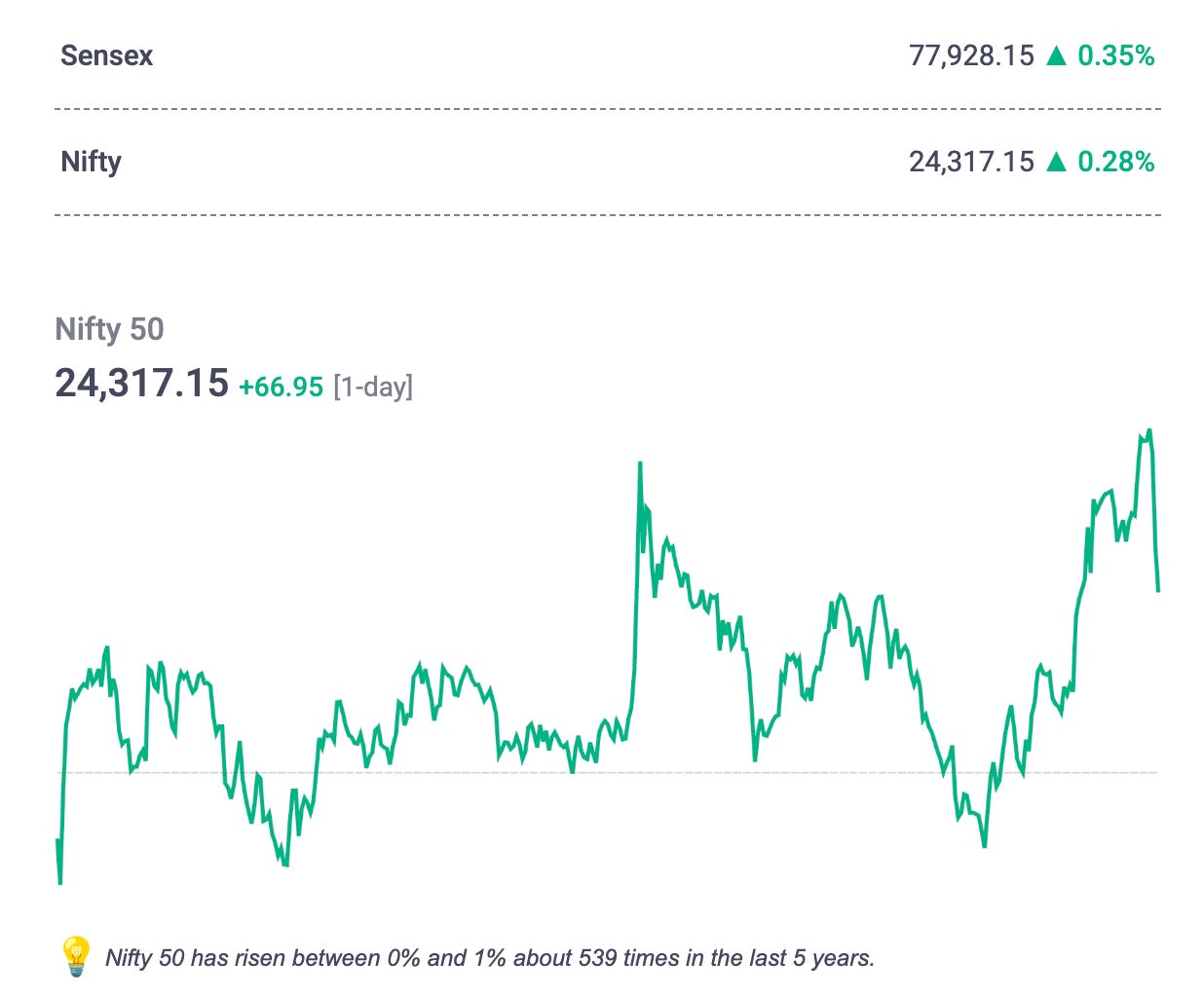
Markets closed higher than yesterday’s closing point.
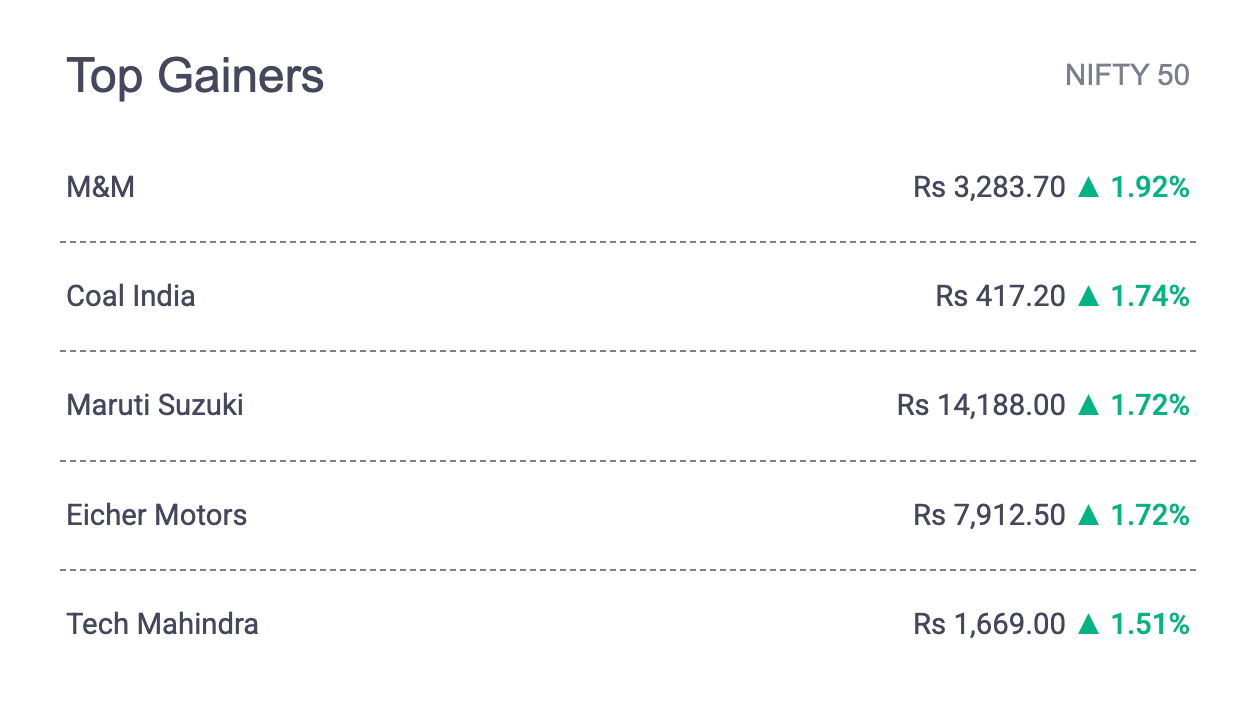
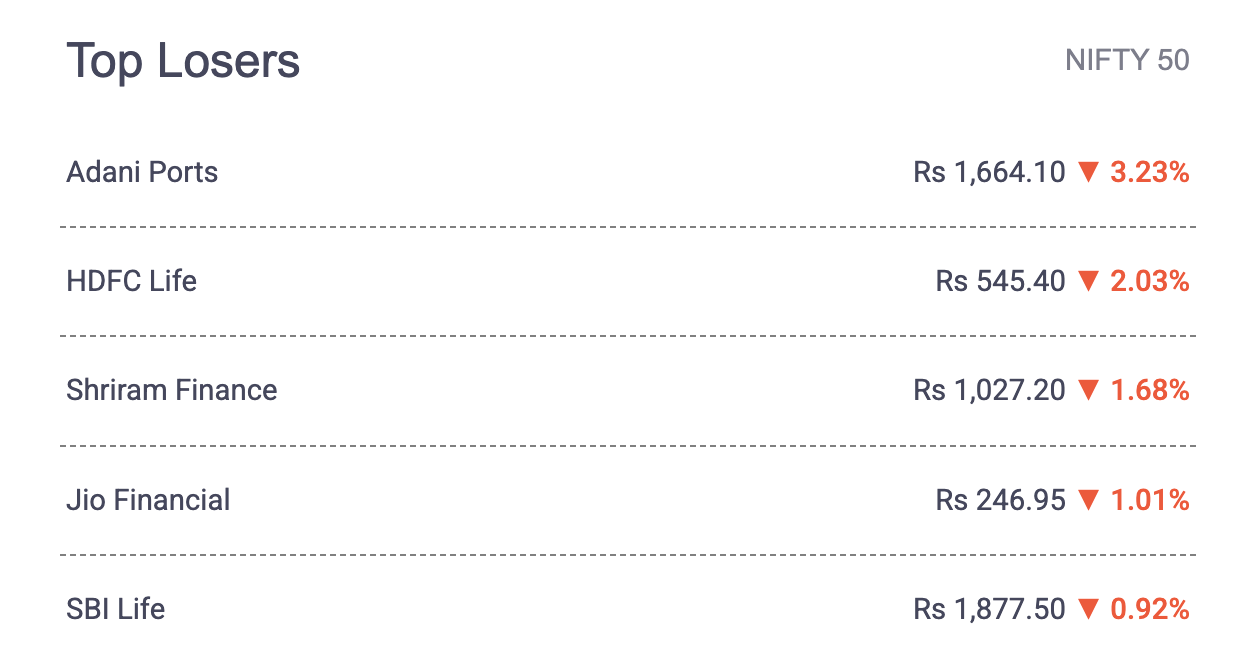
Auto stocks and oil & gas stocks rose the most today. Realty stocks and chemical stocks fell the most.
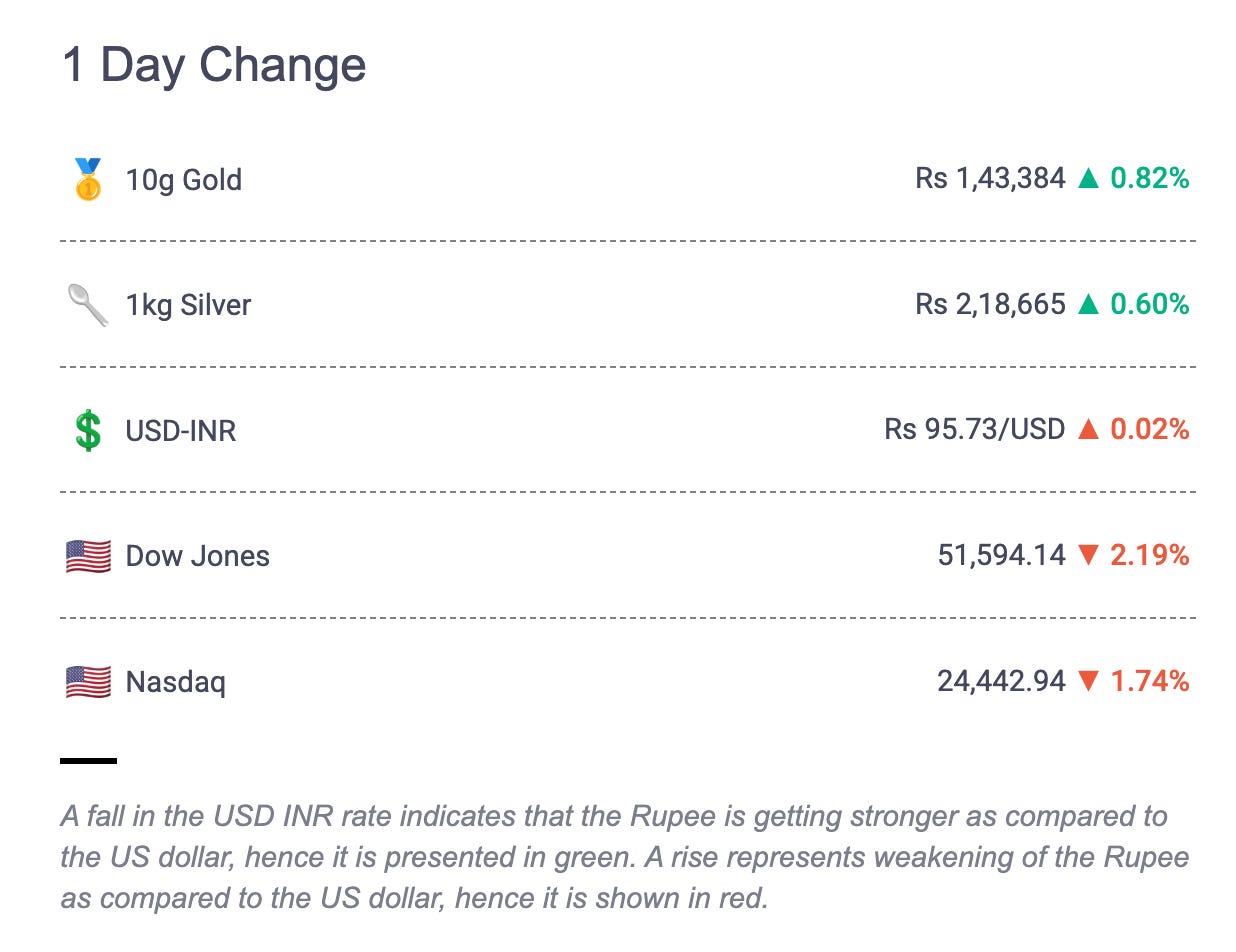
Global markets: US markets fell on Wednesday. Asian markets showed a mixed trend on Thursday. Most European markets traded higher (as of 6 pm IST).
News
The US Federal Reserve kept the benchmark interest rate unchanged at 3.50%-3.75%.
The government said that the Ethanol Blended Petrol programme trials confirmed that E20 is safe for use under prescribed standards and legacy vehicles do not exhibit any significant variation in performance or abnormal wear and tear due to E20.
The Bank of England kept interest rates unchanged at 3.75%.
Manipal Health Enterprises Limited’s IPO was subscribed 0.45 times on day 2. Retail subscription: 0.45 times. The IPO will close for subscription on 31 July.
Juniper Green Energy’s IPO was subscribed 0.36 times on day 1. Retail subscription: 0.12 times. The IPO will close for subscription on 3 August.
Veritas Finance re-filed for an IPO with SEBI. The IPO will comprise a fresh issue of Rs 900 crore and an offer for sale of 1.28 crore shares. The company had earlier filed for an IPO in January 2025.
INDO-MIM Limited listed at Rs 700 on NSE, a premium of 44.33% over its issue price and closed 53.61% higher by the end of the day.
Lohia Corp Limited listed at Rs 461 on NSE, a premium of 8.47% over its issue price and closed 16.07% higher by the end of the day.
Stocks Updates
Bajaj Finance: net profit rose 27.37% year-on-year to Rs 5,985.75 crore in the April-June quarter.
L&T: received a limited notice to proceed from NTPC for the 1,600 MW thermal power project in Chhattisgarh, classified as a mega order (Rs 10,000 crore - Rs 15,000 crore). The full notice will be issued after the project receives environmental clearance.
SBI: raised Rs 4,691 crore by issuing perpetual Basel III-compliant Additional Tier 1 bonds at an annual interest rate of 7.75%. The bonds were allotted on 30 July.
M&M: net profit rose 33.58% year-on-year to Rs 5,454.54 crore in the April-June quarter. The board also approved the merger of wholly owned subsidiary Mahindra Investment Company (Mauritius) with M&M, subject to approvals.
NTPC: a group company of subsidiary NTPC Green Energy commenced commercial operations of 50 MW solar capacity in Rajasthan.
REC/Power Grid: REC subsidiary RECPDCL sold Bhadla Ramgarh Power Transmission to Power Grid for Rs 12.86 crore, Shongtong Power Transmission to Terralight Solar Energy Tinwari for Rs 20.41 crore and Ryapte Power Transmission to Tata Power for Rs 10.87 crore.
Eicher Motors: net profit rose 21.35% year-on-year to Rs 1,462.52 crore in the April-June quarter.
Torrent Pharma: net profit rose 3.28% year-on-year to Rs 566 crore in the April-June quarter.
Vedanta Aluminium Metal: net profit rose 216.06% year-on-year to Rs 5,629 crore in the April-June quarter. It also approved an agreement with Serentica Renewables to add a 150 MW battery-storage system to its existing 600 MW solar-power arrangement and will invest Rs 165 crore for a 26% stake in the project.
Hyundai Motor India: net profit fell 35.10% year-on-year to Rs 888.62 crore in the April-June quarter.. Record date for the final dividend of Rs 21 per share (declared earlier on 8 May 2026) fixed as 5 August 2026.
Tata Power: subsidiary Tata Power Renewable Energy also started construction of an 800 MW renewable-energy project in Andhra Pradesh with Rs 5,750 crore investment.
IRFC: net profit rose 10.40% year-on-year to Rs 1,927.21 crore in the April-June quarter.
GAIL: signed an MoU with Rashtriya Chemicals and Fertilizers to jointly set up a 1.27 million tonne per year urea plant in Maharashtra’s Vidarbha region through an SPV.
Mankind Pharma: net profit rose 29.61% year-on-year to Rs 568.06 crore in the April-June quarter. The board also approved a corporate guarantee of up to Rs 150 crore for wholly owned subsidiary Bharat Serums and Vaccines.
Vedanta: net profit rose 71.84% year-on-year to Rs 5,473 crore in the April-June quarter. Note: the comparison is not directly comparable because four businesses were demerged from 1 May. The board also approved the demerger of its surplus real-estate business into Vedanta Property Platforms, subject to approvals, with shareholders to receive 1 share of the new company for every 20 Vedanta shares.
Sun Pharma: got approval to make and sell semaglutide injections in Brazil for adults with poorly controlled type-2 diabetes. It plans to launch the product in partnership with Hypera Pharma.
Maruti Suzuki: started commercial production at its fourth Hansalpur plant. This increased the Hansalpur facility’s capacity to 10 lakh vehicles and Maruti Suzuki’s total annual capacity to 29 lakh vehicles.
Swiggy: net loss narrowed 33.92% year-on-year to Rs 791 crore in the April-June quarter. Amitesh Kumar Jha resigned as CEO of Instamart with effect from 28 July.
Mazagon Dock Shipbuilders: net profit rose 21.51% year-on-year to Rs 549.41 crore in the April-June quarter.
LIC: received a GST demand of Rs 99.10 crore in GST plus a penalty of Rs 9.91 crore for alleged early use of input tax credit.
Airtel: received a Rs 2.2 lakh penalty from the DoT for alleged violations of subscriber-verification rules in Kerala. The company will pay the penalty.
Word of the Day
Price Discovery
It is a process by which supply and demand determines the price of something
Example: a company might think their share price should be Rs 45.
But they’ll know how much each share should be priced only after they do an IPO and let investors buy and sell the shares.
Then, the price will reach a level that investors think is right for the company’s share.
This process is called price discovery.
Many times, companies tend to underprice themselves. Their share price rises when they do an IPO.
The opposite also happens.
Price discovery can happen with all kinds of assets, products, and services, not just stocks.
6 Day Course
Theme: bonds
Day 4: Thursday
So, what affects the bond prices on the bond markets?
One of the biggest factors is interest rates. We know that countries’ central banks (example: RBI in India) change interest rates from time to time.
Depending on this interest rate, existing bonds’ demand can go up or down.
Example: the central bank reduces interest rates. This would make older bonds with higher rates more attractive.
Thus, their price in the bond markets would go up, and vice versa.
Another factor is the bond issuer’s ability to pay back.
Let’s say a company issued bonds. If that company is going through tough periods, many investors might feel nervous that the company might go bankrupt. Which could potentially mean the bondholders do not get paid upon maturity.
So investors might start selling this bond resulting in its price falling.
Yet another factor is the duration. The longer the duration of payment, the more the things that can go wrong. So it can make investors nervous.
Other factors like inflation expectations, and liquidity also play a role.
Just like shares, the actual number of factors that can affect prices are many. The above are some of the main factors.
————
Featured Question
Q. “What is fundamental difference between RSU and ESOP? how company decide they should give RSU or ESOP to employees? I see vested RSU units but not price, but for ESOP I see vested units and price both. Why such difference?”
RSU = Restricted Stock Units
ESOP = Employee Stock Option Plan
RSUs promise to give employees a certain number of shares as a part of their salary.
ESOPs promise to give employees the option to buy shares at a fixed price later on.
RSUs are usually preferred by mature listed companies.
ESOPs are usually preferred by early-stage start ups that are not listed.
Example 1: Company A will give its senior director 600 RSUs over a period of 4 years.
The value of these RSUs depends entirely on the live share price. It cannot be decided beforehand.
Example 2: Company B will give its senior director the option to buy 600 shares (ESOPs) in the future for a fixed price of Rs 2.
This means, in the future, the employee can buy each share for Rs 2 even if the actual share price is much higher.
ESOPs are usually given by start ups that are not listed yet with the promise that the employee will be able to get shares for very cheap once the share actually lists on the share markets.
This fixed price is called strike price.
The taxation is different in both cases.
RSUs are taxed as and when they are received by the employee.
ESOPs are taxed only when the employee buys shares (vested) using their allocated ESOPs.
Thus, ESOPs can give the employee more control over their taxation.
Did you like this edition?
Leave a feedback here!