

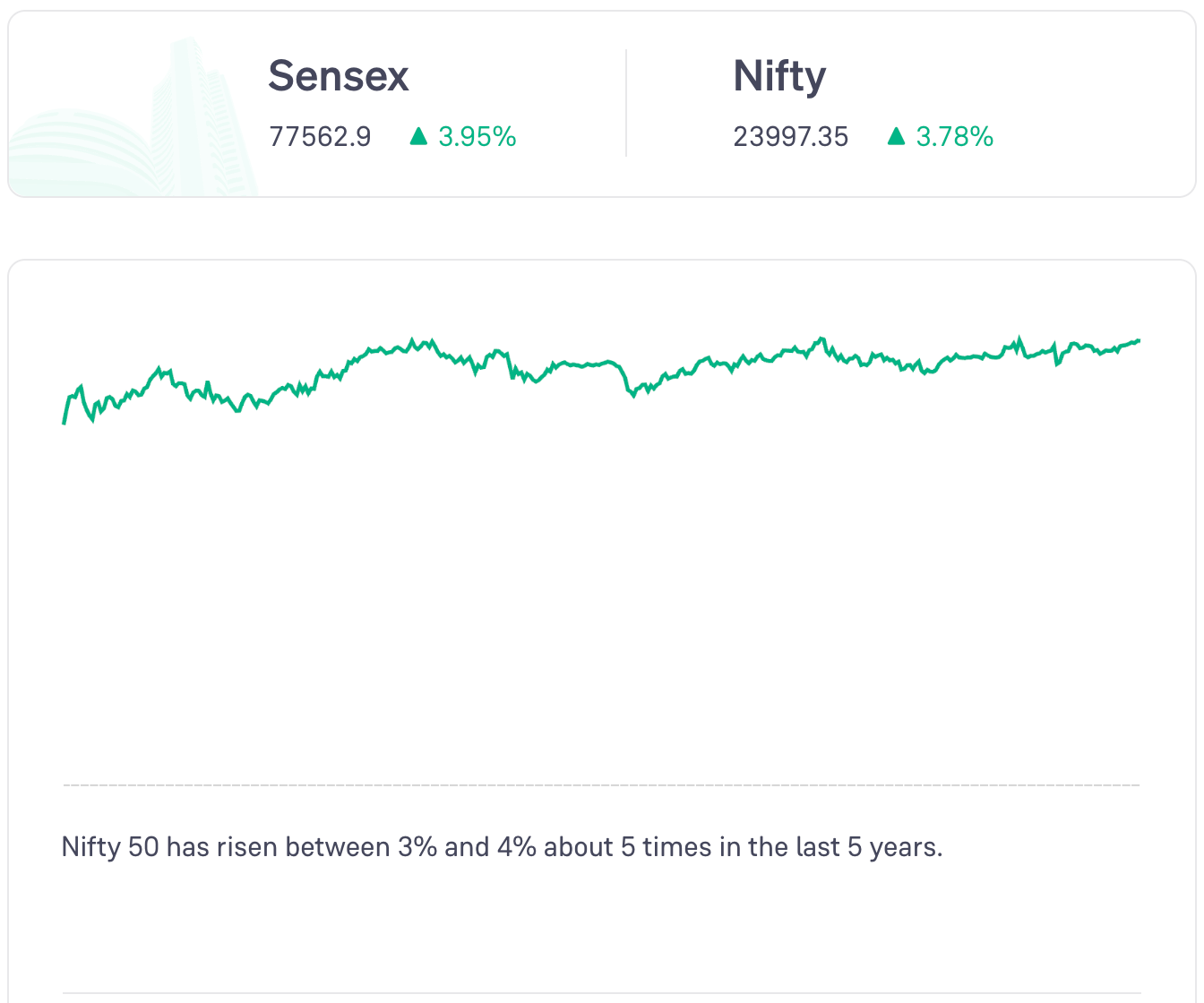
Markets opened significantly above yesterday’s closing point.
The Nifty 50 opened higher and closed in the green. The rise may have been mainly due to positive global sentiments (US-Iran ceasefire) and the RBI keeping the repo rate unchanged.
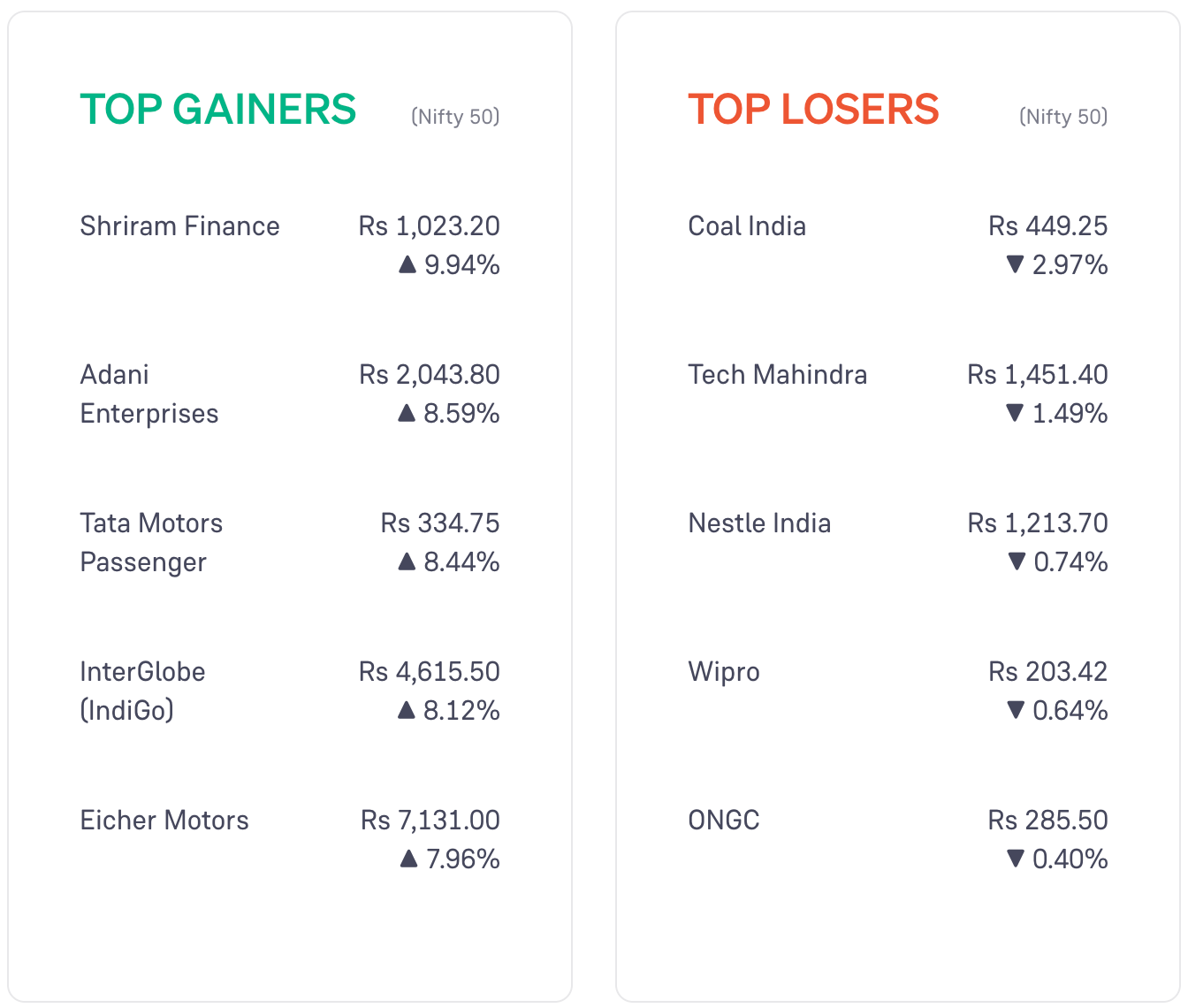
All sectors’ stocks rose today. Realty stocks and auto stocks rose the most.
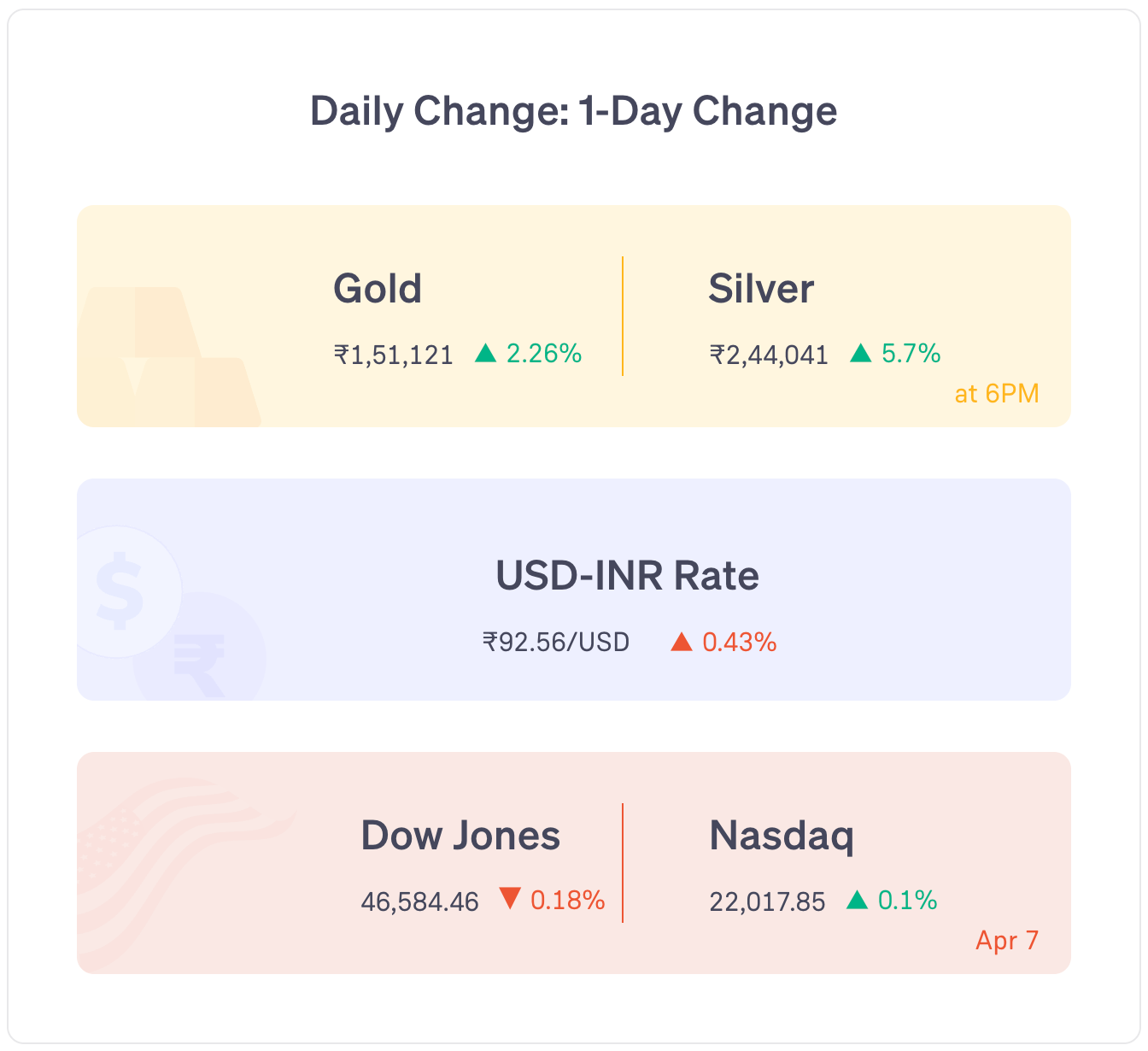
Global markets: Most US markets closed flat. Asian markets and European markets rose (as of 6 pm IST).
News
The US and Iran have agreed to a 2-week ceasefire after more than a month of military conflict.
The RBI kept the repo rate unchanged at 5.25%.
The government has approved a Rs 14,105 crore investment for a 1200 MW hydroelectric project in Arunachal Pradesh, aimed at boosting power generation and strengthening the national grid.
The government has approved Rs 26,069.50 crore for construction of Kamala hydro electric project in Kamle, Kra Daadi & Kurung Kumey districts of Arunachal Pradesh. It also approved Rs 14,105 crore for a 1200 MW Kalai-II hydro electric project in the state’s Anjaw district.
The government has approved the construction of the Jaipur Metro Phase-2, with 36 stations, at a cost of Rs 13,037.66 crore.
Stocks Updates
NTPC: signed a non-binding MoU with Electricite de France (EDF) to explore cooperation in developing new nuclear power projects in India. The company also increased capacity of two units at Dadri power plant, taking total group capacity to 89,128 MW.
Shriram Finance: allotted equity shares worth around Rs 39,618 crore to Japan’s MUFG Bank via a preferential issue on a private placement basis. After this, MUFG will own about a 20% stake in the company.
Max Healthcare: will acquire around a 58.4% stake in Kalinga Hospital, Bhubaneswar, for around Rs 300 crore to expand its presence in eastern India.
Reddy’s: sold its entire stake in wholly owned subsidiary Svaas Wellness Limited to Enspirit Technology Services Private Limited for Rs 2.23 crore.
Lupin: received US FDA approval for diabetes drugs Dapagliflozin and Metformin extended-release tablets.
Zydus Lifesciences: received US FDA final approval for Dapagliflozin tablets, with 180 days of shared generic drug exclusivity. The drug has about $10.2 billion annual sales in the US.
Adani Green Energy: directors of the company have appealed in the US to dismiss a civil lawsuit by the SEC, emphasizing that the company itself is not part of the case and faces no charges.
Word of the Day
Roadshow
It refers to the presentations made by a company to promote itself (as an investment opportunity) to potential investors.
Roadshows are usually conducted before an IPO or major fundraising.
The company management meets investors to explain the business, financials, and growth plans.
The goal is to build interest and attract investment.
Example: before an IPO, a company may conduct roadshows across cities to meet institutional investors.
6 Day Course
Theme: mutual fund AUM
Day 3: Wednesday
Now, let’s get to why AUM gets discussed by investors.
A minimum amount of AUM is required for a mutual fund to be created. This amount is Rs 10 cr for equity mutual funds and Rs 20 cr for debt mutual funds.
If the AMC starting this new mutual fund is unable to gather this much money, it will not be allowed to start the new mutual fund.
It will have to return whatever money it has raised in the NFO.
This is the official minimum requirement.
However, investors often worry about AUMs that are much higher too.
The thinking is that a mutual fund with a low AUM is not able to attract many investors’ money which is why its AUM is low.
For example, investors might consider a large-cap mutual fund with Rs 70 cr AUM to be too low.
Newer mutual funds often don’t have any track record and can sometimes not garner enough attention from investors.
While the thinking is valid, it is not always true.
It is possible for a very good mutual fund to not have a very high AUM in its initial days.
Featured Question
Q. “Mar’26 - My SIP XIRR has gone down to below zero, should I continue my SIP or pause them”
This is a common question among investors.
Pausing SIPs when the returns are poor is a bad decision — if you think the mutual funds’ performance will improve in the future.
If you think the mutual funds’ performance will not improve, then it makes sense to pause or even withdraw.
But if you expect the performance to improve again in the future, then pausing SIPs does not make sense.
Think about it.
When a mutual funds’ performance is poor, your money is entering the mutual fund at a lower NAV value.
This means you are buying more units for less money.
Amounts invested in these phases can give higher returns when the performance improves (greater difference between the buying and selling price).
So, pausing a SIP can actually reduce your chances of getting higher returns — if the mutual fund you are investing recovers in the future and start doing well again.
The information presented in this post has been compiled and prepared by Groww Invest Tech Pvt Ltd and is intended solely for informational purposes. It is not tailored to any specific investment objectives, financial situations, or needs of any individual investor. The content should not be construed as investment, financial, legal, or tax advice and should not be relied upon as a substitute for professional consultation.
Investing in securities markets involves inherent risks. Investors are advised to carefully review all relevant documents and consider their own risk tolerance before making any investment decisions.
Mutual fund investments are subject to market risks; please read all scheme-related documents carefully. Past performance of financial instruments, schemes, or markets is not indicative of future results.
Groww Invest Tech Pvt Ltd is registered with the Securities and Exchange Board of India (SEBI) under Registration No: INZ000301838, as a Research Analyst under No: INH200008662, as a Depository Participant under No: IN-DP-417-2019, and with the Association of Mutual Funds in India (AMFI) under ARN-111686.
SEBI registration details: View registered name and registration numbers
Research Analyst Disclaimer: View Research Analyst disclaimer
Did you like this edition?
Leave a feedback here!