
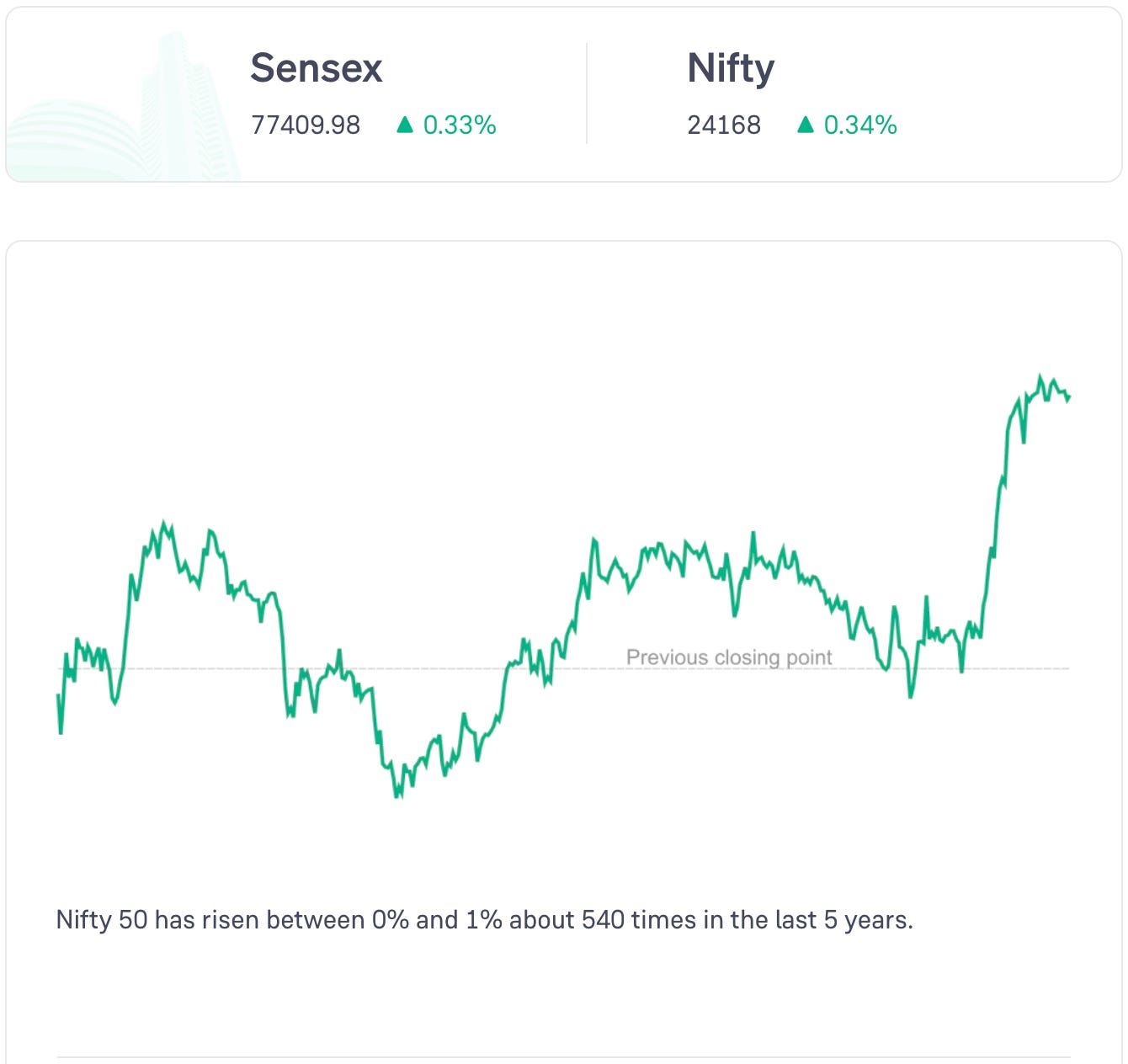
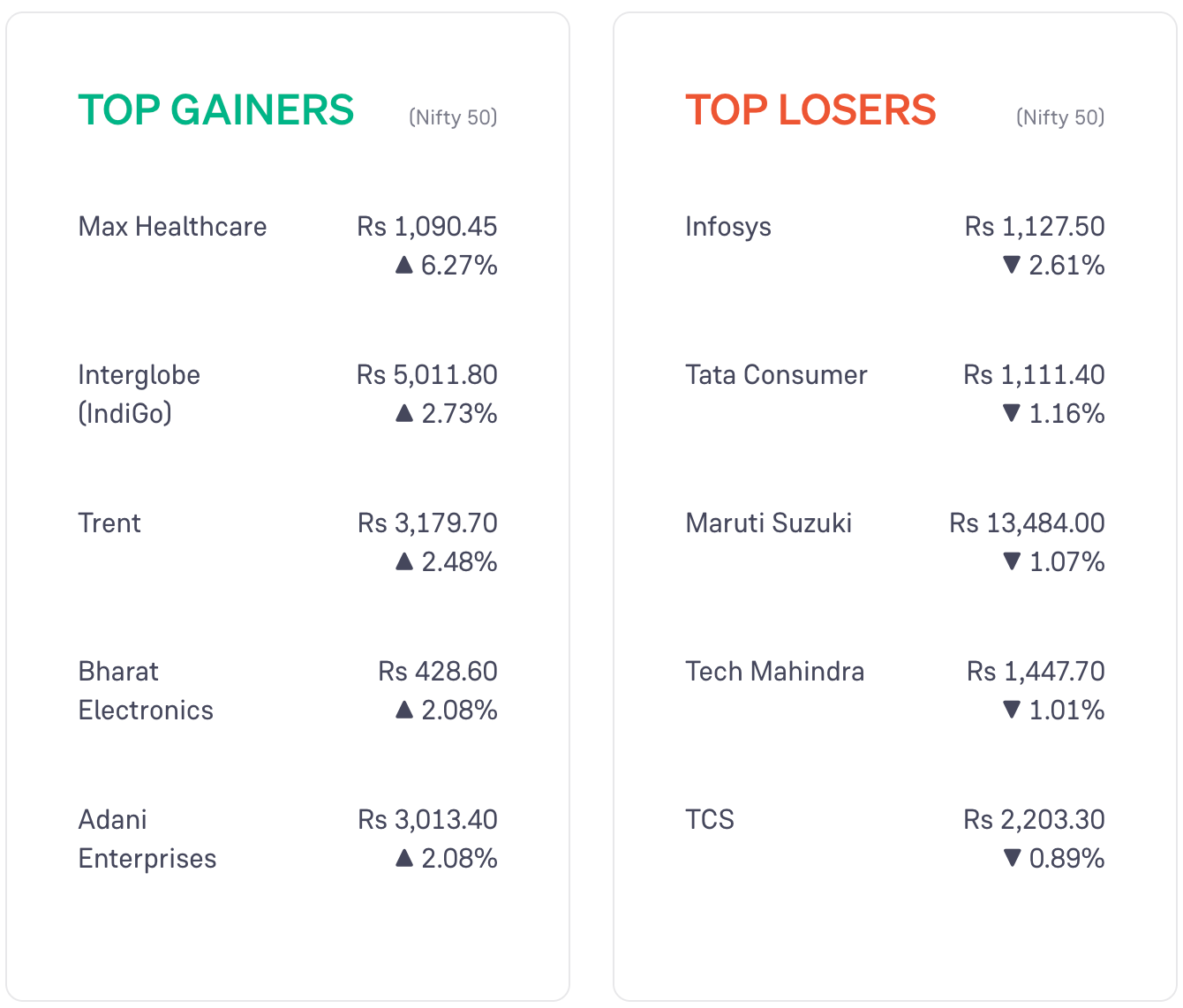
Markets opened below yesterday’s closing point and stayed in the green.
All sectors’ stocks rose today except for the IT stocks and metal stocks. Healthcare stocks and cement stocks rose the most.
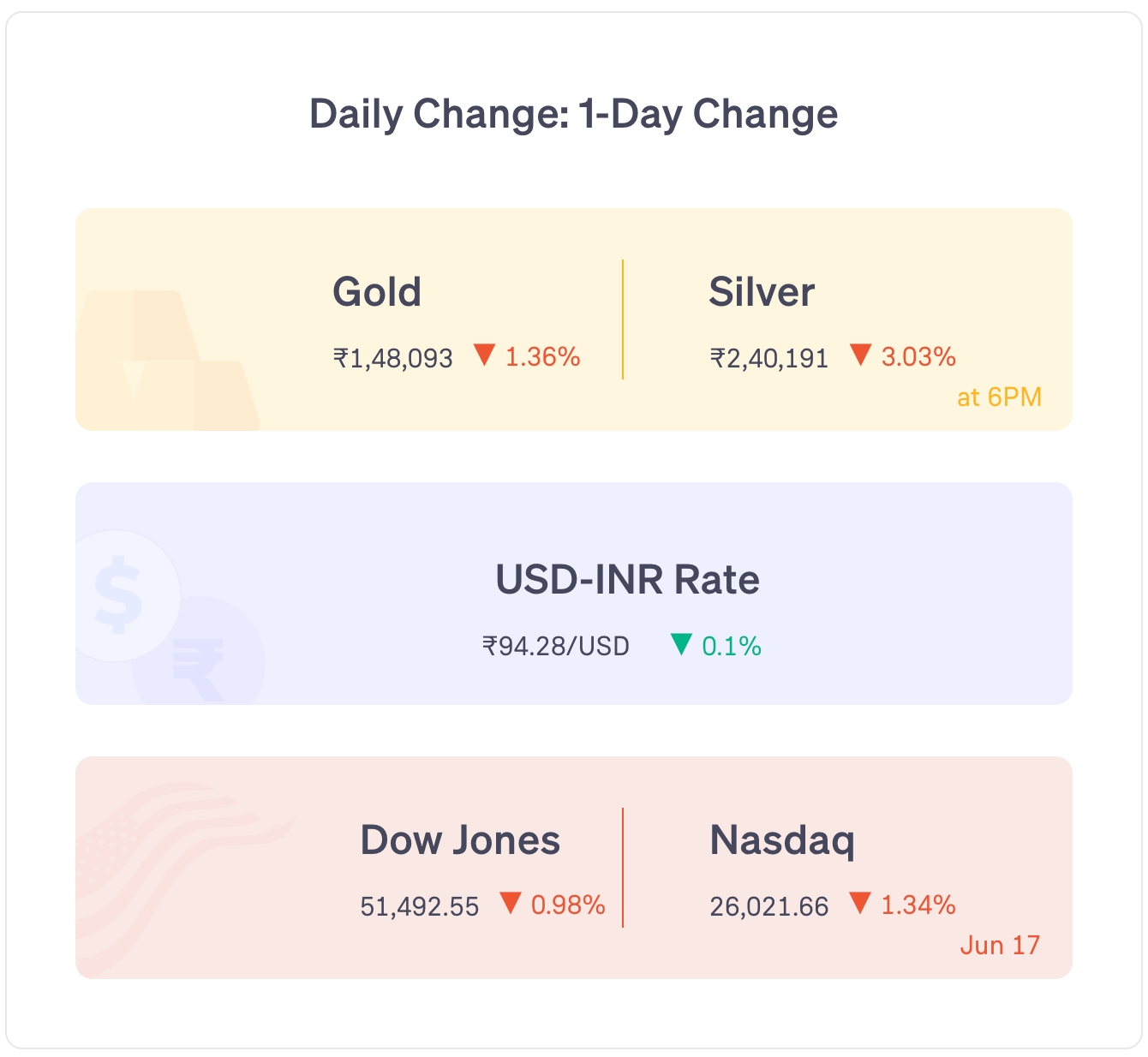
Global markets: US markets fell. Most Asian markets rose. Most European markets fell (as of 6 pm IST).
News
The US Fed kept the interest rate unchanged in the 3.5% to 3.75% range.
The US and Iran have officially signed an interim peace agreement to end the West Asia war. Iran has agreed to dilute its enriched uranium in exchange for major economic relief. In return, the US will lift its naval blockade and waive oil sanctions, while Iran will reopen the Strait of Hormuz.
The RBI has removed interest rate limits on fresh foreign currency NRI deposits until 30 Sept (allowing them to offer higher interest rates) to bring in foreign cash and keep the Rupee stable.
The India-UK Free Trade Agreement (CETA) will officially take effect on 15 July, 2026, significantly reducing tariffs for both sides.
NSE has filed draft papers with SEBI for a Rs 30,000 crore IPO.
Stocks Updates
Bajaj Finance: allotted NCDs worth Rs 1,455.40 crore at 7.07% interest rate on a private placement basis.
Wipro: will acquire an additional 20% stake in Aggne Global IT Services for $2.1 million, increasing its holding to 80%.
Varun Beverages: partnered with Japan’s Asahi Group Holdings to launch dairy-based beverage brand ‘Calpis’ in India from the second half of 2026, with Varun Beverages handling manufacturing, distribution, and sales.
Tata Motors: will increase prices of its commercial vehicles by up to 2.5% from 1 July due to rising commodity and input costs.
Bharat Forge: subsidiary Kalyani Strategic Systems partnered with US-based AM General to jointly offer mounted artillery gun systems for global defence markets.
IDBI Bank: clarified that there is no undisclosed price-sensitive information behind the recent surge in trading volumes and that all developments related to its strategic disinvestment are being disclosed as required.
Word of the Day
Asset Turnover Ratio
It measures how efficiently a company uses its assets to generate revenue
A higher asset turnover ratio indicates that the company is generating more sales from its assets, while a lower ratio may suggest that assets are not being utilized effectively.
It is a metric used to assess the operational efficiency of a business and can be used to compare companies within the same industry.
6 Day Course
Theme: understanding FIIs
Day 4: Thursday
FIIs often invest in multiple emerging markets (EM).
These are countries like India, Vietnam, Brazil, Mexico, South Korea, etc.
Each of these countries are governed by their own individual factors.
Many times FIIs sell in one country to invest in another because they think they’ll get a better return there.
Example: stocks in another country seem very undervalued and therefore attractive. FIIs might sell existing shares they have to buy more shares in the other EM.
Or, if something goes wrong in one EM country, they’ll sell stocks there and invest in other healthier EM countries.
Example: a policy announcement in one EM might signal tougher times ahead. So FIIs start selling shares in that EM and buying shares in other EMs.
Featured Question
Q. “While starting a SIP in MF time will be prefixed for a certain period like 10years or 5 years 1month etc. After completion of SIP say after 5 yrs total SIP investments 5.00lacs and Fund value with NAV may be around 12.00 lacs. Can I lock this NAV value because of Maturity of Fund and withdraw 12.00 lacs in 5 years in monthly instalments without further participating in market due to fluctuations (NAV may be come less and fund value also may be reduced) or I have to withdraw entire 12.00 lacs at the time of maturity of my SIP?”
This is a misconception many investors have.
Mutual funds have no maturity period.
That’s the best part. Money does not automatically stop being invested.
Once you invest in a mutual fund, the amount remains invested forever — until you withdraw it.
For that period, the money continues to be invested and keeps growing.
Think of it like buying a house. Once you buy a house, you will get money when you sell it.
There’s no period after which your money will automatically be given out.
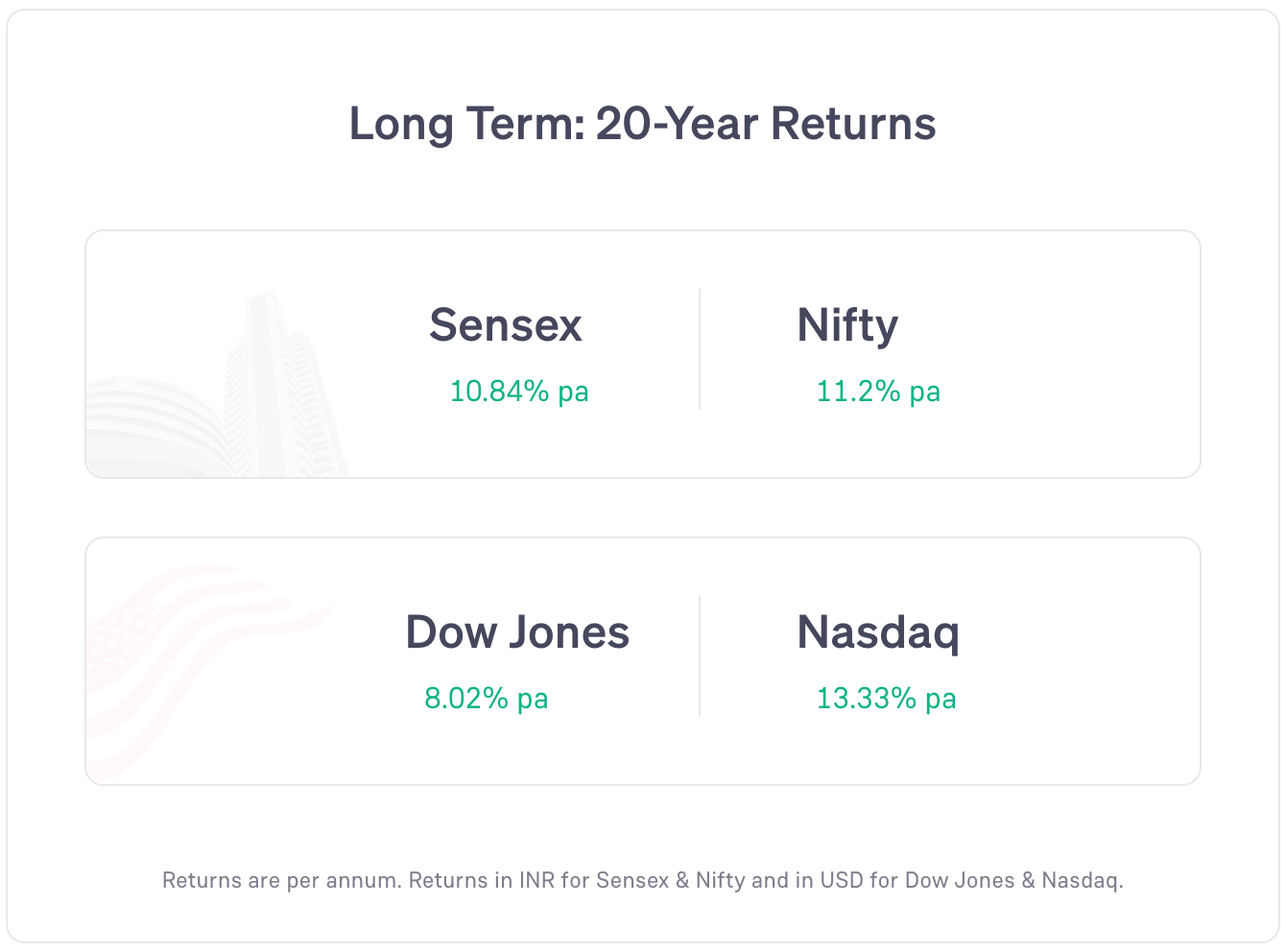
Many investors develop this misconception because nearly all mutual fund pages show historical mutual fund returns commonly in 6 month, 1 year, 3 years, and 5 years format.
So they assume that these are the optimal investment periods.
That is a wrong assumption. The options exist merely for you to analyse the mutual fund’s past performance.
Did you like this edition?
Leave a feedback here!