
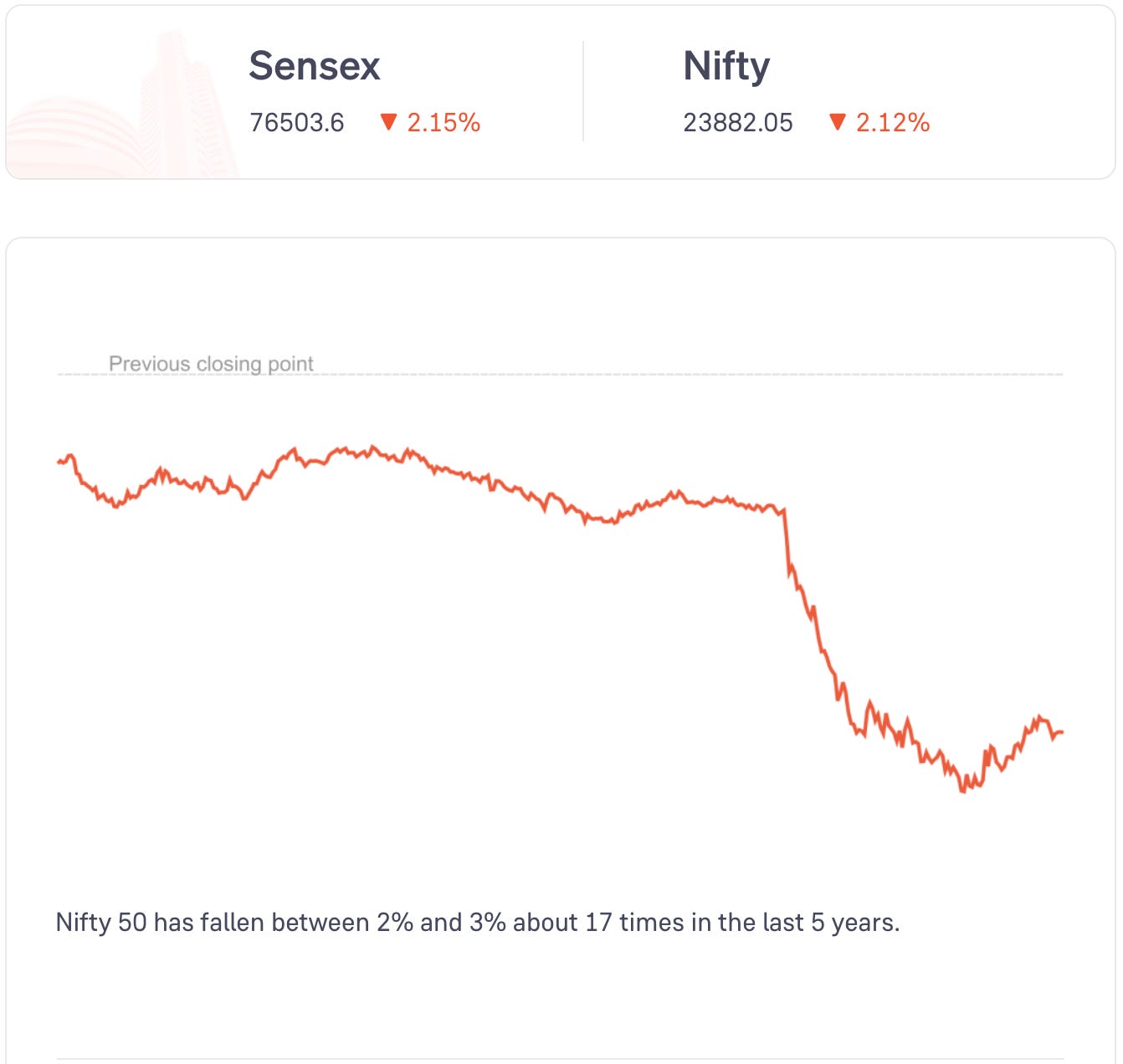
Markets closed significantly below yesterday’s closing point as escalating tensions between US and Iran pushed oil prices higher.
Nifty 50 fell drastically after 1:30 pm after Trump withdrew the US-Iran ceasefire.
All sectors’ stocks fell today. PSU Bank stocks and chemical stocks fell the most.
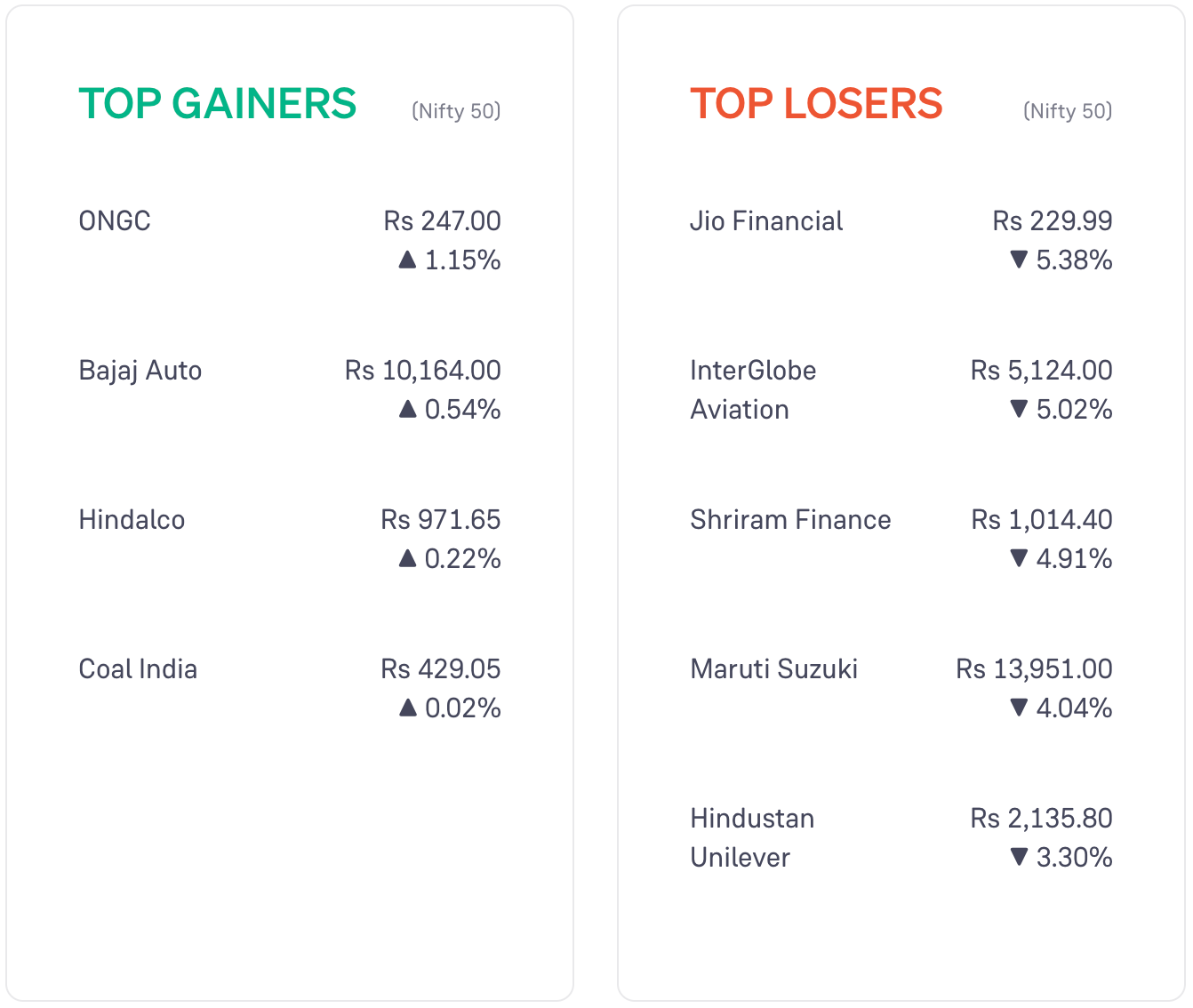
There are only 4 stocks in Nifty 50 that rose today. Hence, there are only 4 stocks in the ‘Top Gainers’ section.
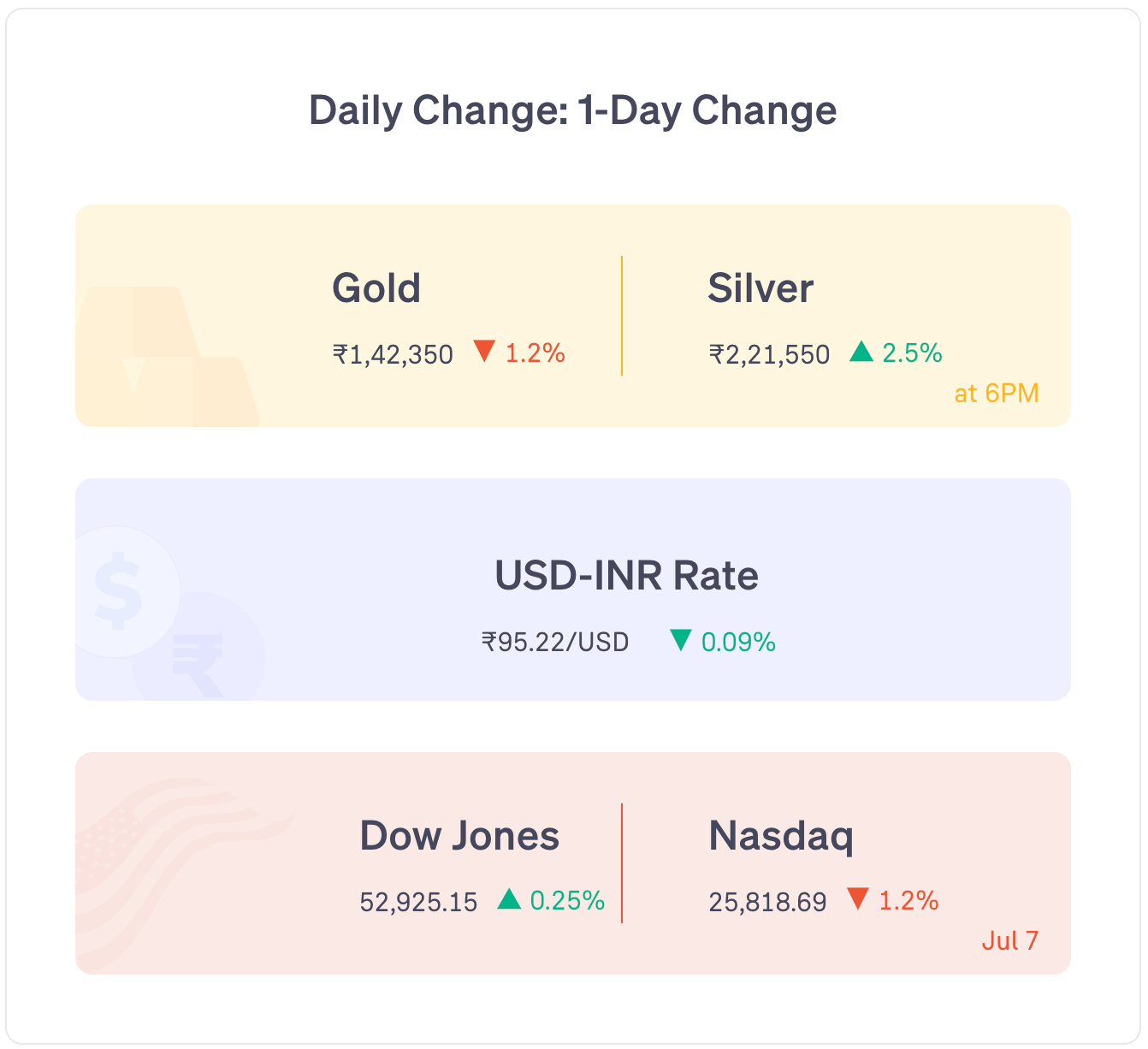
Global markets: US markets fell. Most Asian markets fell significantly. European markets closed in red. (as of 6 pm IST).
News
The US-Iran ceasefire collapsed with the US launching airstrikes on 80 targets in Iran and revoking its oil sanctions waiver after Iran attacked 3 commercial shipping tankers in the Strait of Hormuz. This triggered retaliatory attacks on US bases in Bahrain and Kuwait.
India’s auto component industry grew 12.7% year-on-year reaching a turnover of Rs 7.6 lakh crore in FY26.
SEBI has replaced its dollar-based FPI registration fee structure with flat rupee-denominated charges to simplify tracking and eliminate exchange rate conversion delays for foreign investors.
Kusumgar IPO has been subscribed 3.45 times. Retail subscription: 3.52 times. IPO closes on 10 July.
Stocks Updates
L&T: subsidiary L&T Vyoma partnered with Fortanix to provide sovereign AI infrastructure and confidential computing solutions powered by NVIDIA technology for enterprises and government organisations in India.
Adani Enterprises: allotted 5.2 crore shares to qualified institutional buyers, raising Rs 15,000 crore through its QIP at an issue price of Rs 2,883 per share (a 5% discount to the Rs 3,034.68 floor price).
HCLTech: subsidiary Actian, the data and AI division of HCLSoftware, has completed the acquisition of Jaspersoft, an embedded analytics and reporting platform.
TVS Motor: signed an MoU with Indian Oil Corporation to deploy TVS vehicles across IndianOil’s network of over 13,000 LPG distributors for last-mile cylinder distribution.
Torrent Pharma: completed the amalgamation of J. B. Chemicals & Pharmaceuticals Ltd into itself effective 8 July 2026, following NCLT sanction.
NTPC Green: subsidiary NTPC Renewable Energy Ltd, declared commercial operation of the first 50.4 MW phase of the Vanki Wind Energy Project in Nakhatrana, Kutch, Gujarat. NTPC Green’s total installed capacity increased to 10,721.8 MW.
Word of the Day
Liabilities
This is the money that a company owes.
‘Liabilities’ is a category that includes all sorts of dues.
Some examples of liabilities are debt & interest repayment, pending bills, rent, taxes, salaries of employees, etc.
6 Day Course
Theme: ROE & ROCE
Day 3: Wenesday
In case of ROCE we are comparing the earnings before interest and tax against the capital employed.
Earnings Before Interest and Tax is often shortened and made ‘EBIT’.
What is capital employed?
It is the money that is used in making the business operate.
It includes the shareholders equity and the long term debt the company takes too.
This is the key distinction between the shareholders’ equity and the capital employed — capital employed includes debt.
Many companies are effectively 0 debt companies, which means they have no debt repayments.
In such cases, the capital employed is very similar to the shareholders’ equity.
Featured Question
Q. “When talking about the debt of a company, does this apply to all types of businesses, or does it exclude some businesses like financial companies/banks?”
Debt analysis applies mainly to non-lending companies such as auto, FMCG, pharma, infrastructure, manufacturing, etc.
For banks, NBFCs, and other lending businesses, debt is analysed differently because their core business model itself depends on borrowing money and lending it further.
So, in the case of normal operating companies, debt is usually viewed mainly as a financial liability. But in the case of lending companies, debt becomes a core operating metric and needs to be analysed in greater depth.
For such companies, factors like the source of funds, cost of borrowing, interest rate, asset quality, and repayment profile take on a much bigger meaning.
Therefore, debt is not ignored for banks or NBFCs, but it cannot be interpreted in the same way as debt in regular non-lending companies.
The information presented in this post has been compiled and prepared by Groww Invest Tech Pvt Ltd and is intended solely for informational purposes. It is not tailored to any specific investment objectives, financial situations, or needs of any individual investor. The content should not be construed as investment, financial, legal, or tax advice and should not be relied upon as a substitute for professional consultation.
Investing in securities markets involves inherent risks. Investors are advised to carefully review all relevant documents and consider their own risk tolerance before making any investment decisions.
Mutual fund investments are subject to market risks; please read all scheme-related documents carefully. Past performance of financial instruments, schemes, or markets is not indicative of future results.
Groww Invest Tech Pvt Ltd is registered with the Securities and Exchange Board of India (SEBI) under Registration No: INZ000301838, as a Research Analyst under No: INH200008662, as a Depository Participant under No: IN-DP-417-2019, and with the Association of Mutual Funds in India (AMFI) under ARN-111686.
SEBI registration details: View registered name and registration numbers
Research Analyst Disclaimer: View Research Analyst disclaimer
Did you like this edition?
Leave a feedback here!
Reckless!
Your LLM is really dumb, the word of the day has the wrong definition.
It defines retained earnings and not liabilities.
Why don't you recheck the completions.
I'm losing trust over you now, it has been so many times that you made errors.