

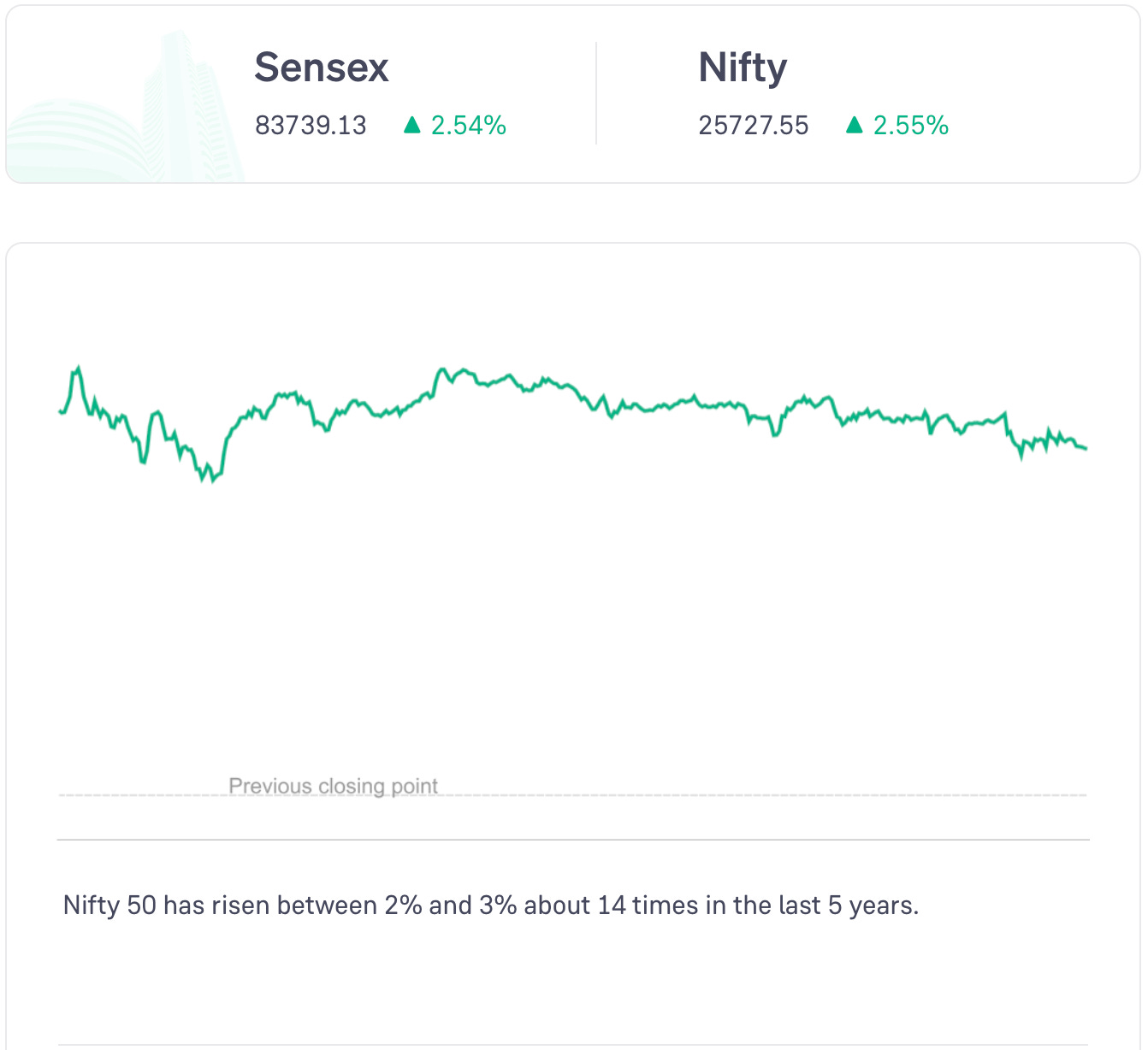
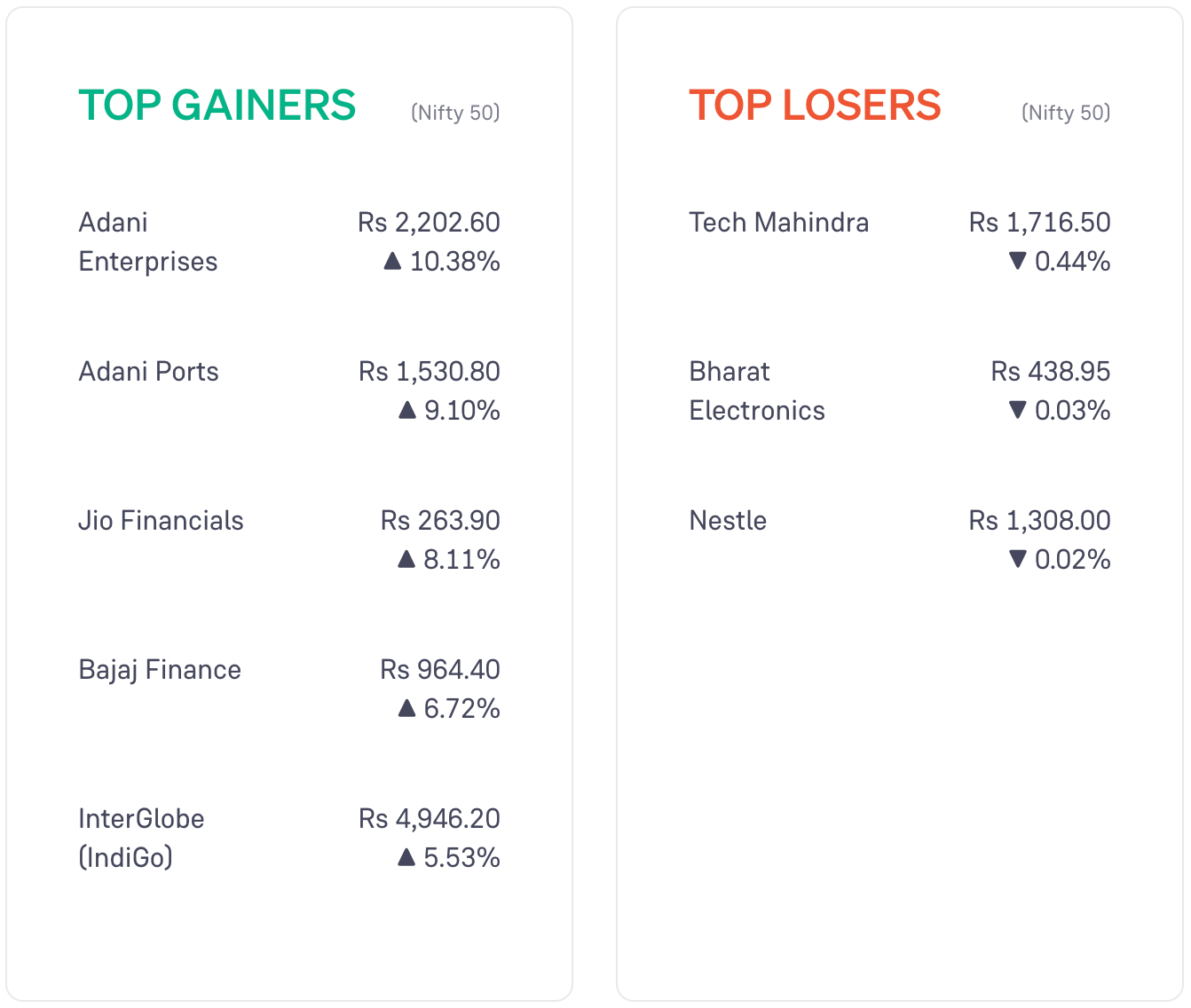
Markets opened significantly above yesterday’s closing point.
Nifty 50 opened higher. The rise was mainly due to positive sentiment around the India-US trade deal.
All sectors’ stocks rose today. Realty stocks and chemicals stocks rose the most.
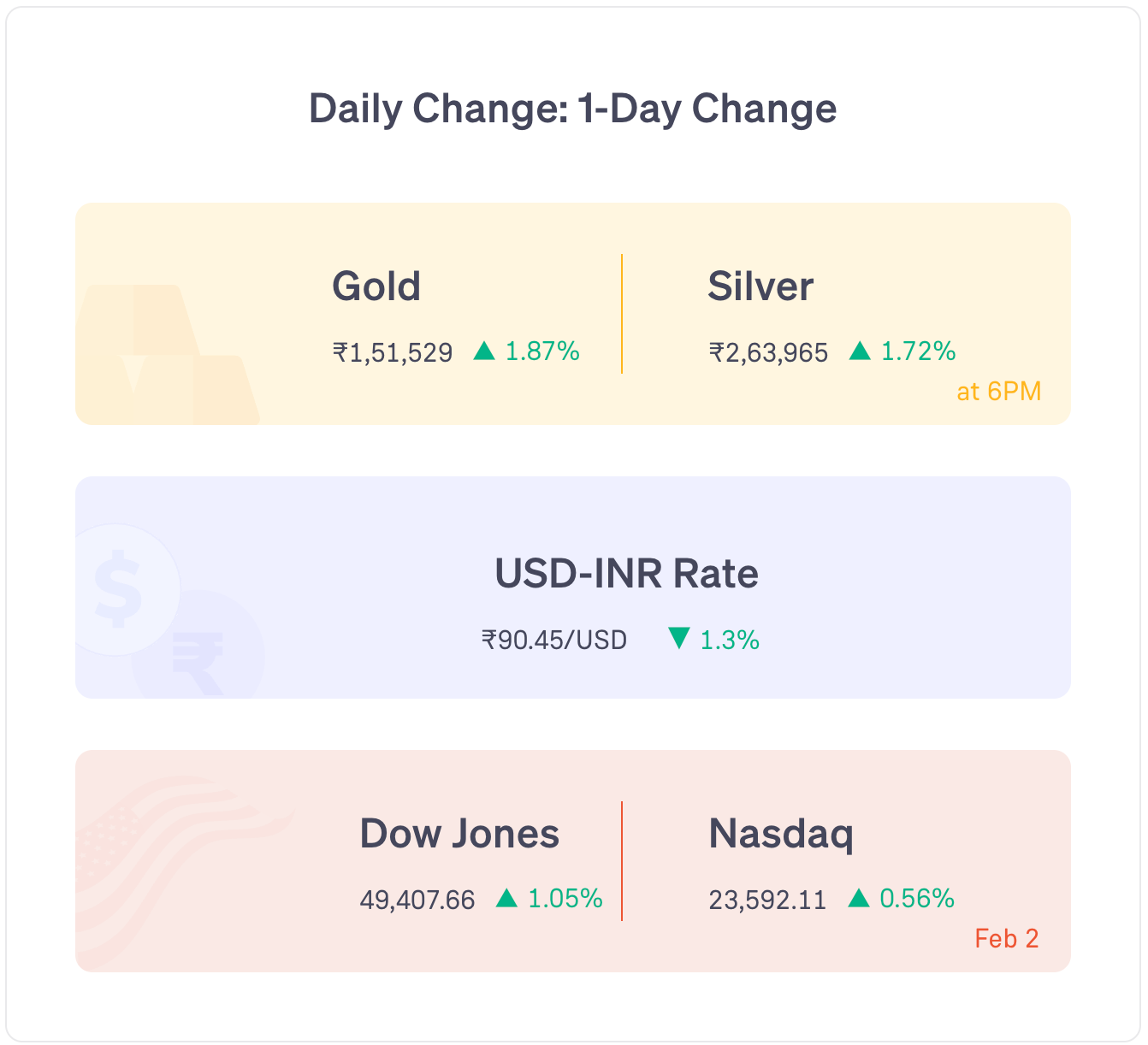
Global markets: US markets and Asian markets rose. European markets showed a mixed trend (as of 6 pm IST).
News
US President Trump announced that tariffs on India will be cut from 50% to 18%. India has welcomed the reduction. Trump also mentioned that India has agreed to stop buying Russian oil, though India has not confirmed this. A joint statement is expected to be issued shortly.
Stocks Updates
Bajaj Finance: net profit fell 6.3% year-on-year to Rs 3,978 crore in the Oct-Dec quarter.
Adani Ports: net profit rose 21% year-on-year to Rs 3,054 crore in the Oct-Dec quarter.
Adani Enterprises: net profit rose to Rs 5,627 crore in the Oct-Dec quarter (vs Rs 58 crore in last year). This was due to a one-time exceptional gain from the sale of stake in Adani Wilmar.
Varun Beverages: net profit rose 36% year-on-year to Rs 252 crore in the Oct-Dec quarter. Dividend declared: Rs 0.5 per share.
Solar Industries: net profit rose 42% year-on-year to Rs 446 crore in the Oct-Dec quarter.
Aditya Birla Capital: net profit rose 33% year-on-year to Rs 945 crore in the Oct-Dec quarter.
Mankind Pharma: net profit rose 7.5% year-on-year to Rs 409 crore in the Oct-Dec quarter.
Reliance: a company subsidiary, RSBVL, acquired a 50.1% stake in Sikhya Entertainment for Rs 150 crore to strengthen Jio Studios’ content and media business.
NTPC Green: signed an MoU with ‘Assago Industries’ to supply green ammonia and renewable power for a 1,000 tonnes per day green urea plant.
Word of the Day
Capital Flows
It is the movement of money and financial assets across countries
This can be for investment or any business operations.
Example: FDIs, FPIs, loans taken by countries, etc.
So when global investors invest in Indian equities and bonds, capital flows into India.
If they sell and move money back to the US, capital flows out.
Capital flows can affect currency values, market stability, interest rates, and overall economic growth.
6 Day Course
Theme: common ways to cook books
Day 2: Tuesday
Another common trick is to move regular recurring costs to the long-term costs section.
So, costs like salaries, office rent, etc, might be categorised under the capital expenditure heading.
Capital expenditure (capex) are usually long-term spends like building a factory, new office etc.
Capex is usually spread out over a few years to reduce its impact on a single year.
Many companies might also unnecessarily create a buffer fund to use in the year the profit is lower. They might term this as required for an exceptional cost like legal fees requirement, etc. So this causes the profit to dip that year.
Then in a bad year, they might channel this fund to boost their earnings.
Why is this not a good practice?
There’s nothing bad about keeping reserves for a future date. Many companies do that.
But in this exact case (showing that saved money as legal expense, etc), the company is trying to show consistent profits year after year whereas the reality is that profits per year are varying.
Featured Question
Q. “In stock market taxation, capital gains tax is charged based on how long the shares are held, and tax is applicable only if gains exceed ₹1,25,000. If an investor buys and sells multiple shares during a financial year, and the individual profits from each transaction are below ₹1,25,000, is capital gains tax still applicable? Specifically, is the ₹1,25,000 exemption limit calculated per share/stock transaction, or is it applied to the aggregate capital gains across all transactions in a financial year? Please elaborate on this.”
Aggregate.
The limit does not apply per stock or per mutual fund. It applies to the total gains from all or just one stock/mutual fund.
Also note, the gains from equity mutual funds as well share sales are combined together.
So investors don’t have to pay long term capital gains tax as long as the total gains from shares + equity mutual funds are less than Rs 1.25 lakh in a financial year
Did you like this edition?
Leave a feedback here!
Hi
Hello sir IAM from india T S Hyderabad
H, no17 -1-391/ m/47/1 khjdabad saidbad Hyderabad 500059
Name babukodhuti babukodhuti.1970@gmail.com