
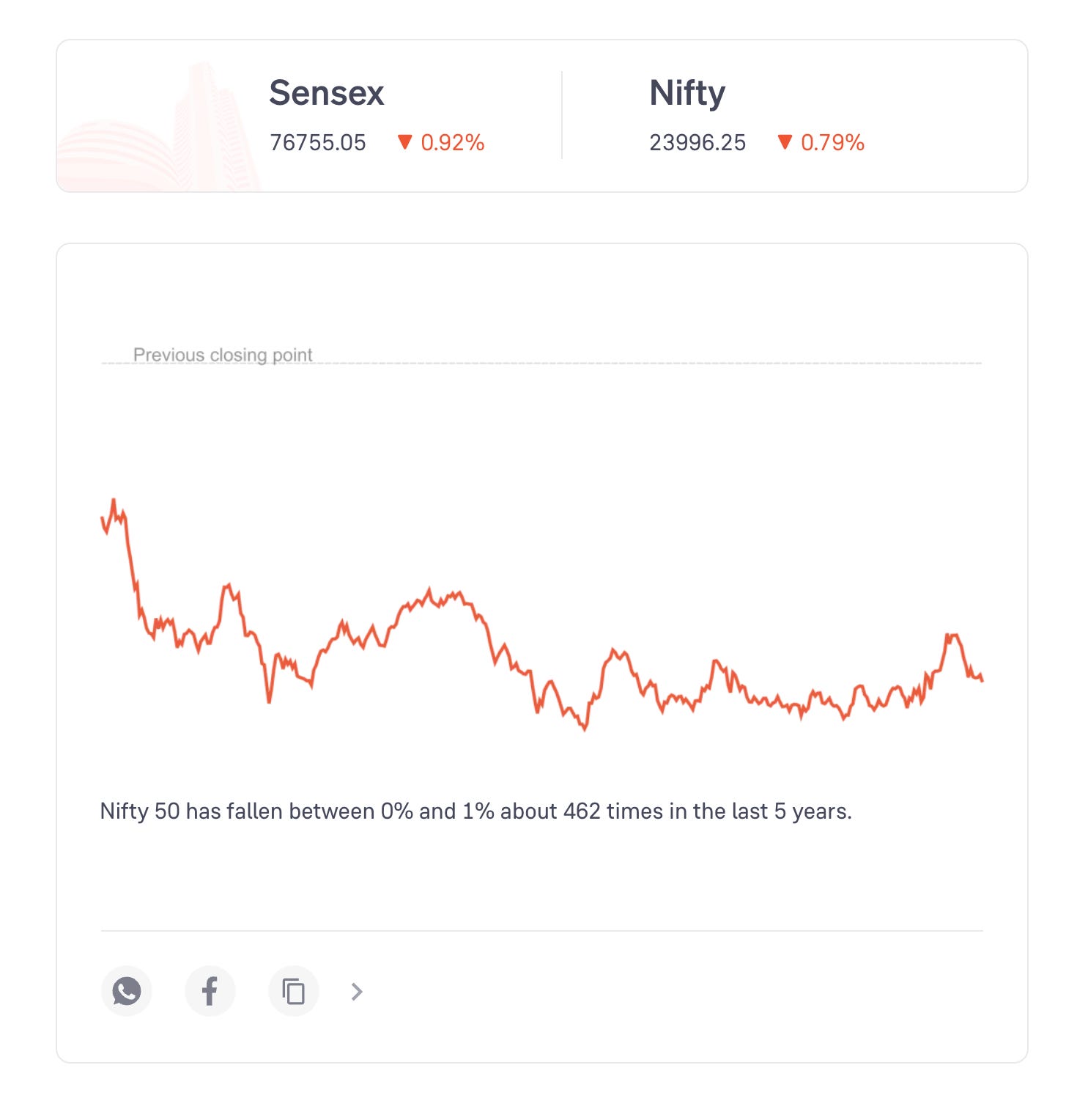
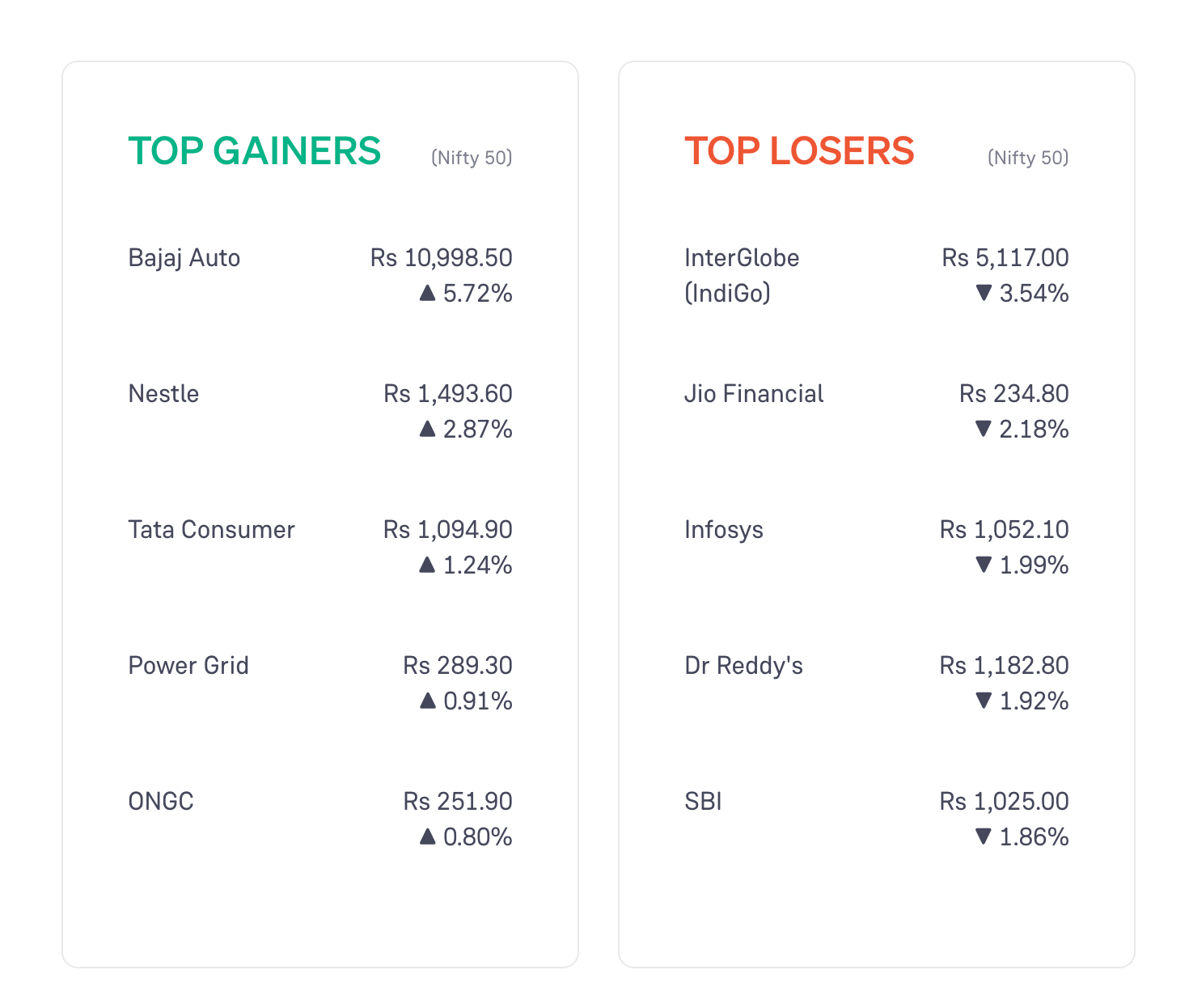
Markets closed lower than yesterday’s closing point after US President Donald Trump made fresh tariff threats on non-US pharma companies.
Realty stocks and media stocks fell the most today. Only FMCG stocks and auto stocks rose.
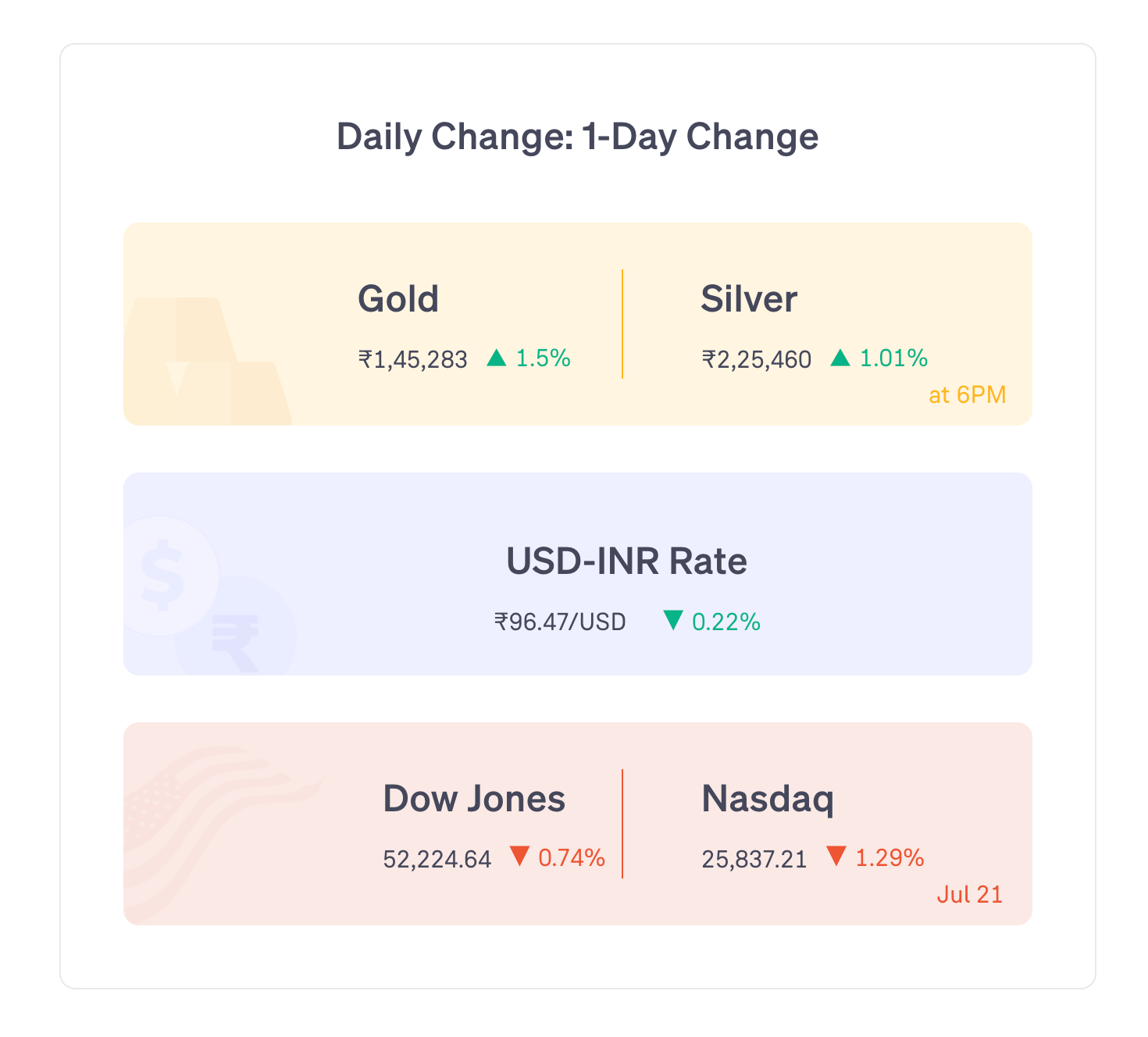
Global markets: US markets rose on Tuesday. Asian markets showed a mixed trend. Most European markets rose (as of 6 pm IST).
News
US President Donald Trump said that all imported generic drugs will have 100% tariff in 2028 and 200% a year after that. There will be no tariff for 2 years starting 1 August. This is done to reshore generic pharmaceutical production into America.
The government approved two Electronics Manufacturing Clusters (EMCs) worth Rs 1,012 crore in Manallur and Pillapaikkam, Tamil Nadu.
Stocks Updates
Adani Power: net profit rose 41.98% year-on-year to Rs 4,805.69 crore in the Apr-June quarter.
Nestle India: net profit rose 48.27% year-on-year to Rs 958.68 crore in the Apr-June quarter.
Eternal (Zomato): net profit rose 268% year-on-year to Rs 92 crore in the Apr-June quarter. It will transfer its Nugget by Zomato business to wholly owned subsidiary Carthero Technologies Pvt Ltd for Rs 35 crore as part of an internal restructuring.
Adani Green: net profit rose 18.5% year-on-year to Rs 845 crore in the Apr-June quarter.
Adani Energy: net profit rose 124.22% year-on-year to Rs 1,149.06 crore in the Apr-June quarter.
Pidilite: received a GST penalty order of Rs 46.98 lakh from the CGST Assistant Commissioner, Indore, which it plans to challenge.
Samvardhana Motherson: completed the acquisition of an 81% voting stake in Japan-based Yutaka Giken through subsidiary Motherson Global Investments BV. Honda Motor will hold the remaining 19% stake after Yutaka Giken bought back its shares.
Tata Capital: allotted $400 million senior unsecured notes at a fixed coupon rate of 5.332%. The notes have a 3.5-year tenure and will mature on 21 Jan 2030.
BPCL: reported a net loss of Rs 1,872.70 crore in the Apr-June quarter, compared to a net profit of Rs 6,839.02 crore a year earlier. Company subsidiary BPRL Ventures acquired the remaining stake in Brazil-based IBV Brasil Petroleo from Videocon Energy Brazil for Rs 2,312 crore, making it an indirect wholly owned subsidiary.
HPCL: reported a net loss of Rs 12,264.67 crore in the Apr-June quarter, compared to a net profit of Rs 4,110.93 crore a year earlier.
Bharat Forge: signed an MoU with French-Canadian firm Flying Whales to jointly develop and manufacture heavy-lift airships in India.
Oracle Financial Services Software Limited: net profit rose 120.52% year-on-year to Rs 1,415.50 crore in the Apr-June quarter.
Dr. Reddy’s: net profit fell 68.67% year-on-year to Rs 444.30 crore in the Apr-June quarter.
SRF Limited: net profit rose 75.53% year-on-year to Rs 758.87 crore in the Apr-June quarter. Dividend announced: Rs 5 per share.
IndusInd Bank: net profit rose 71.68% year-on-year to Rs 1,037.05 crore in the Apr-June quarter. Board also approved raising up to Rs 20,000 crore through debt securities and up to Rs 10,000 crore through equity instruments or convertible debt securities, subject to approvals.
Word of the Day
Corporate Lending
Banks and financial companies lending money to corporate companies.
Corporate lending is one kind of lending banks and financial institutions take part in.
This lending could be for funding day to day operations, purchasing machinery, acquisition, etc.
These loans may or may not have a collateral involved.
The rate of interest applicable also depends heavily on the profile of the company, its likelihood of paying back, duration of the loan, etc.
6 Day Course
Theme: understanding PEG
Day 3: Wednesday
The central idea behind PEG ratio is this: it is okay for a share to have a higher PE ratio if it is growing faster.
The way to calculate it is: PE ratio divided by annual growth in EPS.
Example: if a company’s PE ratio is 45 and its annual earnings-per-share is growing at 30%, it’s PEG will be: 45/30 = 1.5
So, a lower PEG would be considered as the share being undervalued. A higher PEG would be considered as overvalued.
There is no correct PE ratio. It is subjective and depends on each investor.
Likewise, there is no correct PEG ratio either. It is subjective and depends on the investors’ thinking.
Many investors tend to say that a PEG ratio of 1 is the most ideal PEG ratio and anything above it starts feeling overvalued.
But that’s just a commonly held belief. Many investors do invest in shares with a higher PEG if they feel optimistic about the company’s future.
————
Featured Question
Q. “Why GMP is considered while deciding the listing price ? GMP is like black market price and I feel unethical and helps only the MFs and big investors who dump them at higher prices for the small investors who didn’t get allotment. If GMP is correct, then why the listing price collapses within 2 or 3 days after the listing day ? I say it is a way of cheating small investors”
In case of IPOs, GMP or Grey Market Premium is the share price before the listing takes place.
It is completely informal and unofficial. It is not regulated by SEBI or any other regulatory body.
It is the price at which some investors and traders are buying/selling directly with each other. There is no exchange (BSE/NSE) involved.
It is not always accurate since the price is purely based on observation of some trades, not all trades.
Relying on GMP to predict the future price of a share after listing is a bad strategy.
There are enough examples where the share price went down or up compared to the GMP.
Large institutional anchor investors like mutual funds are usually locked in for 30 to 90 days. So they cannot sell within a few days after the IPO listing.
The information presented in this post has been compiled and prepared by Groww Invest Tech Pvt Ltd and is intended solely for informational purposes. It is not tailored to any specific investment objectives, financial situations, or needs of any individual investor. The content should not be construed as investment, financial, legal, or tax advice and should not be relied upon as a substitute for professional consultation.
Investing in securities markets involves inherent risks. Investors are advised to carefully review all relevant documents and consider their own risk tolerance before making any investment decisions.
Mutual fund investments are subject to market risks; please read all scheme-related documents carefully. Past performance of financial instruments, schemes, or markets is not indicative of future results.
Groww Invest Tech Pvt Ltd is registered with the Securities and Exchange Board of India (SEBI) under Registration No: INZ000301838, as a Research Analyst under No: INH200008662, as a Depository Participant under No: IN-DP-417-2019, and with the Association of Mutual Funds in India (AMFI) under ARN-111686.
SEBI registration details: View registered name and registration numbers
Research Analyst Disclaimer: View Research Analyst disclaimer
Did you like this edition?
Leave a feedback here!