

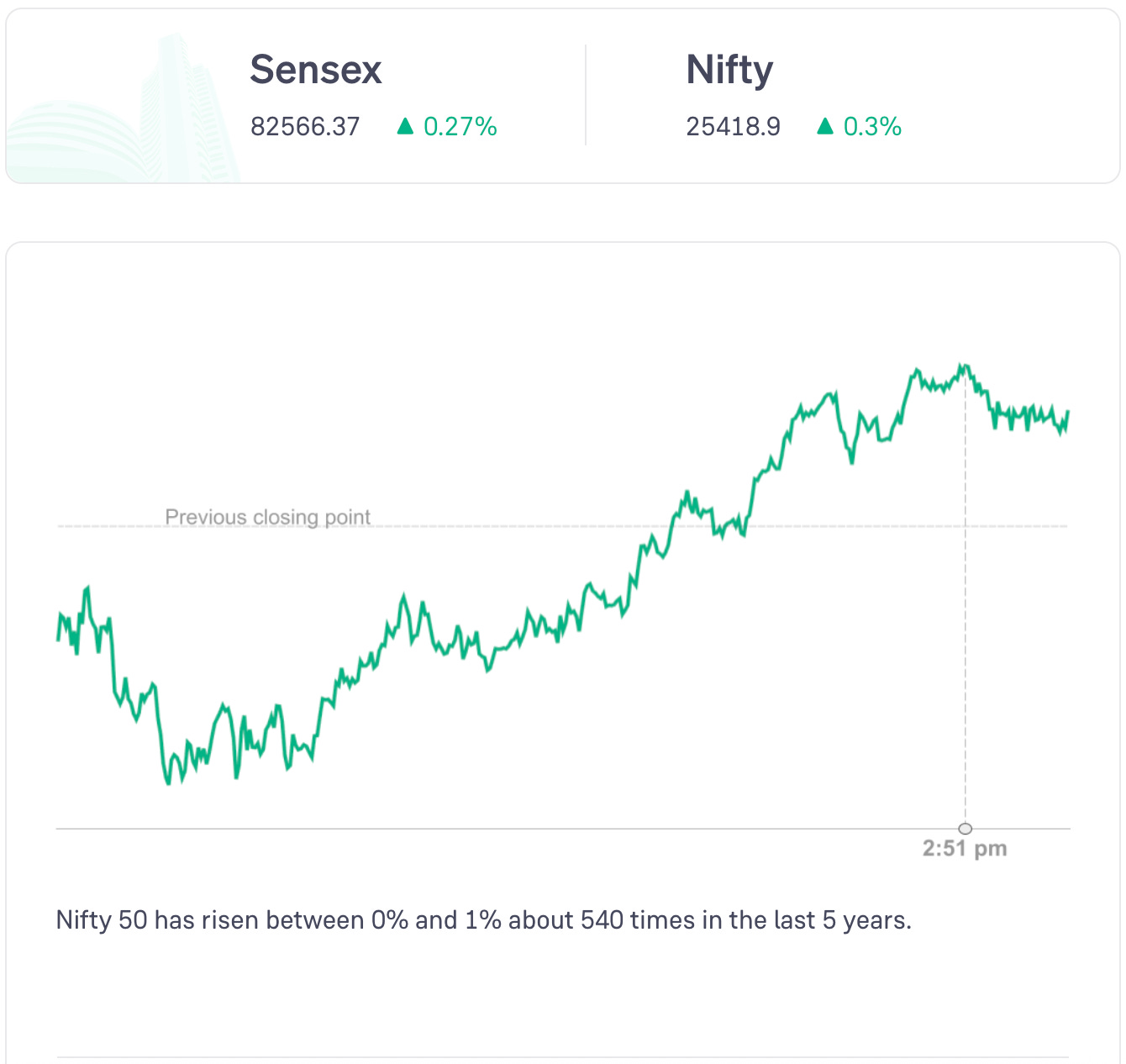
Markets opened below yesterday’s closing point.
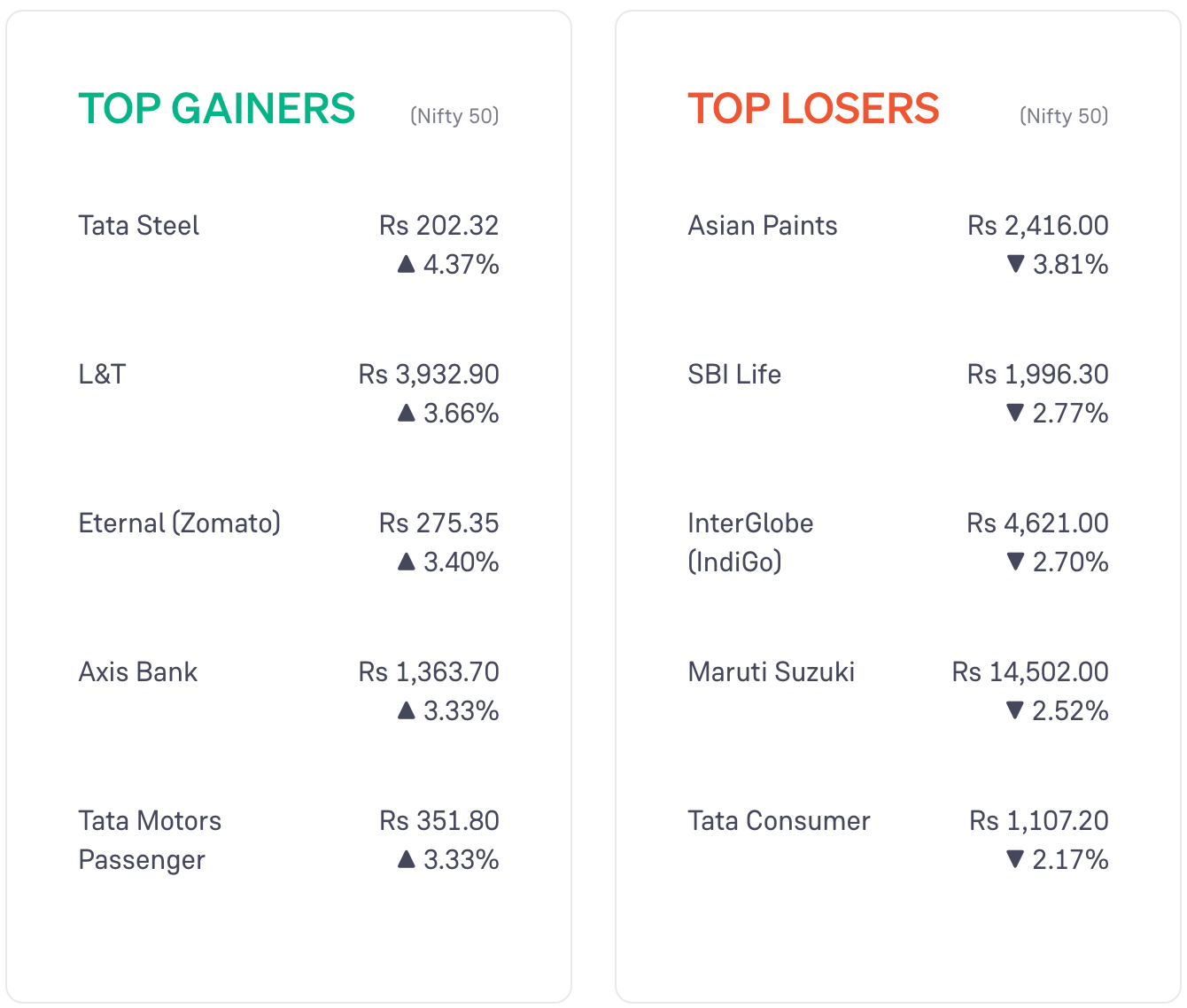
Metal stocks and private bank stocks rose the most today. Healthcare stocks and FMCG stocks fell the most.
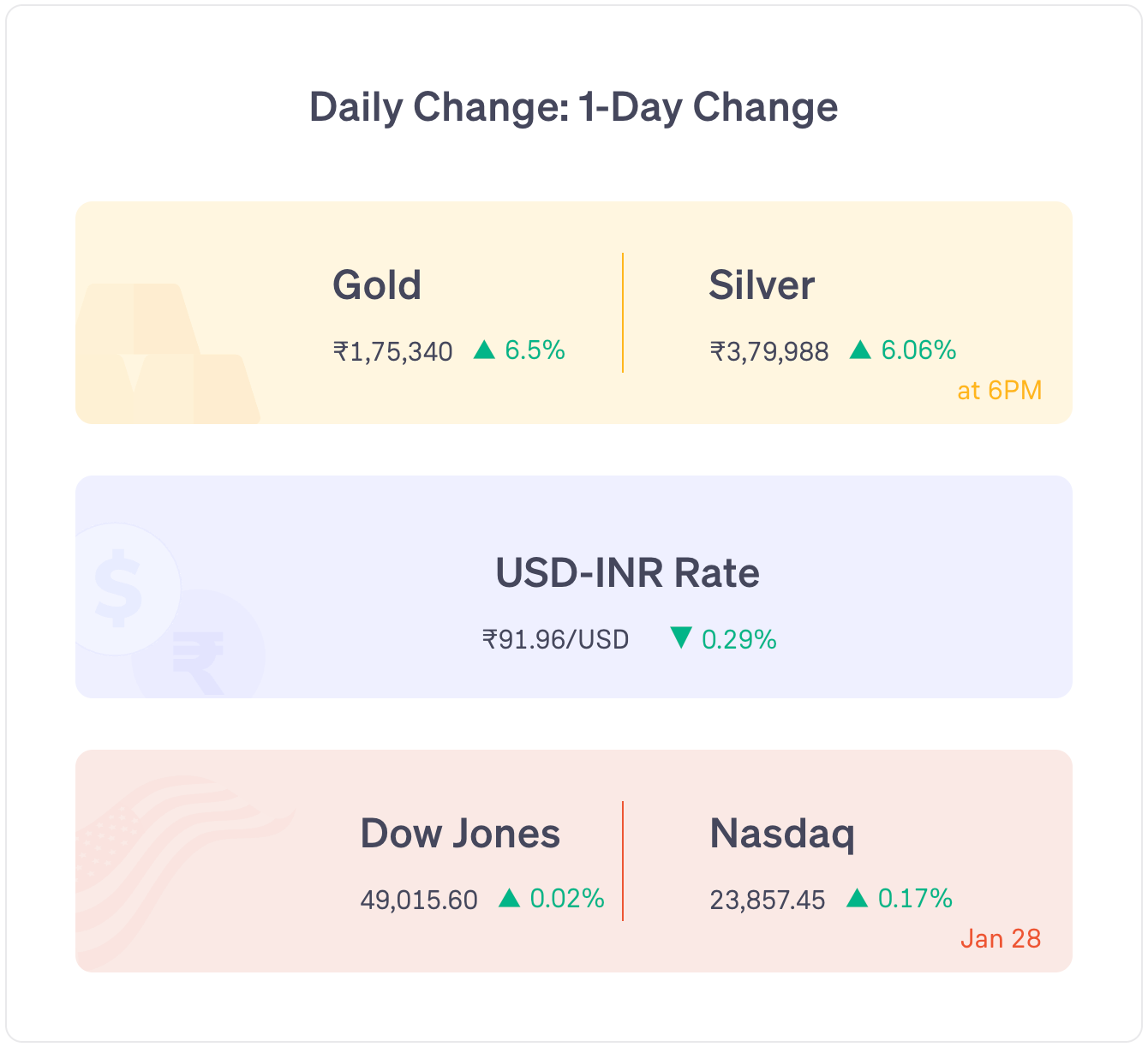
Global markets: US markets closed flat. Most Asian markets and most European markets rose (as of 6 pm IST).
News
India’s economic growth for FY26 is estimated to be 7.4%: Economic Survey 2025-26
Turtlemint Fintech Solutions has filed updated papers with SEBI for their IPO.
Stocks Updates
Hindustan Aeronautics: signed contracts worth over Rs 1,800 crore with ‘Pawan Hans’ to supply 10 Dhruv NG helicopters, to be delivered by 2027.
Marico: completed the acquisition of 93.27% stake in Zea Maize (owner of the 4700BC brand), making it a subsidiary.
HPCL: signed an MoU with Oil India at ‘India Energy Week 2026’ to jointly develop a compressed bio-gas project.
ONGC: the stock exchanges demanded clarification on media reports mentioning potential partnership with ExxonMobil to bid on oil and gas blocks.
JSW Energy: the stock exchanges demanded clarification on media reports on the company to set up its nuclear power plant by 2030.
Vedanta: net profit rose 61% year-on-year to Rs 5,710 crore in the Oct-Dec quarter.
Adani Power: net profit fell 19% year-on-year to Rs 2,480 crore in the Oct-Dec quarter.
Tata Motors: net profit fell 48% year-on-year to Rs 705 crore in the Oct-Dec quarter.
REC: net profit fell 0.6% year-on-year to Rs 4,052 crore in the Oct-Dec quarter. Dividend declared: Rs 4.6 per share. Record date: 6 Feb.
Dabur: net profit rose 7% year-on-year to Rs 560 crore in the Oct-Dec quarter.
Swiggy: net loss widened 33% year-on-year to Rs 1,065 crore in the Oct-Dec quarter.
Word of the Day
Holding Company
It is a company that is formed to own shares/assets in other companies
It owns enough assets that it can control the management and policies without directly producing goods or services.
Example: Tata Sons owns controlling stakes in Tata Motors, Tata Steel, and TCS.
Holding companies are a way to reduce risk while managing multiple businesses.
6 Day Course
Theme: risk-adjusted returns
Day 4: Thursday
Yesterday, we spoke about Sharpe ratio and its limitations.
To fight that limitation, another ratio is used: Sortino ratio.
It is similar to Sharpe ratio except it uses only downside volatility to calculate the ratio.
Which means, if the trend is upward, the volatility is ignored.
This aims at solving the problem of missing out of upward-but-volatile investments.
Treynor ratio: this is yet another ratio that is similar to Sharpe ratio but instead of using volatility, it uses relative volatility (the stocks’ volatility compared to the overall index’s volatility).
And there are a few other ratios as well.
It must be remembered that each of these ratios has their own limitations.
One common limitation is that many risks are silent — they do not cause the price to change or volatility to occur before something goes wrong.
Featured Question
Q. “In continuation to your today's answer, can you please elaborate on when new ETF units are created and will the investors be notified about it? Isn't it better to wait and buy till new ETF units are created, so that we might get it at the actual Market rate?”Think about it like a small town.
There are 100 families living in the town. And, there are 100 houses.
Now, one family decides to leave the town and go somewhere else.
So they sell the house to an existing family in the town.
Then, another new family comes to the town and they want to buy a house.
The family that owns 2 houses sells them a house.
In such situations, no new houses need to be constructed.
Now let’s say 100 families are living here and another 10 families come to the town. None of the existing houses are on sale. Nobody is selling.
Then?
In such a case, those new families will have to get new homes constructed.
Homes that did not exist will become a reality.
ETF units are similar.
Each unit of an ETF represents a certain asset.
When ETFs are bought and sold in equal numbers, no new ETF units are created.
But when many new ETF investors come (more than there is supply of existing units), new ETF units need to be created.
1 unit of an ETF represents the same asset.
The creation of new units happens all the time automatically. It is not an event that happens with a lot of announcements.
An investor cannot choose whether he/she is buying older units or newer units.
The units cost the same and are worth the same to the investor.
Did you like this edition?
Leave a feedback here!