

In 2022, the world went through a shock.
Russia invaded Ukraine, and suddenly Europe was at war again. Markets reacted immediately. Stocks fell, investors got nervous, and money started moving into assets that were considered safer.
Gold was one of them.
Whenever uncertainty rises (wars, inflation, economic slowdowns), investors usually move towards gold. Not because gold generates income, but because it is seen as something that holds value when everything else becomes uncertain.
And that’s exactly what happened.
Gold prices started rising as investors looked for stability. Over the next few years, uncertainty didn’t really go away. Inflation remained high in many countries, interest rates moved sharply, global growth slowed, and geopolitical tensions kept showing up in different parts of the world.
Through all of this, gold largely held its ground and often moved higher. This reinforced the old belief in markets that in times of crisis, gold performs well.
In fact, since the start of the Russia-Ukraine war, gold prices have risen more than 100%.
But something interesting happened recently.
Late February this year, tensions between the US and Iran escalated, and markets once again started worrying about a potential conflict in the Middle East. This is a region that is extremely important for global oil supply and trade routes.
Normally, in a situation like this, gold should have risen. But it turns out, gold fell around 10%.
And that raises an interesting question.
If gold is supposed to be the safe asset, why did it fall during a geopolitical crisis?
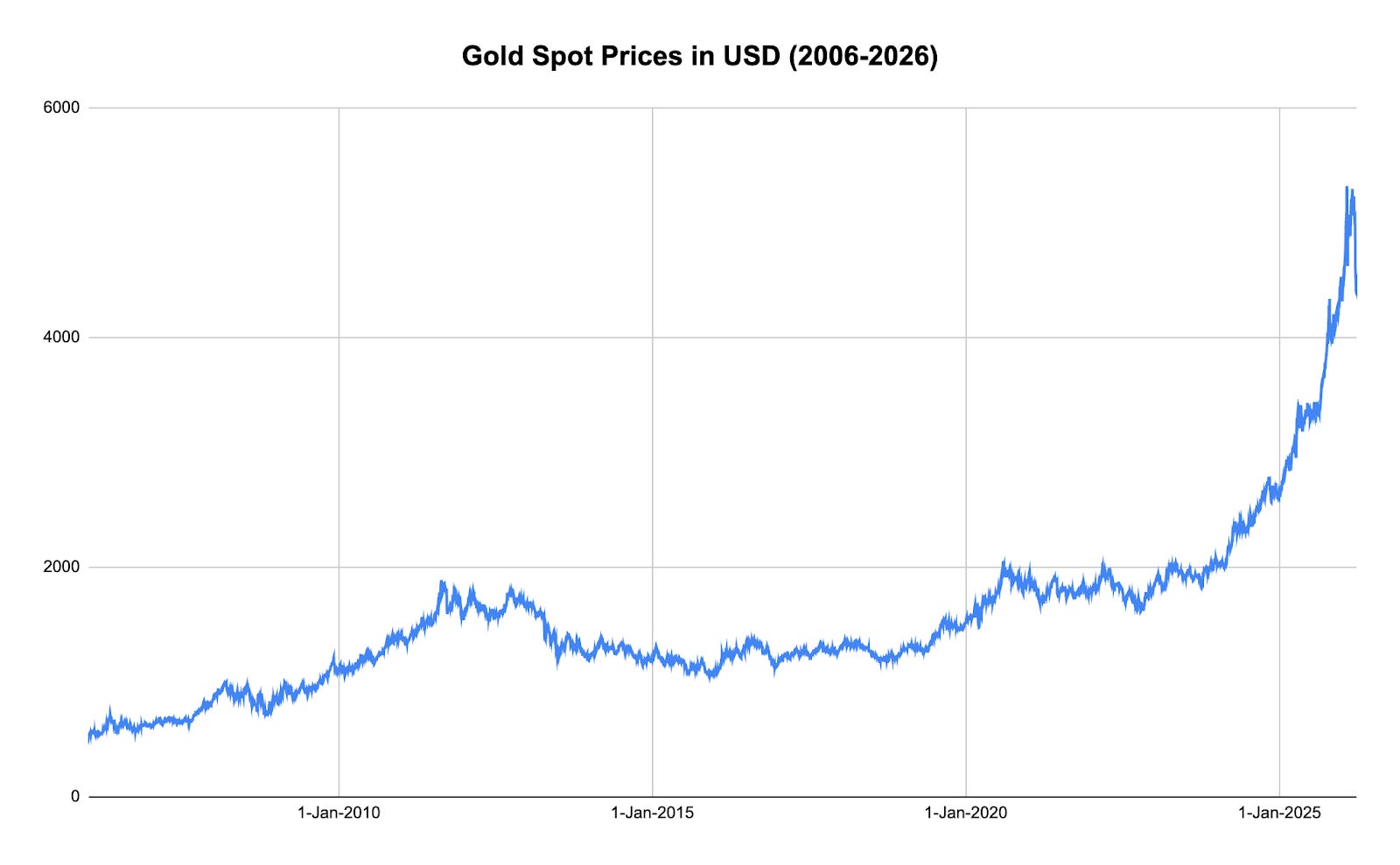
If gold is considered as the safe asset, why have the prices been falling?
We decided to take a look into it.
The Study
Now, gold prices change with the supply and demand in the market. But what affects this supply and demand? How do prices change in relation to these external factors?
We analysed a dataset spanning almost 20 years of daily market movements, from 2006 to 2026 (nearly 5,000 trading days).
We tracked the relationship between three specific forces that are connected to each other: Gold prices (in USD), the Broad US Dollar Index, and 10-Year US Treasury Yields.
Unlike a simple exchange rate, the broad US Dollar index measures the dollar’s strength against a massive basket of global currencies from the Euro to the Rupee. This index is useful for this study because gold is priced in dollars worldwide and the two usually share an inverse relationship.
Gold as an asset pays zero interest. The US Treasury Bonds, however, pay a guaranteed return. When those returns (yields) rise, the cost of choosing Gold over Bonds increases, which may affect the price of gold.
Results
The Gold-Dollar Movement
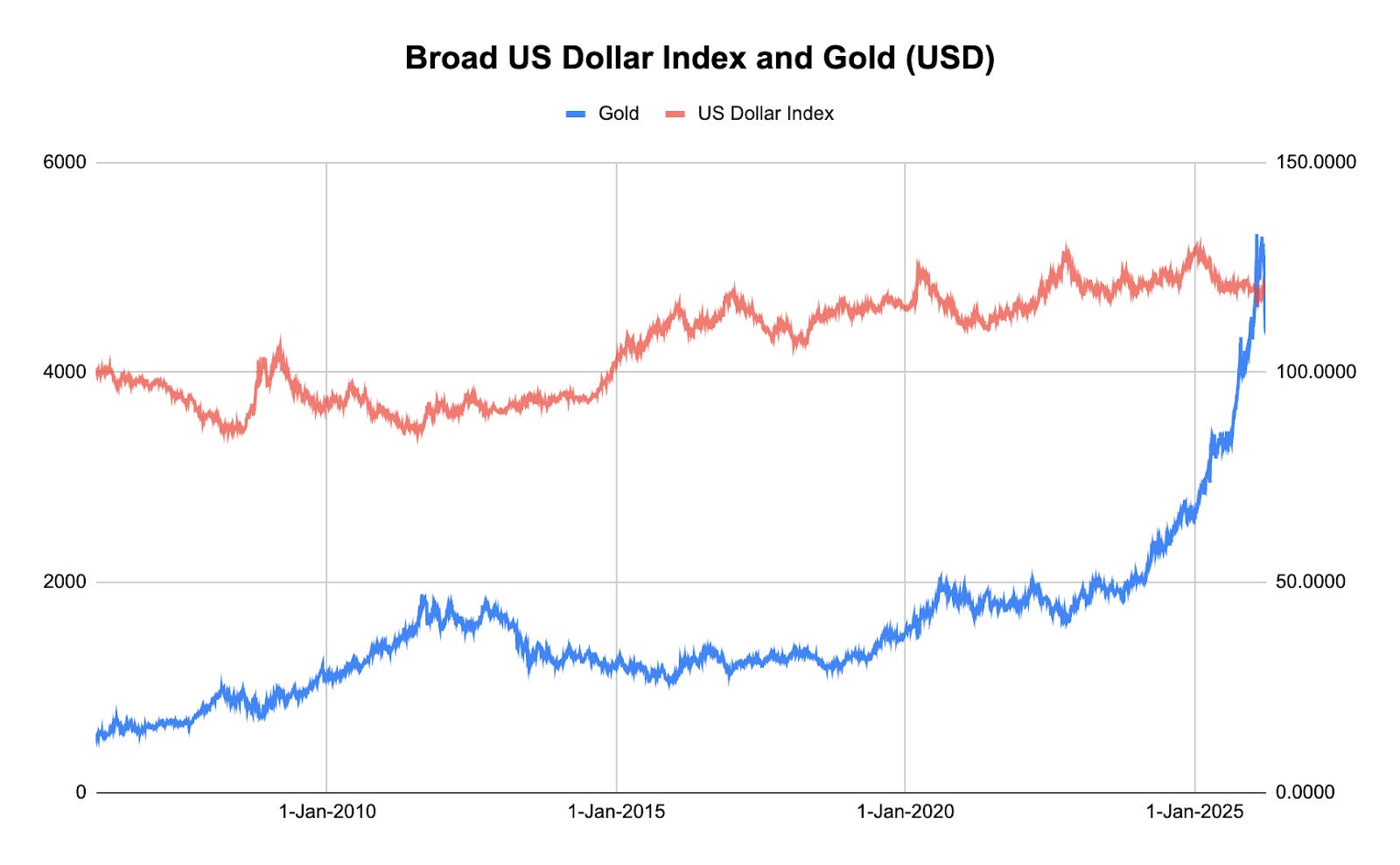
When we looked at the statistical correlation between the dollar and gold in the dataset, the value was -0.40. In simple terms, this means that gold and dollars have a moderate inverse relationship. Gold and the dollar move in the opposite direction, but even that relation is not perfect and not very strong.
In statistics, if you square that correlation (-0.40 x -0.40), you get a value known as R-Squared (0.16) This value means that the Dollar’s movement only explains about 16% of why Gold moves.
Moving away from statistics, we looked at a simpler metric: how often do they actually move in opposite directions?
Over the last 20 years, gold and the dollar moved against each other 65.9% of the time.
It basically means that for every 10 days the dollar rises, gold will likely fall about 6 to 7 times.
Volatility in Gold
We wanted to see how the 10-Year Treasury Yield environment impacts gold price’s stability. To do this, we compared two distinct scenarios in our 20-year dataset: a Low Yield environment and a High Yield environment.
We specifically looked at periods where yields were below 2% versus periods where they rose above 4% to see if Gold’s behaviour changed.
- The Low-Yield Test (Yields < 2%)
During periods where 10-year yields remained below the 2% mark, Gold showed a higher degree of price stability. The average daily price change was 0.03%.
In this environment, the opportunity cost of holding Gold is relatively low. Meaning, since traditional fixed-income assets provide minimal returns, there is less incentive for capital to move out of gold.
- The High-Yield Test (Yields > 4%)
When we looked at periods where yields were above 4%, the dataset showed a shift in Gold’s price movement. The average daily price change was 0.10%, which was over 3 times larger compared to the low-yield periods we tested.
This comparison might help explain why gold has been struggling recently.
After the US-Iran tensions started, bond yields began rising again. When bond yields rise, bonds start offering better returns, and investors have more incentive to move money into bonds instead of gold. This shift in capital can make gold prices more volatile and sometimes even push them down.
But there is one important thing to remember here.
High yields do not automatically mean gold prices will fall.
In fact, over the last few years, yields have been high, and gold has still risen.
This is because gold today is not driven only by interest rates. There are also structural factors influencing gold prices like central banks around the world buying gold, countries trying to reduce dependence on the US dollar, and geopolitical uncertainty pushing countries to hold more gold reserves.
So gold today is influenced by interest rates, the dollar, central bank buying, geopolitics, and global financial stability.
Historical Context: Significant Periods in the Dataset
The 2008 Financial Crisis:
During the early stages of the 2008 crisis, especially around the fall of Lehman Brothers, markets behaved in a surprising way.
Gold did not immediately rise. In fact, it fell for a bit (though it held its ground better than the stock market).
The reason was simple. Investors were not looking for safety. They were looking for cash. The US Dollar Index rose as investors sold assets across the board to hold liquid dollars.
It can be said that during extreme fear (in the initial stages), the US dollar becomes the preferred safe haven over gold. Gold cannot be used for immediate needs, but cash can be.
The 2011 Debt Crisis
In 2011, the US faced a credit rating downgrade, and Europe was dealing with a sovereign debt crisis.
Gold responded strongly and rose to its highest level at that time.
The key factor was interest rates. US yields were falling toward 1.5%. With such low returns, there was an incentive to hold gold. Gold saw steady gains with low volatility.
The 2020 Covid 19 Pandemic
When COVID first hit global markets in March 2020, something very similar to 2008 happened initially.
Gold actually fell in the first few days of the market crash. The dollar rose sharply as investors again rushed to hold cash.
But then something changed.
Central banks around the world cut interest rates aggressively, and US Treasury yields fell to less than 1%. With yields almost at zero, bonds were giving almost no return.
At that point, holding gold became attractive again.
So after the initial fall, gold rose significantly during the pandemic period.
The 2022 Russia-Ukraine War
The conflict following the Russian invasion of Ukraine followed the usual pattern.
Gold rose significantly as uncertainty increased.
Although the dollar remained strong, interest rates were still recovering from pandemic lows. Yields were typically in the 2.5% to 3.5% range and had not yet crossed the 4% level that becomes a major threshold.
Gold was able to rise despite dollar strength because interest rates were not high enough to pull investors away.
Gold Movements after a Crisis
One critical finding in this study was the performance of gold in the immediate 48-hour window of a crisis versus the next 30 days.
In the initial stage of a major shock (such as 2008, 2020), gold often experienced a price decline. This is due to institutional selling to meet margin calls and the immediate global demand for US Dollar liquidity.
Historically, gold only begins its ‘safe-haven’ climb once the initial panic for cash has stabilised.
The 2026 Reality
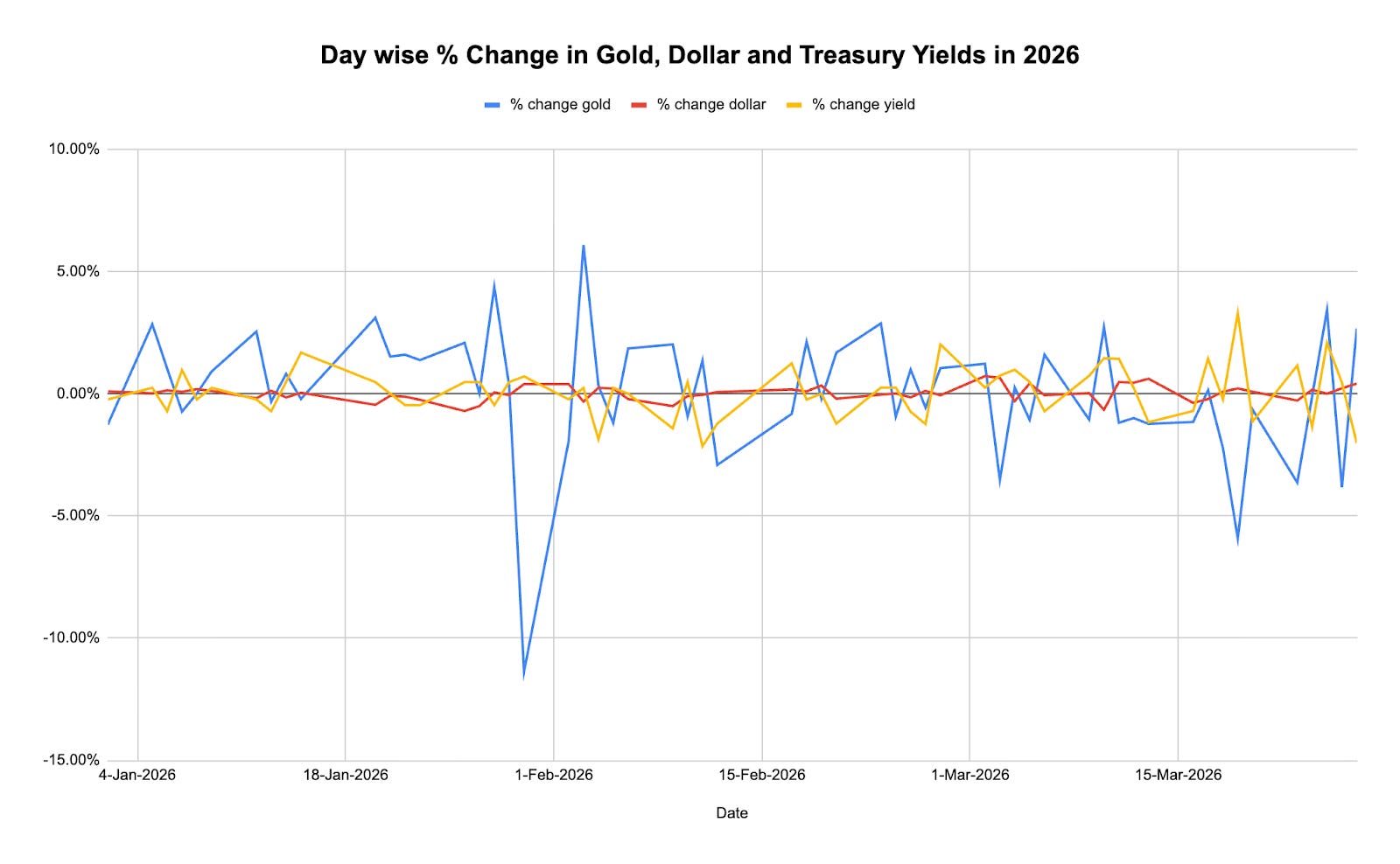
The US-Iran conflict coincided with the strengthening of the Dollar (a rise of 2.60% of the broad US dollar Index) which made gold expensive globally. High yields of 4.35% as of March 2026 means bonds are more attractive.
All of this could mean that gold is still in the liquidity phase. Moving money into bonds may seem more attractive than keeping in gold.
Conclusion
To say gold is not a safe asset anymore would not be fair. But the data from the last 20 years indicates that gold does not automatically rise during every conflict.
Its behaviour depends largely on macro conditions rather than just uncertainty itself.
At the same time, interest rates play a critical role in shaping gold’s attractiveness. When yields are low, gold faces little competition. But when yields rise meaningfully (even taking into account inflation) the opportunity cost of holding gold increases, making it less appealing relative to fixed-income assets.
The interaction with the US dollar further adds to this dynamic. In periods where the dollar strengthens alongside geopolitical tension, it can offset or even outweigh the traditional safe-haven demand for gold.
Gold’s performance is not driven by fear alone. It is shaped by the trade-off between liquidity, returns, and global capital flows.
Gold still remains a store of value, but not in isolation.
Limitations of the experiment
The study is based on historical data and identifies correlations between different factors, not causation.
It focuses mainly on the US Dollar and Treasury yields, while other factors like inflation, central bank actions, and investor sentiment are not fully captured.
The analysis is based on historical data. Market behaviour can change across different cycles, so past patterns may not always predict future outcomes.
Yield thresholds (such as 2% and 4%) are chosen benchmarks; different thresholds could lead to different results.
The findings should be viewed as indicative trends rather than fixed rules. Short-term market movements can deviate from observed patterns due to unexpected events or shocks.
Gold prices can vary across countries due to currency differences. This study uses USD-based prices and does not account for INR or other local currency effects.
It has been observed during 2020 onwards that whenever Gold prices are higher, there is no buyer in the market at the prevailing price and people having black money are buying it at the discount up to 25% of the market price. This is the reality of Corona I of 2020 .
Nice article!