

There were 510 actively managed equity mutual funds in the market in March, 2025.
Almost a third of them have been added in the past 4 years alone.
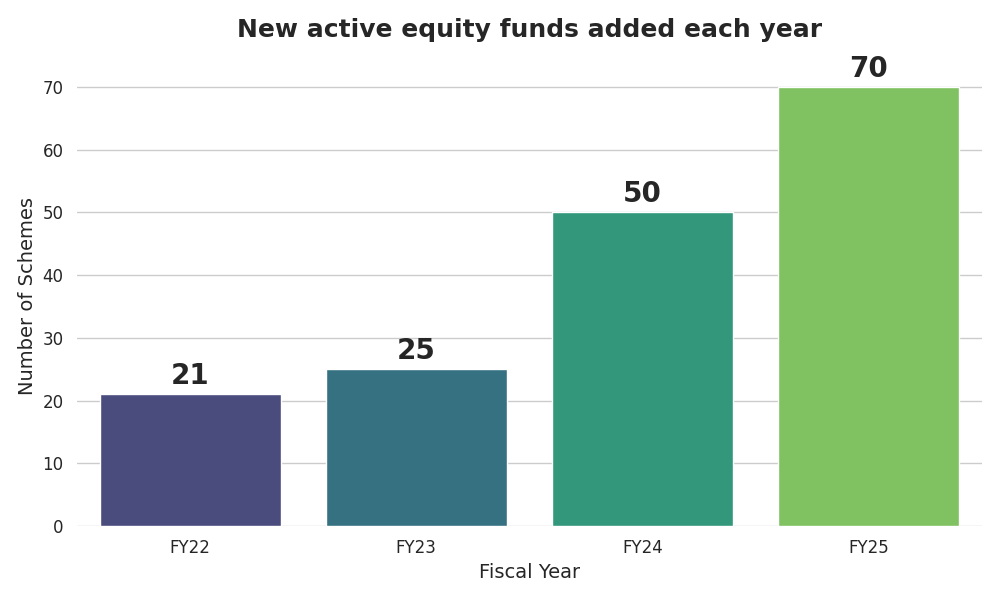
The Nifty 50 rose by almost 60% in the same interval.
So it seems that bull runs do bring a high influx of new schemes or NFOs (New Fund Offerings) in the market.
Now NFOs are for mutual funds, what IPOs are for companies, the gateway to enter the public market.
‘These days’, chances are that you will almost always find at least one NFO being open for subscription: https://groww.in/nfo
But is it worth investing in them?
Well, we don’t really know the answer to that.
But we tried testing a scenario, what would happen if someone indulged themselves in all NFOs in the last 19 years.
What does it mean?
Let’s say a new mutual fund comes up and you start doing a monthly SIP in it, but only until the next NFO hits the market.
Once that happens, you stop the old investment and start putting money in the new fund, and so on.
Now remember, we didn’t sell any of the older investments, and they kept compounding over time.
In this simulation, we have considered all NFOs of ‘active large-cap funds’ since 2006.
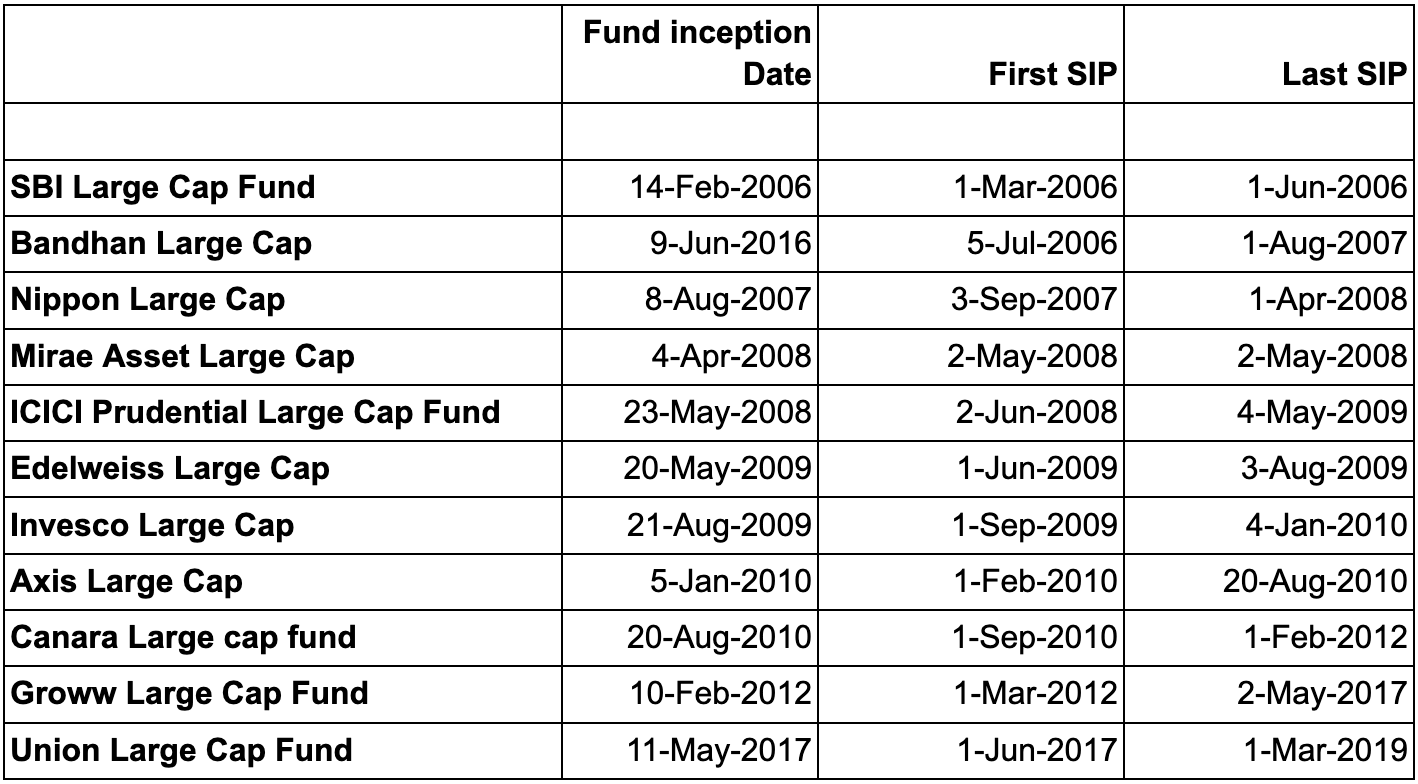
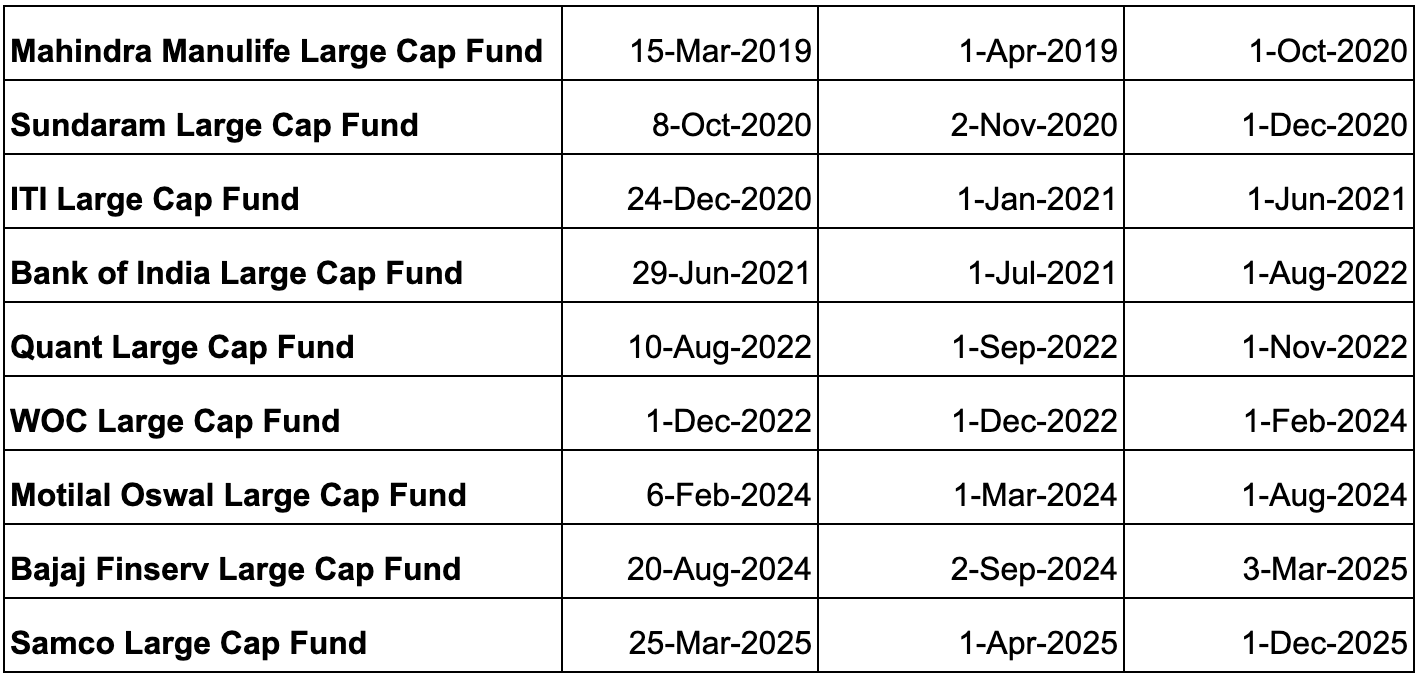
So we juggled across 20 funds in 19 years.

To really understand how this investment worked out, we need to have a benchmark, a reference for comparison.
So we compared it to a monthly SIP in SBI Nifty 50 Index Fund for the same duration.
And within the same timespan, the index fund grew up to become Rs. 86.29 Lakh.
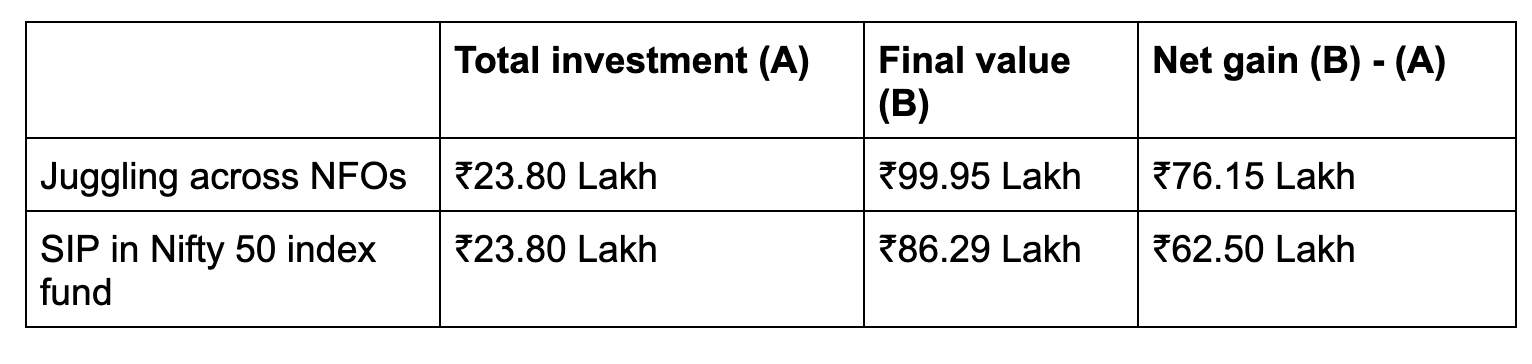
So juggling across active large cap funds generated an additional return of Rs 13.6 Lakh.

And the active funds managed to outperform the good old index fund SIP, as this method seems to have generated a decent alpha, or additional returns.
But there is more to it, for example, till date, a good chunk of active funds are known to have beaten the regular indices.
For example, as of March-2025, 40% of active large cap funds outperformed their respective benchmarks over a 10 year period.
Also, the active funds NFO had an additional upper hand for the case we tried out, as being a beginner to the market, the active funds had a small AUM(assets under management) compared to the continuously enlarging index fund.
And smaller sized active funds are usually known to be more agile and potent to generate higher returns, the contrary is true when the fund grows bigger, as it becomes relatively difficult to allocate large sums of money without affecting the market.
Additionally, do note, this simulation only considered large cap funds, and ran between 2006 and 2025.
The results may differ from what we have found here, if a different set of funds or timeline is chosen.
One more thing to note here is, that the outcome here is not supposed to be taken on the face value.
The probability of someone actually making realistic returns in the long term is actually by sticking to simple strategies (like disciplined SIPs), and ‘understanding what they are doing’.
Experimenting can theoretically prove beneficial once in a while; but what if the success was limited in just ‘those few cases’, and you simply happen to waste your time and money by experimenting further?
The simulation here is back dated, hence it has the liberty of checking what ‘could have happened’ but certainly not ‘what may happen’.
While this ‘What If’ scenario was nothing but a fun banter over a highly unlikely situation, let us know in the comments if you would want us to try some other wild ideas.
Note:
The outcomes of this simulation are based on the new large-cap active funds. Results may vary if a different fund category is selected.
Final investment values are as of December 9, 2025.
The results shown here are specifically tied to the chosen period (March 2006, to December 2025); outcomes may vary if a different timeframe is selected.
The calculation of all mutual fund returns is based on their Regular-Growth variants.
The dates for SIP investments sometimes differed slightly by a few days between the index and active funds. This is because the Ace MF system, the data sourcing tool we used, occasionally omitted certain NAV dates for some of the funds.
Great 👍