

There are countless debates about the best way to invest in the market.
Each investor has their own style of investing. Some look at earnings, some look at growth, and some look at stability.
So we wondered, what if we invested using two very different strategies in the Indian market?
We decided to compare 2 indices: the Nifty Alpha 50 and the Nifty100 Low Volatility 30.
These indices act as proxies for two different sets of stocks, representing high-momentum winners and stable low-volatility performers, respectively.
The Nifty Alpha 50 tracks 50 stocks that delivered the highest alpha over the past year, aiming to capture strong momentum (Alpha measures how much a stock or portfolio outperforms its benchmark. In this case, Nifty 50).
The Nifty100 Low Volatility 30 selects 30 stocks from the Nifty 100 that move the least, prioritising stability and lower risk.
Why compare these 2 indices?
These 2 indices are widely different investing approaches.
The Alpha 50 focuses on recent market winners, aiming for higher returns, while Low Volatility 30 chooses stable stocks that move less, prioritizing safety.
Low Volatility 30 sticks to the top 100 large-cap stocks, offering safety and consistency, whereas Alpha 50 looks at the top 300, including mid-caps, which gives exposure to faster-growing but potentially riskier stocks.
The goal is to see if the higher returns of alpha are worth the extra risk, or if slow and steady actually wins the race.
The Experiment
We compared historical data of the two indices from January 2015 to February 2026, a period of 134 months.
Let’s imagine an investor who put Rs 1 lakh into each index in 2015.
This is how the returns look like.
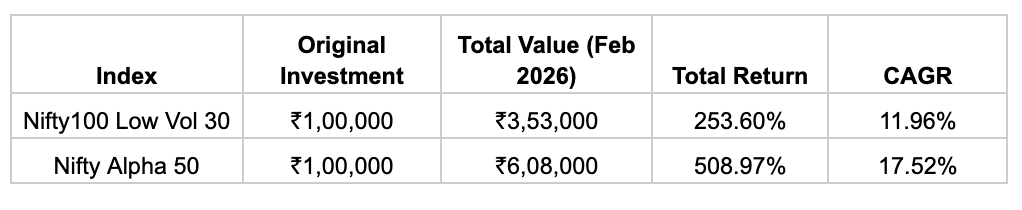
Over the decade, the Alpha 50 index gave nearly double the Low Volatility returns, with a CAGR of about 17.5% vs 12%.
But returns alone don’t tell the full story.
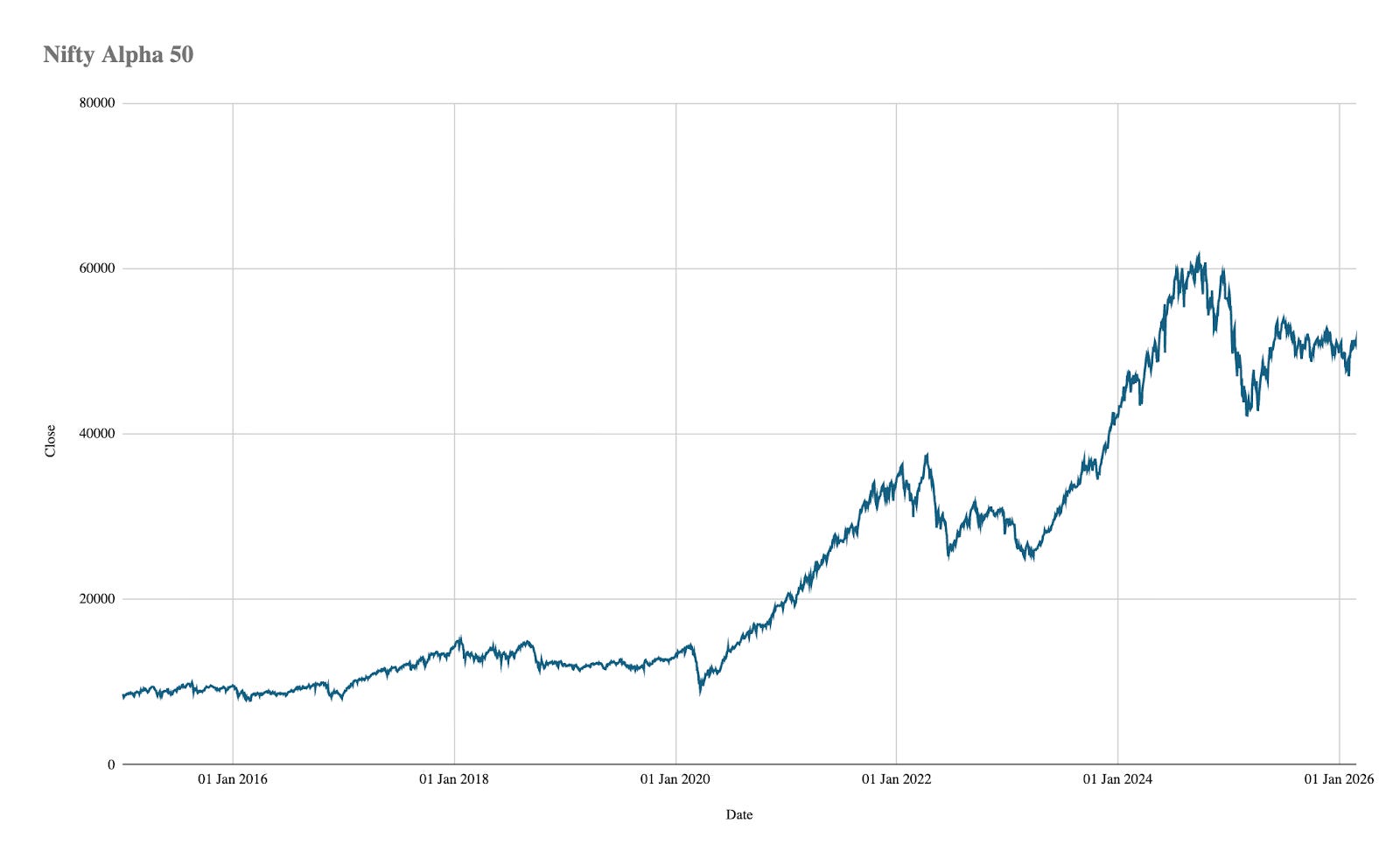
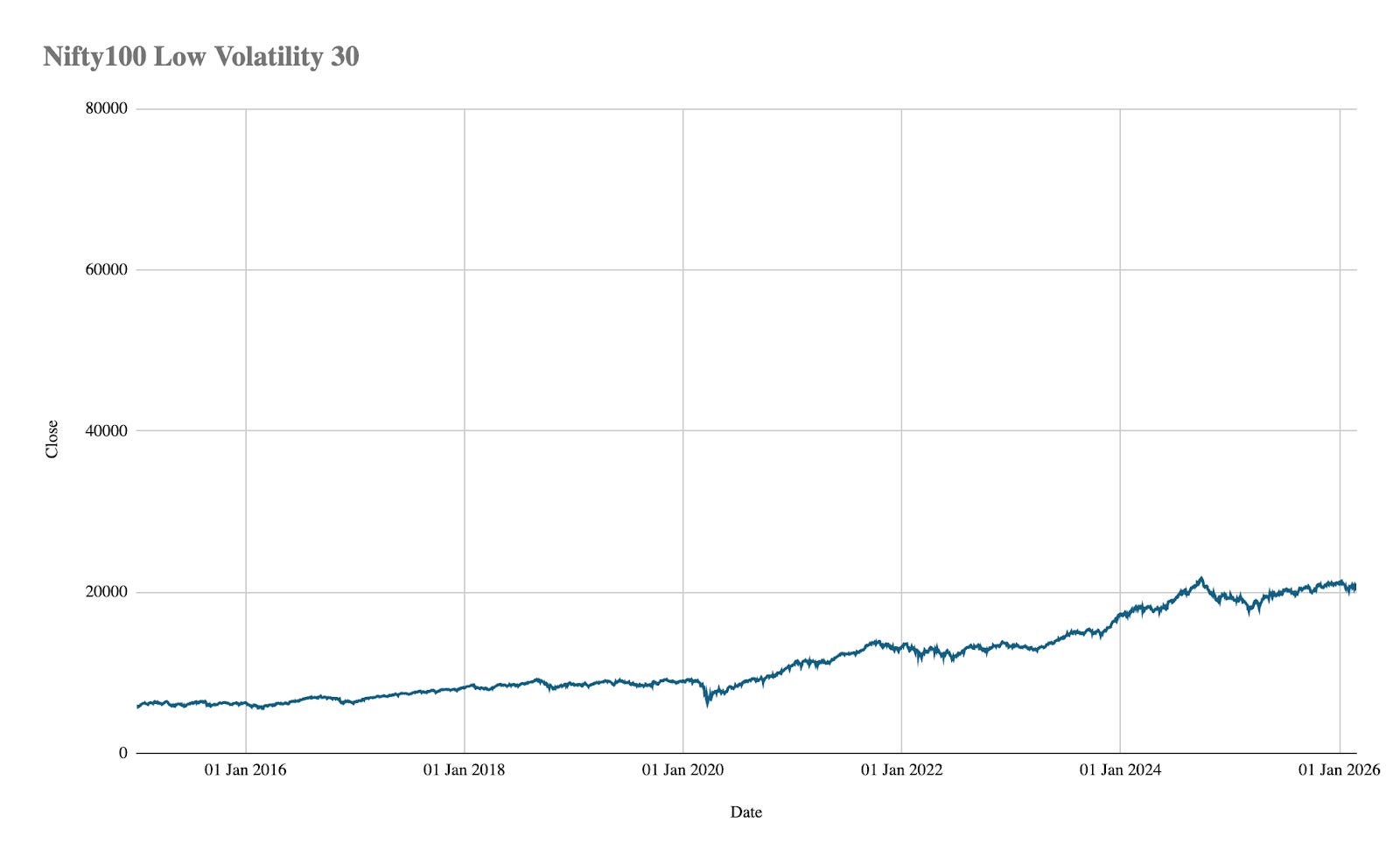
Logically, we know this because the Alpha 50 index focuses on stocks which are able to grow faster during bull markets.
At the same time, this strategy carries higher risk, meaning the swings (both up and down) are much sharper than a low volatility approach.
Understanding the Risk
To see the real difference, we looked at maximum drawdown, which is the largest drop the indices experienced from peak to trough.
During the 2020 COVID-19 crash,
Nifty Alpha 50 fell 38.3% in around 32 days.
Nifty100 Low Volatility 30 fell 31% in the same period.
Recovering from these drops isn’t symmetrical.
Mathematically, after a 31% drop, Low Volatility needed a 45% gain to break even, whereas Alpha 50 needed a 62% gain.
In practice, Alpha 50 took two months longer to recover and reach its previous position.
Daily Volatility and Single-Day Shocks
The difference in daily swings makes the risk more tangible.
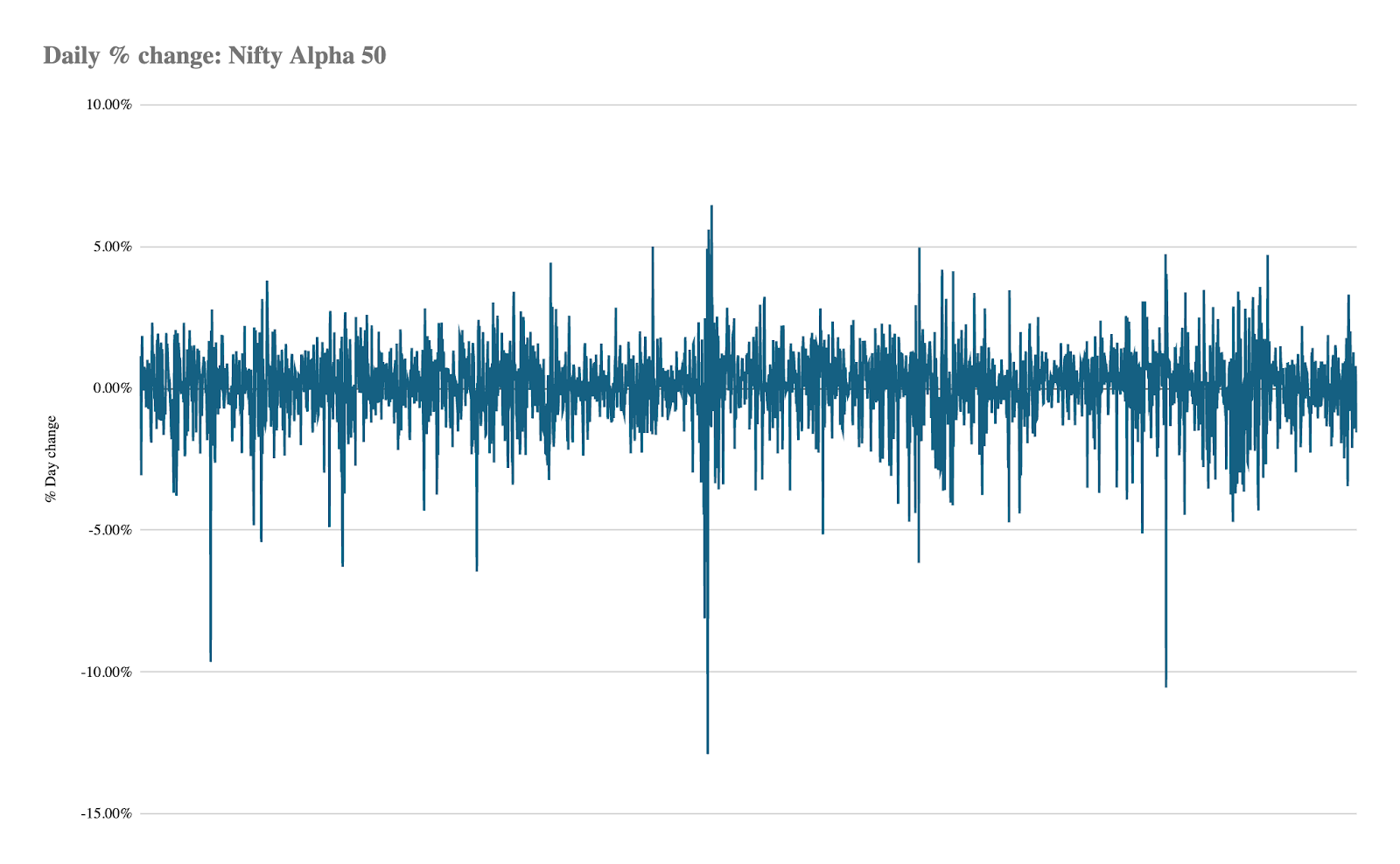
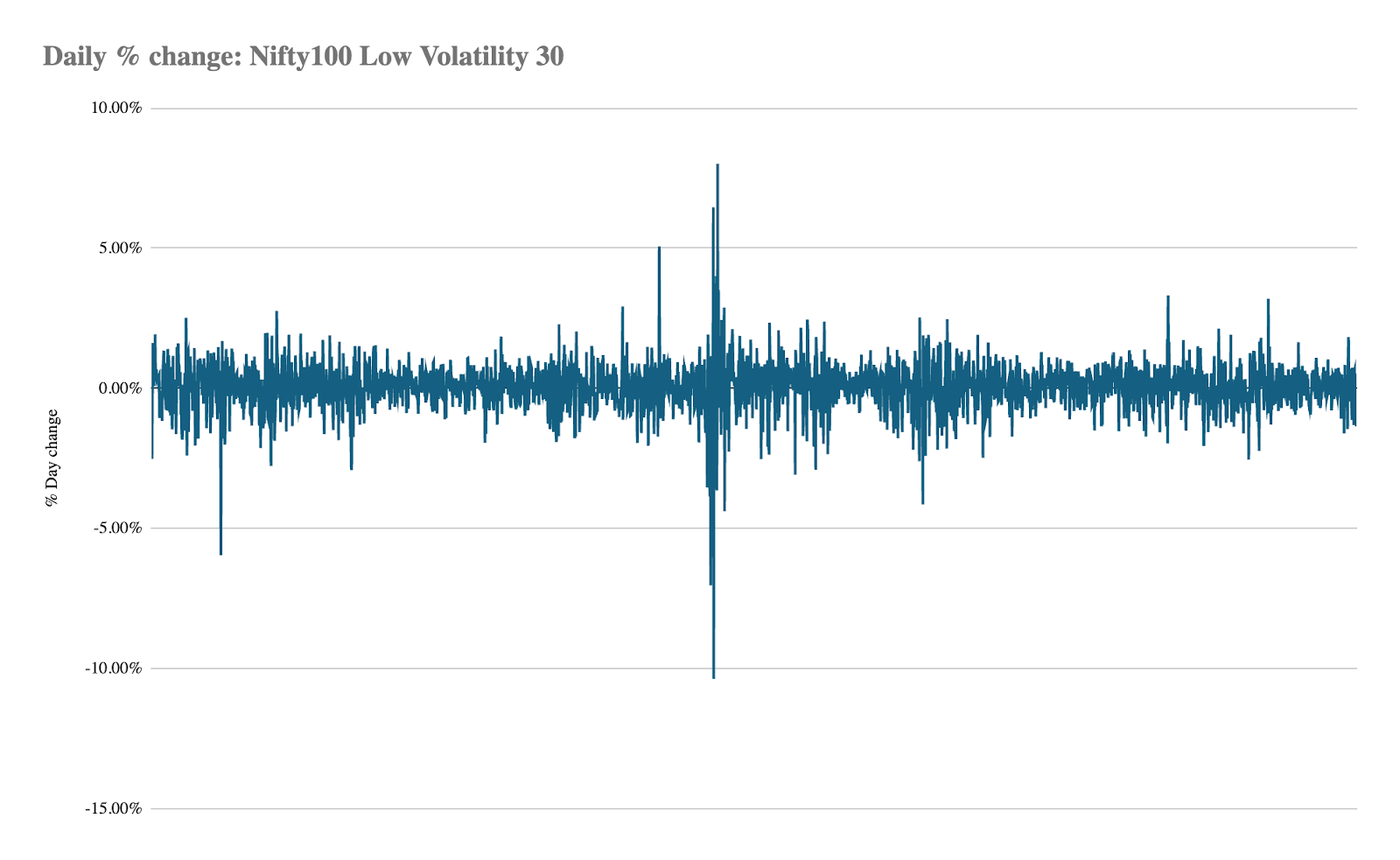
On most days, Low Vol 30 moves less than 1%. Alpha 50, however, swings more frequently, creating rapid gains but also sharp drops.
Some notable examples:
June 4, 2024 (General Election results): Alpha 50 dropped -10.55%, Low Vol 30 fell -1.97%.
March 23, 2020 (COVID panic): Alpha 50 fell 12.89%, Low Vol 30 fell 10.37%.
2024-2026 peak-to-trough: Alpha 50 dropped 17.7%, Low Vol 30 fell 5.4%.
Here is a side-by-side comparison of the daily changes of the 2 indices:
The Verdict: Two Paths, Two Priorities
This 11-year experiment shows that both strategies ended up in the green, but they offer very different experiences for an investor’s portfolio and peace of mind.
There is a clear difference in final wealth. Alpha 50 turned Rs 1 Lakh into Rs 6.08 Lakh, nearly double Low Vol 30’s Rs 3.53 lakh.
But this gap in reward came with something we can call a ‘stress tax’. During volatile periods, an Alpha investor may see 10% of their portfolio value vanish in just a few days — a scenario that occurred with the calmer Low Vol stocks very rarely.
The indices also grew wealth in different ways. Even during the shaky markets, Low Vol offered a smoother path than the Alpha 50, cushioning the portfolio against sharp downturns.
Timing matters too. A Low Volatility investor can generally predict a range for their portfolio at any given time, while an Alpha investor faces “timing risk.” For example, withdrawing in 2025 could have meant selling at an 18% loss, whereas Low Vol investors would have seen much smaller declines.
The best strategy isn’t necessarily the one with the highest returns on paper, but the one an investor can stick with. Alpha 50 offers a high-performance ride for those who can tolerate turbulence. Low Volatility 30 provides steadier, more predictable growth, prioritising capital protection and consistency.
In the world of compounding, momentum can create higher wealth, but stability may make it easier to stay invested.