

Before every major IPO, there’s always a buzz around one number, the Grey Market Premium (GMP).
It’s not official, it’s not regulated, but it’s widely watched.
The Grey Market Premium (GMP) is the unofficial price at which IPO shares trade before they list on the stock exchange.
It reflects early demand and market sentiment even before the stock begins formal trading.
People often treat it as a preview of how the stock will list and how much would they profit from the listing gains.
So we asked a simple question:
Does GMP actually hint at the listing day gain?
To answer it, we looked at large IPOs, with issue size > Rs 5,000 crore, from 2016 to 2025, comparing their GMP (one day before listing) with the actual listing performance.
Since the size of these IPOs was above Rs 5,000 crore, it signalled an already established and considerably large business of the company going for the IPO.
We found around 30 such IPOs for which we could find some sort of GMP figure.
Take a look at the table below showing the GMP and listing gains these IPOs:
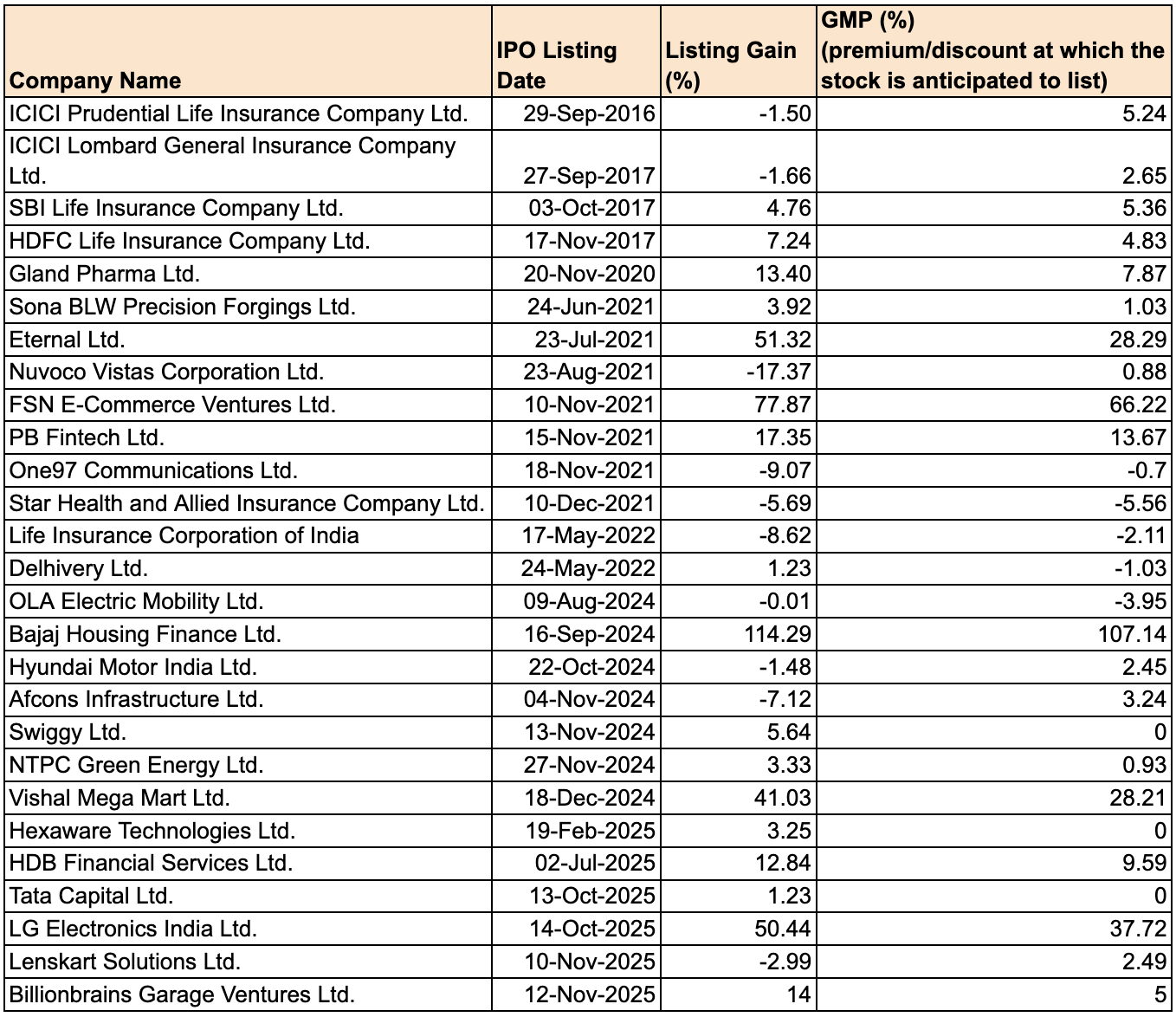
Across the dataset, we noticed a clear trend:
IPOs with high GMPs are usually listed strong.
And IPOs with very weak GMPs mostly showed muted listings.
When sentiment is strong, people are willing to pay more in the unofficial market — and that often shows up on listing day too.
Where things get a bit tricky
Even though the overall trend is clear, the finer details show why GMP should be read with care.
1. Low GMP is noisy
When GMP was 20-30% or higher, the IPO often listed strong.
But when GMP was below 5%, the outcomes were mixed:
Some listed in mild profit
Some were flat
Some even listed in the red
So low GMP doesn’t predict anything clearly.
2. Positive GMP doesn’t guarantee a positive listing
Some IPOs showed a small positive GMP but were still listed at a loss.
This happens when broader market sentiment turns weak at the last minute.
3. Zero GMP doesn’t always mean a dull listing
A few IPOs with zero GMP still managed modest positive listings.
This usually happens when grey-market activity is low but institutional demand is steady.
4. GMP reflects emotions, not fundamentals
GMP can jump simply because:
markets are in a good mood
liquidity is high
there’s hype around the company
And it can stay low even when a company is fundamentally strong.
So GMP is a sentiment indicator, not a quality indicator.
What investors should take away
GMP is helpful, but only in the right context.
Strong GMP (>20%) → probable chance of a strong listing
Moderate GMP (5-15%) → could go either way
Low or zero GMP → don’t make assumptions;
dig deeperSudden GMP changes → often reflect market mood, not company quality
But before applying these findings to every kind of IPO, it’s crucial to understand where this analysis does NOT apply.
Here are the key limitations, explained simply:
The study covers only large IPOs (Rs 5,000 crore+)
All the IPOs in this dataset belong to one category — very large issues. These IPOs generally attract higher institutional participation and more mainstream attention.
But many mid-sized and small IPOs behave very differently. So the insights here cannot be applied blindly to smaller IPOs.
GMP works differently when markets are volatile
The grey market is extremely sensitive to last-minute market moods.
If the market falls sharply a day before listing, GMP may no longer represent reality.
Our dataset includes IPOs from calmer periods and turbulent periods — but the analysis does not model how volatility affects GMP predictability.
GMP itself is an unofficial, unregulated indicator
GMP comes from informal trading channels and:
does not include large institutional trades
may be driven by hype
can be manipulated in rare cases
may not reflect long-term investor sentiment
So GMP is not a reliable or audited metric.
It’s simply a “‘temperature check’ of the IPO about to get listed.
Some IPOs in the list had very low or zero GMP
Several IPOs showed 0-5% GMP because the grey market was quiet, not because there was no demand. Institutional investors often don’t participate in the grey market, so low GMP may understate real demand.
The sample size is limited
Even though we covered almost a decade of data, the number of very large IPOs is still small (around 30).
This is not enough to generalise across all sectors, all market cycles, and all IPO types.
GMP does not incorporate fundamentals
A company with excellent fundamentals can have a low GMP if market mood is weak. A company with aggressive pricing can have high GMP during bull phases. Our analysis does not account for valuation, sector prospects, or financial strength.
Listing gains are affected by external events
Corporate news, policy announcements, global events, and market-wide moves can all impact listing day behaviour ,which is independent of GMP.
Grey market data quality may vary
GMP numbers are collected from publicly available sources and reported informally. Different trackers may show slightly different numbers. The study tries to arrive at a fair GMP estimate for older IPOs, but grey-market data always carries noise.
Why understanding these limitations matters
GMP can be directionally useful, especially for large, high-profile IPOs; but it is not a universal predictor.
It should be used as a sentiment indicator, not a guarantee or a basis for investment decisions.
These limitations make it clear that:
GMP should supplement analysis, not replace it.
Past trends do not assure future behaviour.
Every IPO needs its own deeper evaluation.