

March 2012.
Apple did something it had not done for 17 years. It announced a dividend.
Apple last paid a dividend in 1995. The next year, it posted a net loss of $816 million and came close to collapse.
In 2012 things had changed. Apple was sitting on a record-breaking cash pile of $98 billion on its balance sheet.
The company that had once struggled to survive now had more money than it knew what to do with.
For investors, the dividend announcement seemed like a green light. Because a dividend basically is cash leaving the company and landing in investors’ bank accounts.
A company that did not pay any dividend for 17 years would not suddenly start doing so unless it was confident about its future.
So what happened next?
Sure enough, 6 months after the dividend, the stock went up around 30% and hit an all-time high.
But interestingly, by April 2013, it fell more than 40% below that peak and only got back near that high in August 2014.
The company’s recovery was real and so was the dividend it announced. But by the time the cheque arrived, the market had already paid for the good news.
That got us thinking if a company restarts dividends, does it always have the same fate as Apple? Apple is one company in one market. What about India?
We decided to test it for Nifty 500 companies.
What if you had bought every company that started paying dividends again? Would you have beaten the market? Or was the good news already in the price by the time the dividend arrived?
The Study
We looked at the current Nifty 500 companies and pulled their dividend history for every financial year from FY2009 to FY2026.
Then we identified two moments:
A comeback: when a company pays a dividend after paying nothing for at least three financial years in a row, having paid one at some point before that.
A first dividend on record: a company pays a dividend for the first time since FY2009, after at least three years of paying nothing.
We also required each company to have been listed for at least three years before the moment, so the market had actually watched it go without dividends.
That gave us 71 moments across 67 companies, 47 comebacks and 24 first dividends. Through the rest of this article, “restart” covers all 71 moments. The typical company in the list had gone six years without paying anything.
We assumed you bought each stock about two months after the financial year in which the dividend came back (more on this in the limitations). Then we tracked it for 3, 6, 12 and 24 months after buying, and looked back at the 12 months before.
The most obvious benchmark for comparison is the Nifty 500 index. If a stock beats this index, it would look like a positive signal.
Except, there is a catch.
Every company in our list is in today’s Nifty 500. That means every one of them survived and grew enough to be among India’s 500 biggest listed companies in 2026. Companies that restarted dividends and then collapsed are not in our list at all.
A group of survivors will look good against the index, whatever the dividend did. So we added a second benchmark: peers, meaning all the other companies in today’s Nifty 500.
For every moment, we took the average price return of all the other stocks in today’s Nifty 500 over exactly the same dates.
If restart stocks beat their peers, the dividend is telling you something. If they only beat the Nifty 500, the win probably comes from being a survivor.
Did the market already know?
Before getting into what happened after the dividend, we dug into what happened before it.
For a company to restart paying dividends, its profits have to come back first. Indian listed companies report their earnings quarterly. So better profits show up in quarterly results months before the board announces a dividend.
The earnings are widely tracked by the market, especially analysts and institutional investors.
So we wanted to check if the investors already had an idea of the possibility of a dividend, which could then move the stock price.
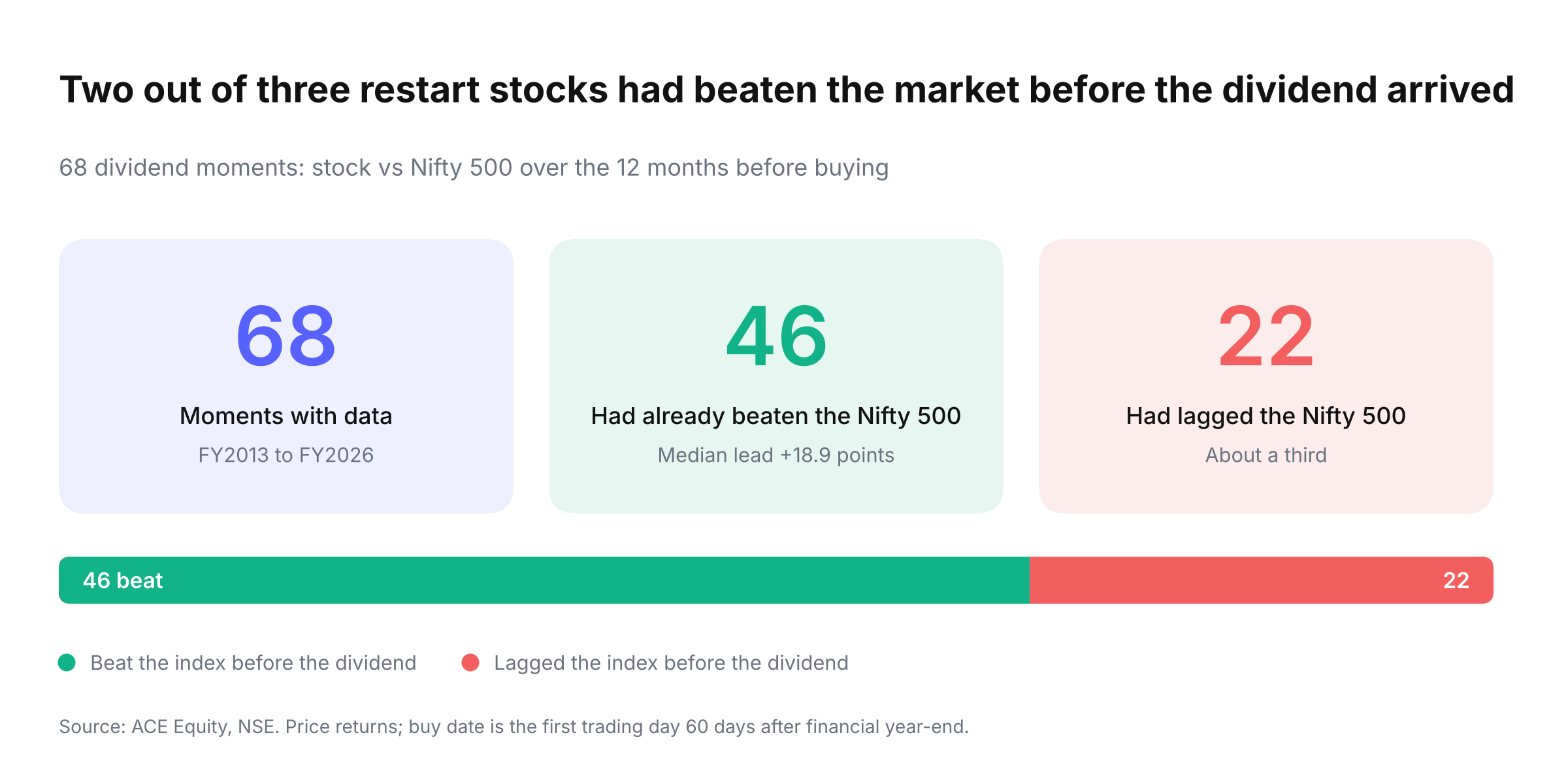
And that did seem to be the case. In the 12 months before our investor could buy, the typical restart stock rose 39.9%. The broader Nifty 500 rose 11.4% in the same period.
Two out of three restart stocks had already beaten the market by the time our investor could buy. They even managed to beat their fellow survivors more often than not.
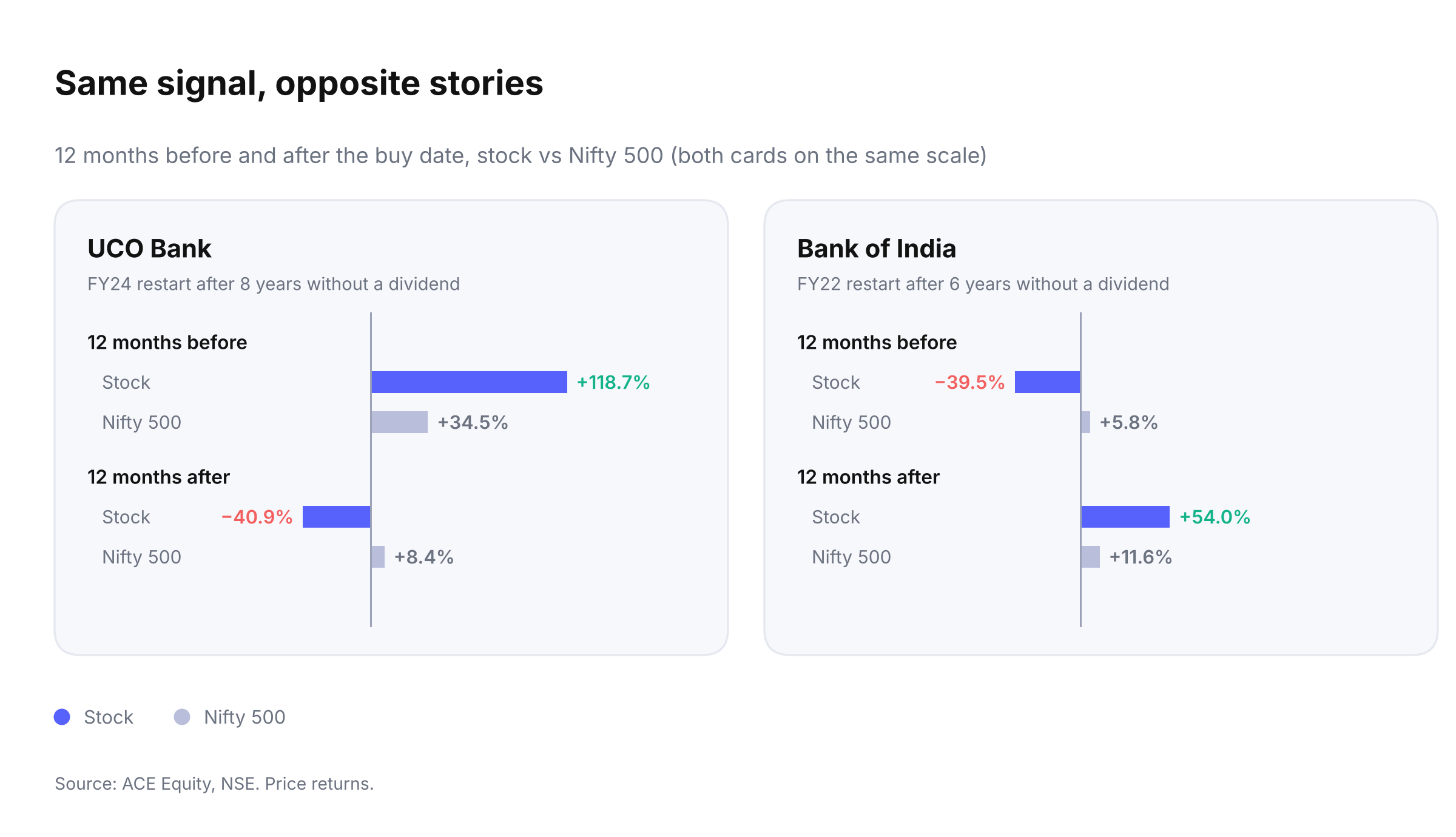
UCO Bank shows how this played out. It restarted its dividend for FY24 after eight years without paying one. In the 12 months before our investor could buy, the stock had more than doubled, up 118.7%. The Nifty 500 rose 34.5% in this period.
In the 12 months after our investor bought, it fell 40.9% while the index rose 8.4%. The good news had been priced in, and then some.
But not every restart came after a rally. About a third of them had lagged the market in the year before.
Bank of India is a good example of this. The bank restarted its dividend for FY22 after six years without paying one.
In the 12 months before our investor could buy, the stock had fallen 39.5% while the Nifty 500 rose 5.8%. In the 12 months after, it rose 54.0%, against 11.6% for the index.
So should you look for the dividend restarts the market had ignored?
Of the 19 restarts that had lagged the Nifty 500 in the year before, 58% beat the Nifty 500 over the next 12 months.
Of the 45 that had already beaten it, 64% did. So the restarts the market had ignored did slightly worse, not better.
Dividend restarts did not reveal the turnaround but the share price had been reporting it for a year. By the time our investor could buy, the market had already priced most of it in the stock price.
This is all about what goes on before our investor could buy, but what follows after the dividend restart?
What happened after the restart?
When we looked at the performance of the dividend restart stocks after the buy date, at first glance, buying on the dividend signal looked effective.
Over a 12-month holding period, the typical restart stock generated a median return of 29.8%, and the typical restart beat the Nifty 500 by 21.4 percentage points.
If held for 24 months, this lead expanded to a massive 34.1 percentage points.
But, measuring these stocks solely against the Nifty 500 creates a survivorship bias. So we also compared the performance to the average return of all other current Nifty 500 stocks over the exact same dates (peer comparison).
The results were flipped!
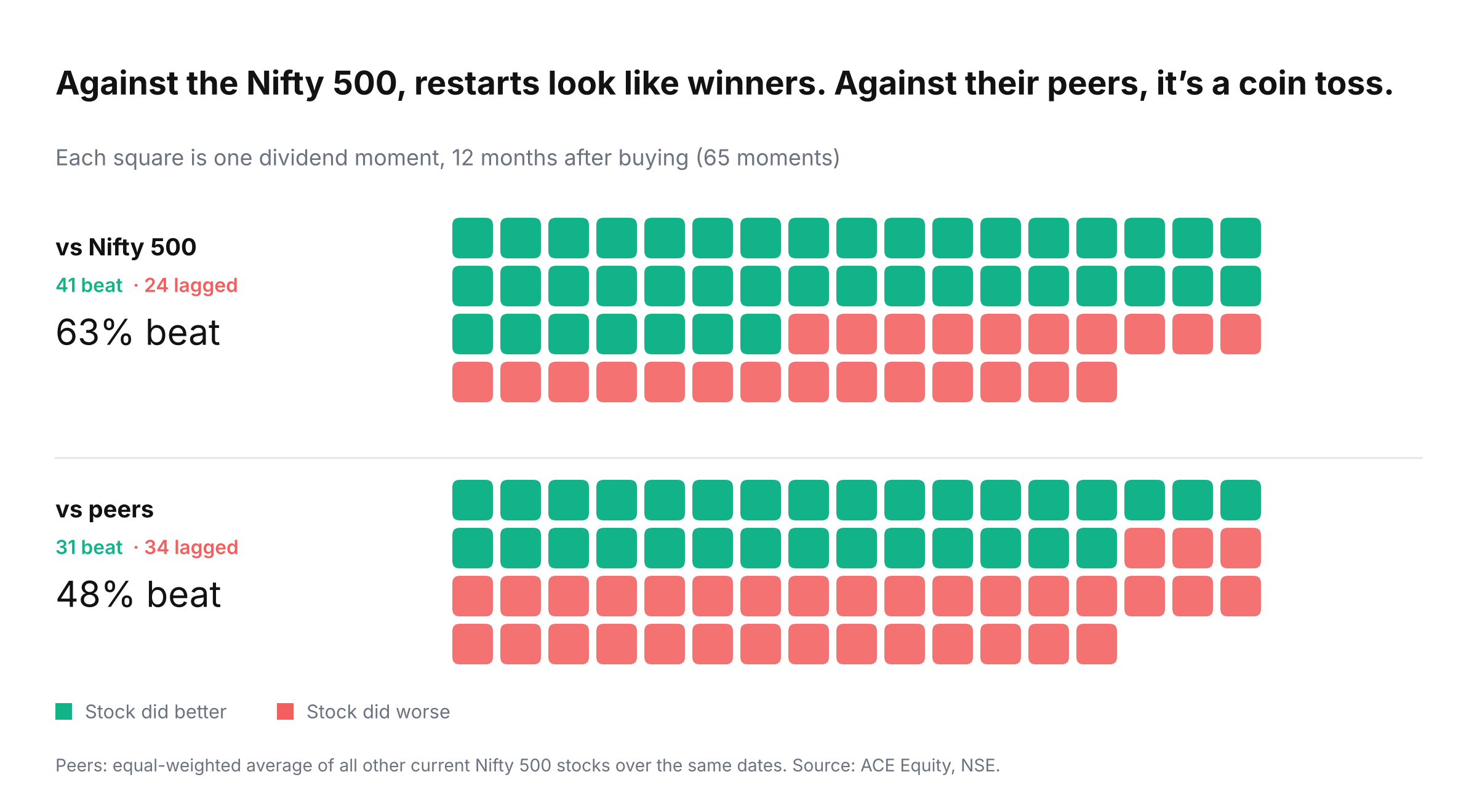
Against its peer group, the typical (median) restart stock lagged at every single holding period of our study: by 3.3, 3.8, 5.6 and 14.3 percentage points at 3, 6, 12 and 24 months. Fewer than half beat their peers at any holding period.
On average across these 12-month windows, peers rose 32.7%, against 13.1% for the Nifty 500 index. On the same average basis, restart stocks rose 46.6%. Averages are pulled up by a few big winners (more on that below), which is why we compare the typical (median) stock.
Why did the narrative flip in the peer comparison?
The restart stocks did not win because they brought back their dividend but because today’s Nifty 500 companies, as a group, beat the Nifty 500 index anyway.
The restart stocks are all companies that made it into today’s index, so a large part of the outperformance is simply looking at the data in hindsight.
So the dividend restart was not what made these stocks win. Being a company that would later grow into the Nifty 500 was. And nobody could know on the day they bought which companies would make it into the Nifty 500 years later.
Another interesting finding is that a handful of stocks did spectacularly well.
While the average 12-month lead over the Nifty 500 was an impressive 33.5 points, this was pulled up by a few stocks riding sector tailwinds.
Jupiter Wagons and Titagarh Rail Systems, for example, restarted dividends in FY23 and grew 331% and 287% in the 12 months that followed. But this was not just an outcome of the dividend signal.
Both make railway wagons. The Union Budget 2023-24 set a record Rs 2.40 lakh crore capital outlay for the railways and raised the allocation for rolling stock about 2.5 times, from Rs 15,158 crore to Rs 37,581 crore.
That budget came on 1 February 2023, before our 30 May buy date, so it helps explain why both stocks had already more than doubled in the 12 months before our investor could buy.
Stocks like these pull the average up. A restart picked at random would typically have done far less well.
So against the market as a whole, restart stocks looked like winners. Against companies that also made it into today’s Nifty 500, they were a coin toss.
But our 71 moments mix two very different kinds of company: ones coming back after years of trouble, and ones paying a dividend for the first time. Did the market treat them differently?
Comeback vs First Dividends
Like we saw in the case of Apple, a company coming back to dividends or restarting dividends tends to signal that it is out of the financial stress it was experiencing.
In our data, 37 of the 71 moments came between FY2021 and FY2024, after the Covid crash.
But the company that announces its first dividend is telling a different story altogether.
A company that announces its first dividend usually signals a transition in its business cycle from growth to maturity, where it now generates more cash than it can reinvest.
For a high-growth company, that can also mean its best reinvestment opportunities are behind it.
To see which narrative the market favored, the study split the 71 moments into 47 comebacks and 24 first dividends.
Comebacks turned out to be the winners.
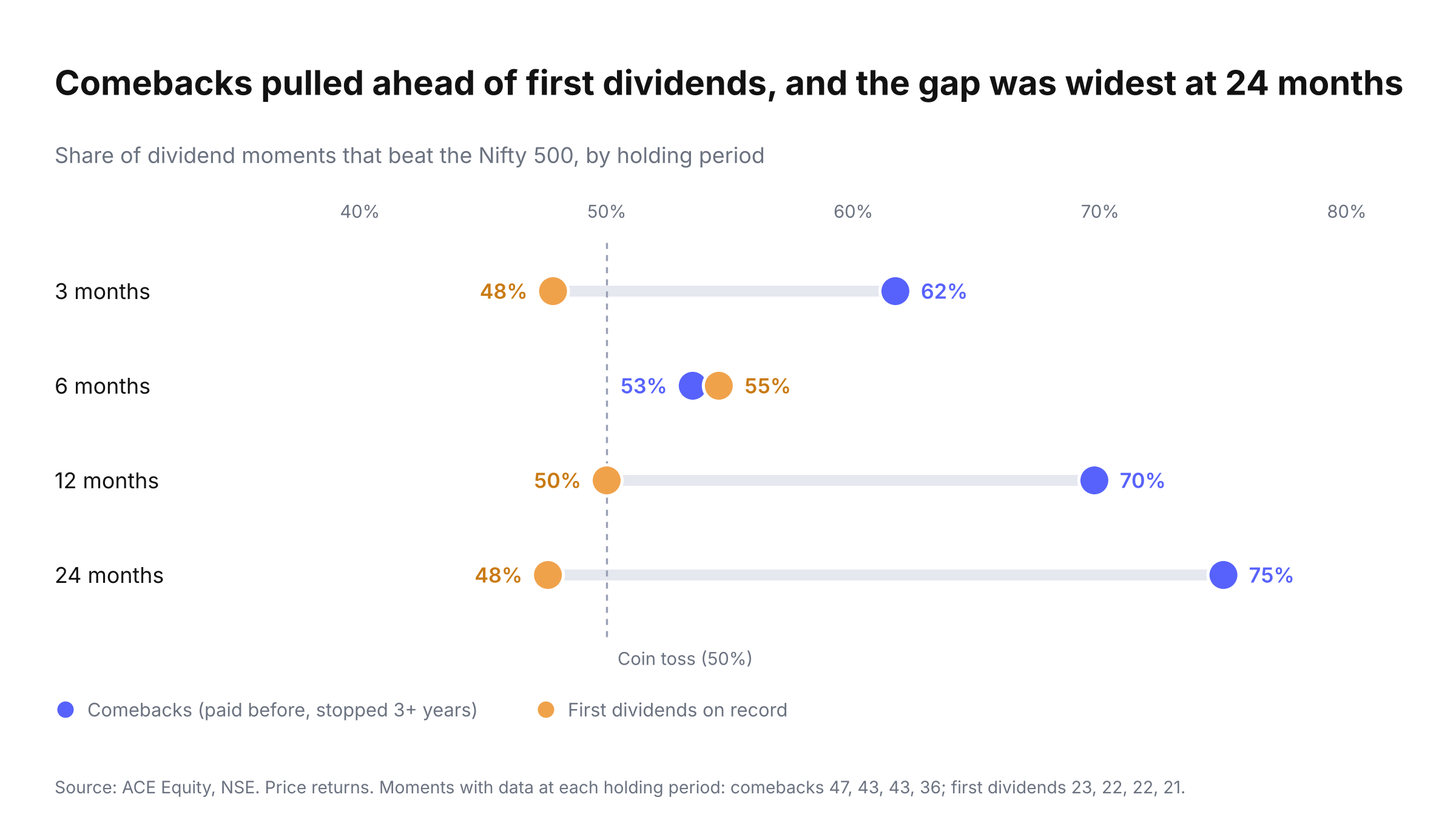
Three out of four comeback stocks beat the Nifty 500 index over a 2 year period. The median lead over the index was 82.9 percentage points.
Over two years, first dividends only matched the index, with exactly half beating it, and clearly lagged their peers. One reason for this could be that as companies transitioned from growth to maturity, the market may have repriced them downward.
Only 32% of first-time dividend payers managed to beat their peers, lagging by a severe median of 24.0 percentage points over a 2 year period.
Despite its massive outperformance, comebacks only managed to match their Nifty 500 peers, winning exactly 50% of the time in the 2 year period.
This means that when compared to the peer group, being a comeback made a stock no worse than other future Nifty 500 constituents, but importantly, no better either.
In other words, the dividend itself did not provide an edge over comparable surviving companies.
A dividend restart or a comeback stock is a moment in the market for sure as it signals a recovery, but does this restart mean that the company is going to continue paying dividends?
Did they keep paying after years of not paying?
A dividend restart indicates a company’s recovery if the financial health that funded it remains sustainable.
If a company pays a dividend as a restart but then goes quiet again, the payout may have come from a one-off gain rather than a lasting turnaround.
To test this, we checked whether each company paid a dividend again in the following financial year, and compared their 12-month market returns.
Restarts from FY2026 were excluded from this specific test, as their subsequent financial year had not yet ended by the study’s cutoff.
The results split sharply on one thing: whether the dividend continued.
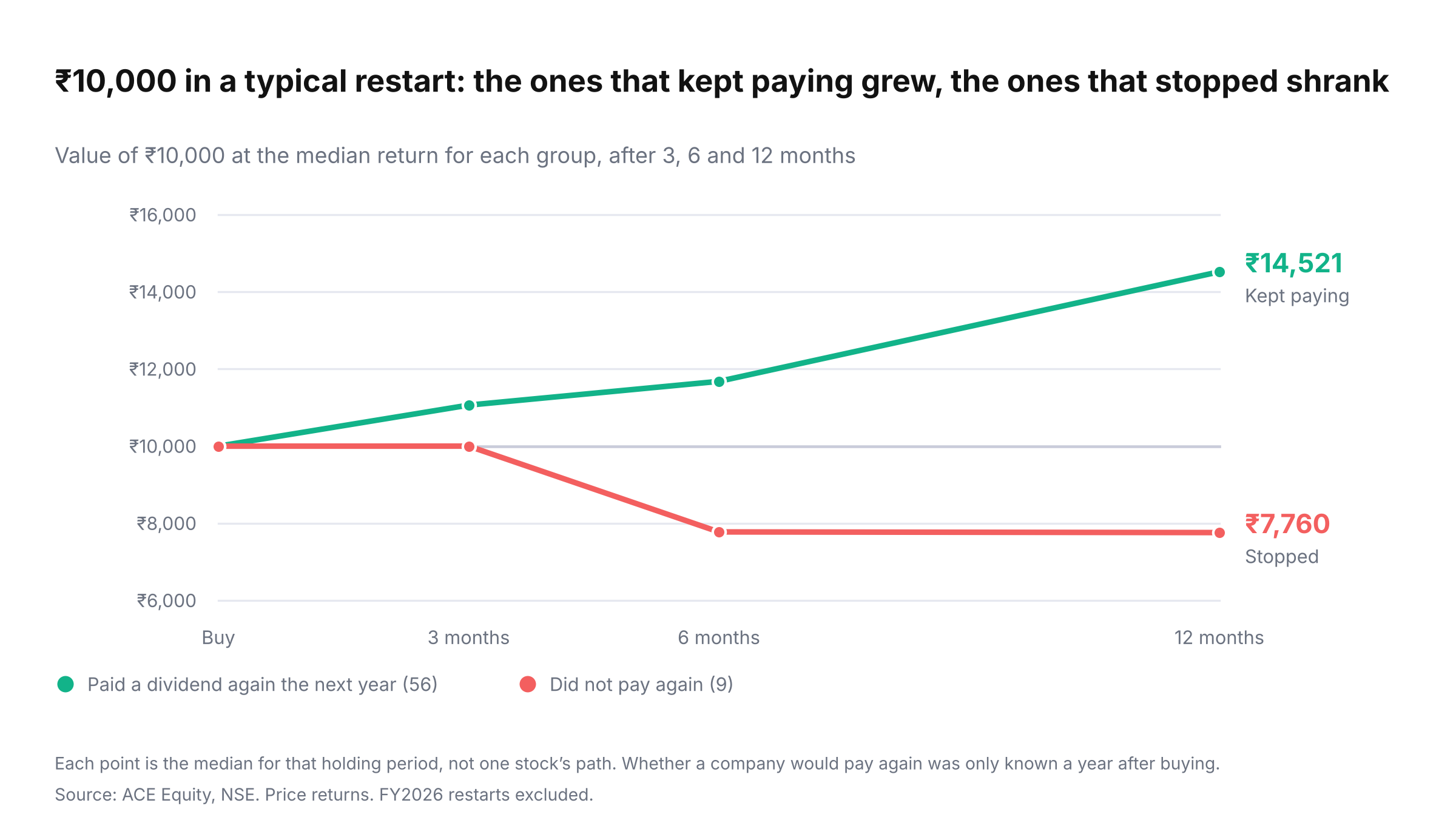
Companies that kept paying dividends beat the Nifty 500 seven times out of ten. On the other end of the spectrum, the companies that stopped paying mostly lost money, with a median fall of 22.4% over 12 months.
They beat the broader index only about two times out of ten, and when compared to their true surviving Nifty 500 peers, they won only 11% of the time, which is just once in nine moments.
Jaiprakash Power Ventures restarted dividend for FY14 after 4 years which could be considered by some investors as a green light, but they did not pay a dividend the next year.
In fact, investors who bought on the dividend restart saw the stock fall 67.5%, while the Nifty 500 index rose 19.9% in the same period.
It is also vital to remember that the data shows what separates the long term winners from the losers, rather than offering a strategy that can be followed in real time.
This is because on the exact day you buy the stock, it is impossible to know whether the company’s board of directors will approve and pay another dividend a full year later.
That can only be known in hindsight. So this is not an actionable trading strategy.
Conclusion
When a company starts paying dividends again after years of silence, it feels like the clearest signal a stock can give.
The data says the signal is real, but it arrives late. In the year before our investor could act, two out of three restart stocks had already beaten the Nifty 500.
After the restart, the stocks beat the Nifty 500 about 63% of the time over a year. But against other companies that also made it into today’s Nifty 500, they won less than half the time.
Comebacks did better than first dividends, and the restarts that stuck did best. But even comebacks only matched their peers, and who would keep paying was known only a year later.
So a dividend restart is better read as a receipt than a ticket. It confirms that a turnaround has happened. It does not tell you that the next leg of gains is still ahead.
Limitations
No exact dividend dates. We assumed you bought on the first trading day 60 days after the financial year ended, the deadline for annual results. For most companies, that is around 30 May. Mid-year dividends are picked up late, and we could not measure how stocks reacted on the announcement day.
Survivorship bias. We only tested companies in today’s Nifty 500, so restarts that later collapsed are missing. The peer comparison corrects for much of this, but not all of it.
Special dividends are included. They could not be separated from regular dividends.
“First dividend on record” starts in FY2009. A company that paid before 2009 could appear as a first-time payer.
Price returns only. Dividends are excluded from the returns of both the stocks and the indices.
Demergers. Prices are not adjusted for demergers, so we dropped any holding period with a one-day fall of more than 20%, for restart stocks only. We checked each fall: Aster DM’s (a Rs 118 special dividend) was excluded, and PG Electroplast’s (a guidance cut) was kept.
Restarts come in waves. 37 of the 71 moments came in FY2021–FY2024, including five PSU banks in FY2022.
Recent restarts. FY2025–FY2026 moments lack 24-month data, and FY2026 moments also lack 6- and 12-month data.
Small groups. Some splits are small, such as the 9 companies that stopped paying in ‘Did they keep paying after years of not paying?’.
Data gaps.
Prices for 16–31 December 2019 are missing, and the Nifty 500 series ends on 11 November 2026.
Lloyds Metals (December 2019 to July 2023) and Piramal Finance (June 2021 to November 2025) have gaps in their prices, so they drop out of some or all windows.
Peers. Only stocks with prices on both dates count as peers: about 310 of today’s 500 companies in 2013, rising over time.
In the beginning, you guys used to do some good experiments like based on VIX, earning reports, etc.
But now it is more slop, like based on dividend comeback, money through QIPs etc.
They're neither useful nor interesting, more like AI slop.
I hope you to fix that and publish some quality content.