

iPhone Duo.
That is the Apple phone unveiled last week, its first foldable iPhone.
And like most new Apple launches, one of the first things people started looking at was the price.
Let’s not get into whether the phone is overpriced or underpriced. There is something more interesting we can learn from how differently the same phone is priced across countries.
In India, the 256GB version starts at around Rs 3 lakh. But the exact same phone costs much less on the other side of the world.
In the UAE, for example, Apple lists the 256GB version at AED 8,499, which is around Rs 2.22 lakh at the current exchange rate.
That is almost a Rs 78,000 difference for the same phone.
Now, if you are anything like us, one thought is pretty obvious: why can’t I just buy it there and sell it here?
On paper, that looks like Rs 78,000 sitting there for you to make.
But obviously, it is not that simple.
Once you add customs, taxes, travel costs, currency changes and even the difficulty of selling it at the Indian price, that difference gets smaller.
So seeing a price difference is one thing. Actually being able to capture that difference is another.
There is something similar to this that happens in the stock market.
Take a stock trading at Rs 100 today.
If you buy it normally in the stock market, you pay Rs 100. That is the cash market.
But the same stock can also have a futures price.
Think of the futures price as the price at which traders are agreeing today to buy or sell that stock at a later date.
So while the stock is available for Rs 100 today, its futures price for a later date might be Rs 102.
That means the same stock has two prices at the same time:
Rs 100 in the cash market
Rs 102 in the futures market
So for the same stock, there is a Rs 2 price difference between the cash and futures markets.
Trying to earn from a price difference like this is called arbitrage.
And there are mutual funds that mainly look for these kinds of opportunities. They are called arbitrage funds.
That leads to the next question: when are these differences more likely to become attractive?
One possibility is when markets become more uncertain and prices start moving sharply.
And that is where India VIX helps us.
India VIX tells us how much movement the market expects in the Nifty over roughly the next month. A low VIX means the market expects relatively calmer movement. A higher VIX means it expects bigger swings.
So the idea is If VIX rises and markets become more volatile, maybe arbitrage funds get better opportunities to earn.
But does that actually happen?
That is what we decided to find out.
The Study
We started with 40 Direct Growth arbitrage funds, along with India VIX and Nifty 50 data.
Out of these, 39 funds had enough NAV data for at least one complete monthly period.
For every month, we took the first available NAV and compared it with the first available NAV of the next month.
So if we entered a fund in early May, we checked its NAV again in early June.
This gave us 3,417 actual fund returns across 164 monthly entry periods.
We then compared each fund’s return with its return in the previous monthly period.
For example, if a fund returned 0.40% in one period and 0.55% in the next, its return had improved. If it moved from 0.55% to 0.40%, its return had fallen.
Both returns could still be positive. We were simply checking whether the return became higher or lower.
To do this, a fund needed two back-to-back monthly returns. The first usable return for each of the 39 funds had nothing earlier to compare with.
That left us with 3,378 cases across 163 monthly periods, from February 2013 to August 2026.
One case means one fund compared across two back-to-back monthly periods.
We then did the same with VIX. If the VIX reading before the new period was higher than before the previous period, we said VIX rose. If it was lower, we said VIX fell.
Then we asked one simple question:
When VIX rose, did the same arbitrage fund earn more or less than it had in the previous period?
Did the individual funds tell the same story?
We then checked the funds one by one.
There were 77 months when VIX had risen compared with the month before.
Now imagine one of those months had just three arbitrage funds:
Fund A
Fund B
Fund C
For that month, we would ask:
Did Fund A’s return improve compared with the previous month?
Did Fund B’s return improve?
Did Fund C’s return improve?
So that one month gives us 3 results.
If the next time VIX rose there were four funds available, that month would give us 4 more results.
We repeated this for every fund available in every one of the 77 months when VIX rose.
The funds are repeated across months. We are not talking about 1,560 different funds.
There were only 39 usable funds in the entire study.
But because the same funds were checked again every time VIX rose, those 77 months together gave us 1,560 cases.
In simple terms:
One case = one fund compared across two back-to-back monthly periods.
Then we checked whether that fund’s return was higher or lower than it had been in the previous monthly period.

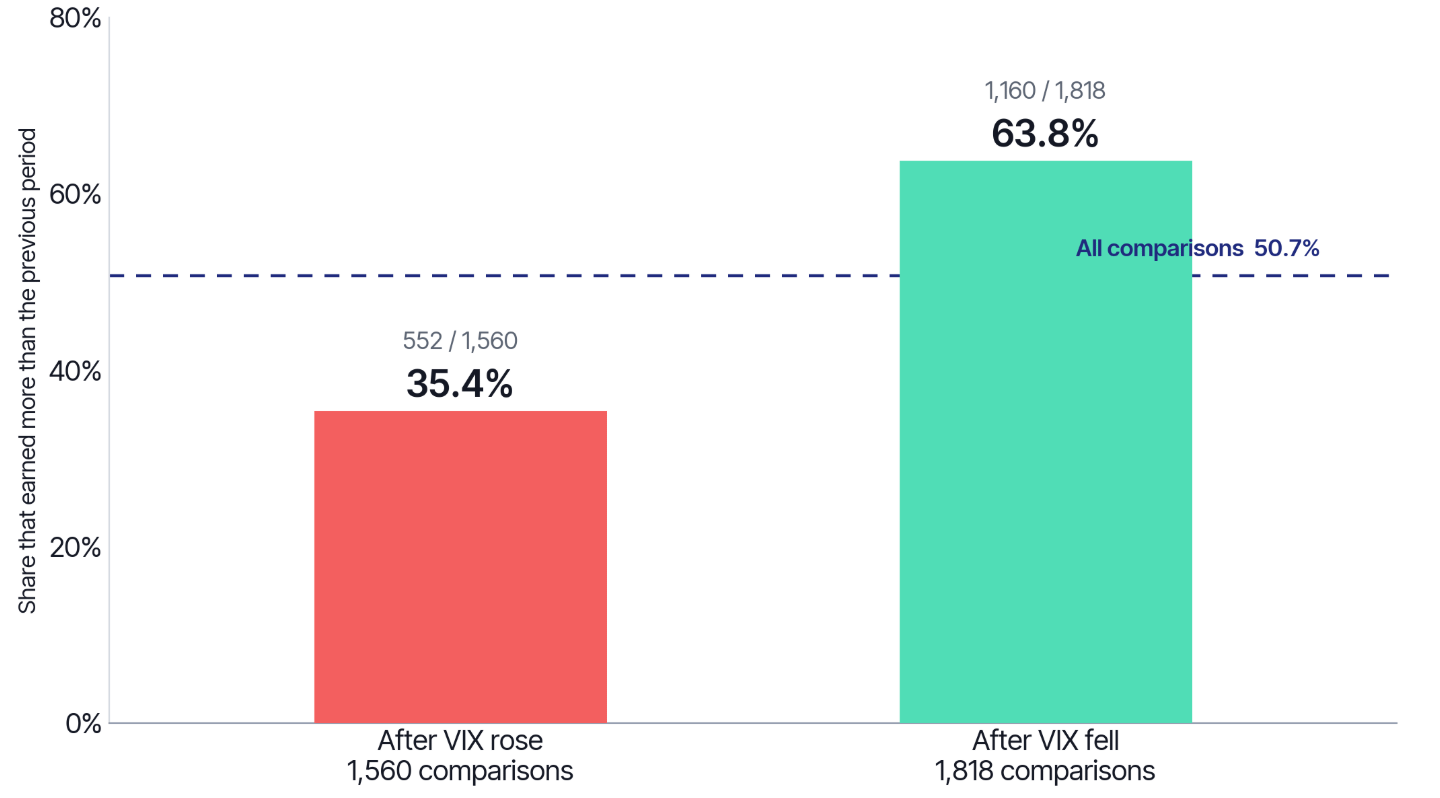
After VIX rose, the fund’s return improved in 552 of 1,560 cases, or 35.4%.
In the other 1,008 cases, the fund earned less than it had in the previous period.
When VIX fell, returns improved in 1,160 out of 1,818 cases, or 63.8%.
So in our data, arbitrage-fund returns were more likely to become lower than higher after VIX rose.
We also checked the funds individually to make sure this result was not being caused by just one or two schemes.
Twenty-seven funds had enough rising-VIX months for us to study them properly.
For all 27 funds, there were more rising-VIX months in which their return became lower than rising-VIX months in which their return became higher.
This does not mean rising VIX caused arbitrage-fund returns to fall. It simply tells us that the pattern was visible across many different funds.
A rising VIX is not the same as a high VIX
There is an important difference between a rising VIX and a high VIX. For example, a move from 12 to 16 means VIX has risen, while a move from 35 to 30 means VIX has fallen, even though 30 is still a much higher level.
Our main test looks at whether VIX rose or fell before the investment started. But we also wanted to see what happened when investors entered at different VIX levels, so we divided the observations into four groups
We used simple VIX ranges of below 15, 15–20, 20–30 and 30 or above. These are only used to make the historical comparison easier to understand; they are not official investment thresholds.

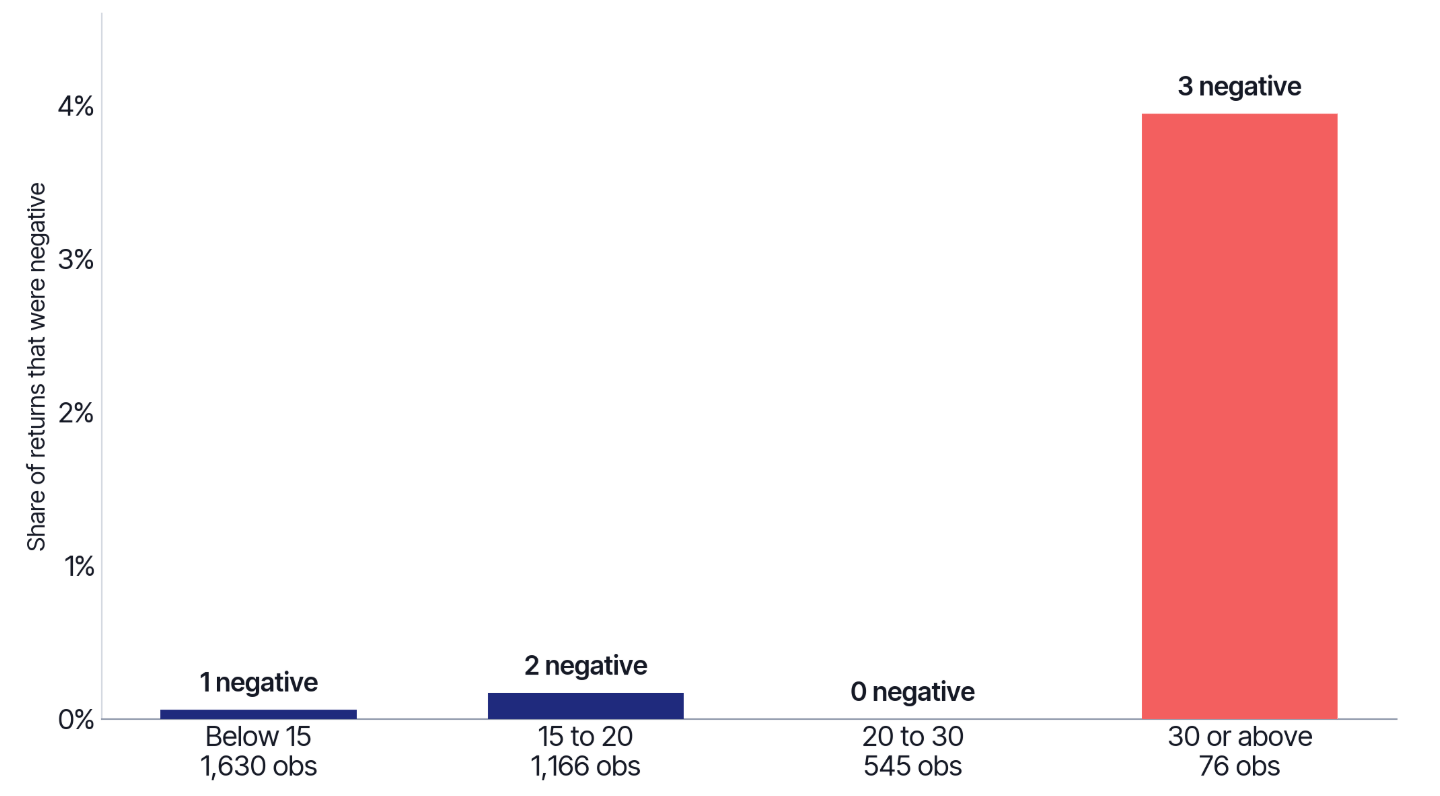
Negative returns were rare across most VIX levels.
When VIX was below 30, only 3 out of 3,341 fund observations were negative.
But when VIX was 30 or above, 3 out of 76 observations were negative.
So even though arbitrage funds were positive in most periods, very high VIX did not guarantee a positive return.
This table only tells us whether the return was positive or negative. It does not tell us how large the return was.
One example from the data
Before the May 2021 investment period, VIX was 23.03. Before the June period, it had fallen to 16.89.
There were 24 funds with returns available for both periods, and all 24 earned more in the June period than in the May period, even though VIX had fallen.
For example, Aditya Birla SL Arbitrage Fund, Direct Growth returned:

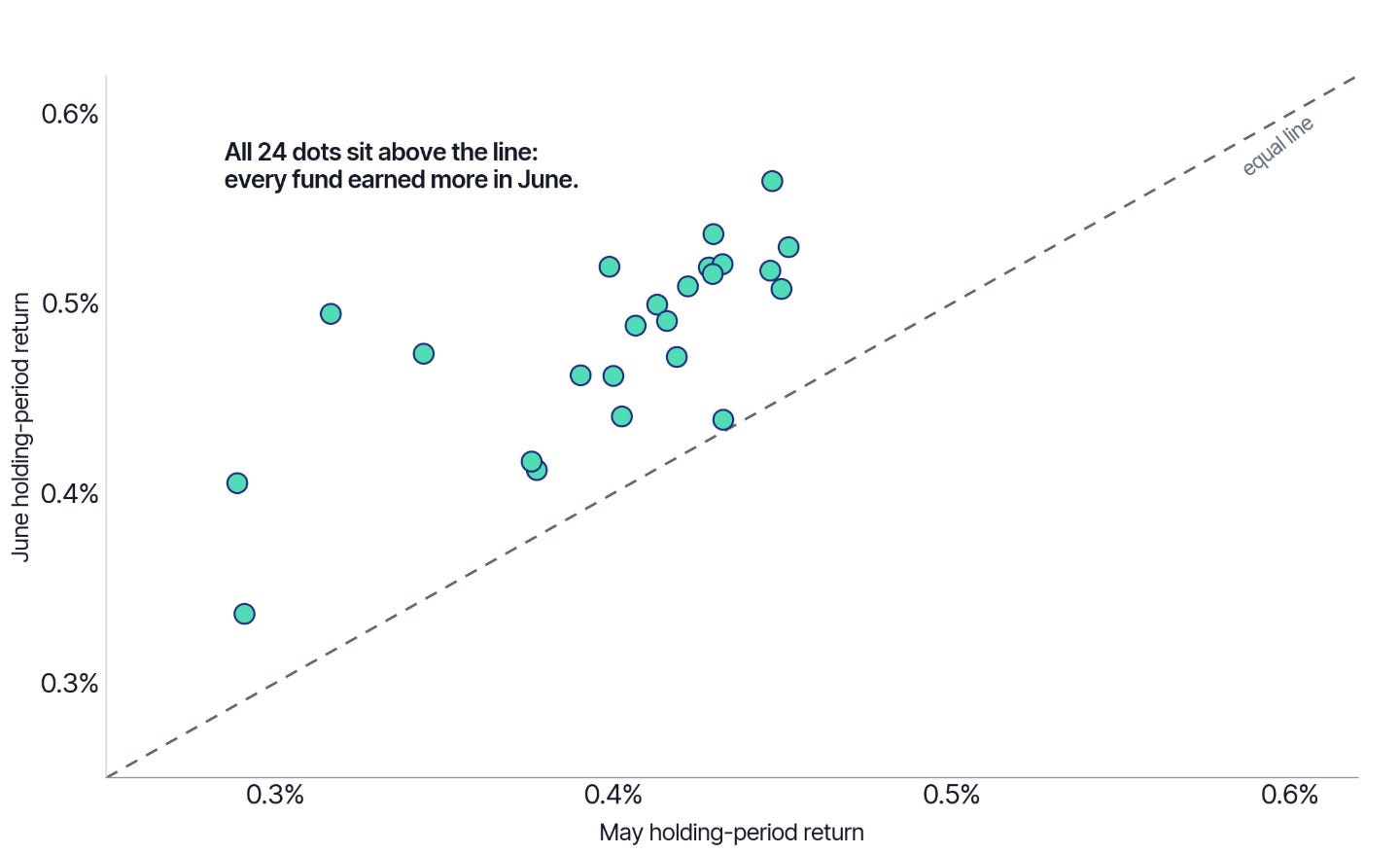
So in this example, VIX fell, but the fund’s return increased. One example does not prove a rule, which is why the study looks at every eligible period across all the funds rather than relying on one month.
So what should we take away?
Arbitrage funds try to earn from price differences between the cash and futures markets.
VIX tells us something different. It shows how much volatility the market expects over the next 30 days.
A higher VIX can mean markets are more uncertain, but it does not automatically mean that the cash-futures price gap available to an arbitrage fund will be larger.
In our study, VIX by itself was not a reliable signal for deciding when to enter an arbitrage fund.
When VIX rises, it can seem logical to assume that arbitrage funds will get more opportunities and earn better returns. But our data did not show that consistently.
So waiting for VIX to become high before investing, or moving money into an arbitrage fund just because markets have become more volatile, may not be very useful.
A better way to look at an arbitrage fund is to start with why you are investing in it.
If you are using it to park money for a relatively short period, things like how long you plan to stay invested, the fund’s exit load and the possibility of a small negative return over shorter periods are also important to consider.
Arbitrage-fund returns depend on whether the fund can actually find and capture useful price differences between the cash and futures markets.
VIX only tells us how much volatility the market expects. It does not tell us how large those cash-futures price gaps will be.
So instead of asking:
“Is VIX high enough for me to invest in an arbitrage fund?”
The more useful question is:
“Does an arbitrage fund make sense for the period and purpose for which I want to use this money?”