

A South African company’s investment in the company behind PUBG Mobile grew more than 5,000 times.
In 2001, Naspers, a South African media company, bet $32 million on a Chinese startup.
This startup later built WeChat, which is often called China’s WhatsApp.
It is used by 1.4 billion people, and not just to chat but also to pay bills, shop and send or receive money.
The same company also became the world’s largest game publisher. Among its many hits is PUBG Mobile.
Tencent.
Valued at nearly $500 billion as of early October 2026. Naspers got a big slice of this pie since they had invested early on.
By 2018, that $32 million investment was valued at more than $175 billion (that is more than 5,000x)
It came to be one of the most successful venture capital deals ever. Even today, Naspers remains the largest shareholder in Tencent.
Naspers now holds its Tencent stake through its investment arm, Prosus. And one of the other companies they invested in was Indian.
Byju’s.
In 2018, it started investing in Byju’s and over the years, Naspers and Prosus put a total of $536 million into the company.
By October 2022, Byju’s was valued at more than $22 billion.
Other well-known global investors, including BlackRock, the world’s largest asset manager, also backed it.
But things quickly turned sour.
By the end of 2023, about a year after Byju’s reached its peak valuation, Prosus valued the company at less than $3 billion. BlackRock valued it even lower, at just $1 billion.
Things got worse. In 2024, Byju’s was struggling to repay its debts and was caught up in a legal process over the money it owed. Prosus and BlackRock both considered their investments in Byju’s to be worth zero.
So, the interesting thing here is that the same investor had invested in two companies.
One turned out to be one of the most successful startup investments ever. The other was considered worthless.
When a big investor puts money into a company, other people notice.
Some might even invest because they think that if such a big investor is putting money into it, the company must be good.
But does that really mean the company will do well?
We see something similar in the stock market too.
QIP, or Qualified Institutional Placement.
It is one of the ways in which listed companies can raise money.
The company issues new shares, but instead of offering them to everyone, it sells them to a selected group of big investors. These include mutual funds, foreign investors and insurance companies. Regular investors like you and me cannot participate.
Unlike IPOs and FPOs, which require lengthy, heavily regulated processes such as filing detailed offer documents with SEBI, QIPs let companies raise money from institutions much faster.
QIPs are priced using a SEBI formula based on the stock’s recent prices, which sets a floor price. The floor price is the benchmark.
Companies can then offer institutions a discount of up to 5% on that floor price. This discount is optional, not mandatory.
This raises a question. If the most sophisticated investors are writing big cheques, shouldn’t the stock do well?
After all, if the “smart money” is pouring thousands of crores into a stock, shouldn’t you be buying it too?
We decided to test this.
Can institutional buying be considered the stamp of approval, and could that lead the stock to outperformance when a company raises money through a QIP?
Do these stocks create wealth in the long term?
The Study
We picked the five biggest QIPs by issue size in each year from 2016 to 2025. That gave us 50 QIPs.
We removed 3 because those companies later merged with other companies and their shares were no longer trading.
So, we were left with 47 QIPs from 40 companies. Together, they raised about Rs 2.5 lakh crore.
Some companies raised money through QIPs more than once. For example, Bajaj Finance and Godrej Properties appeared 3 times each. Bank of India, Kotak Mahindra Bank and State Bank of India appeared twice. We looked at each QIP separately.
Then, we checked how the stocks performed at different points:
One month before the QIP was announced.
One day after the announcement.
Between the announcement and the day the new shares were given to investors.
One month and one year after the shares were given.
From the day the shares were given until 5 October 2026.
We also compared each stock’s performance with the Nifty 50 over the same periods to see whether it did better or worse than the broader market.
Stocks ran up before the QIP, not after it
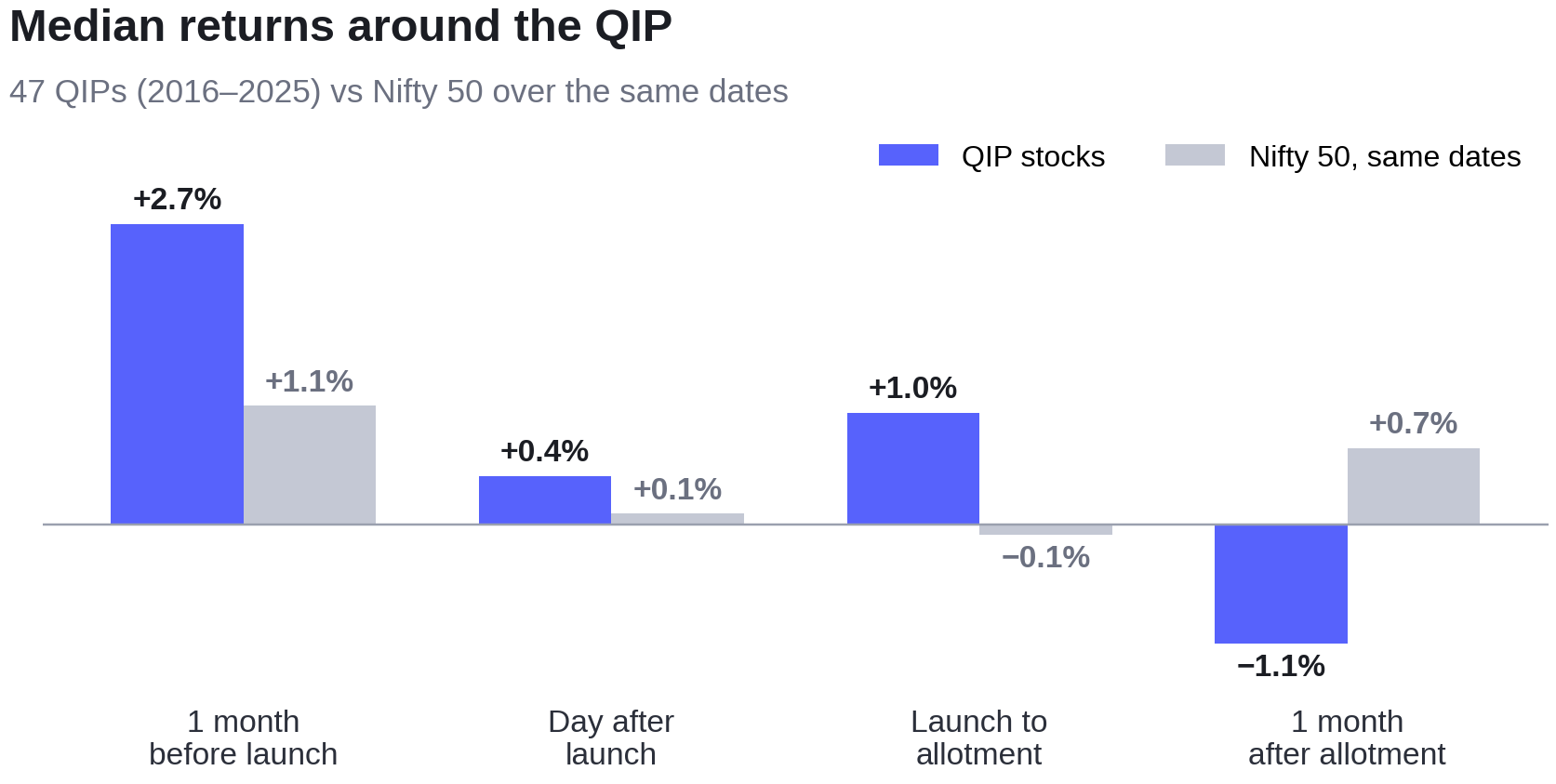
In the month before the QIP started, 29 of the 47 stocks went up, and 23 performed better than the Nifty 50.
The median stock gained 2.7%, compared to 1.1% for the Nifty.
So, does that mean you should buy a stock when you hear a QIP is coming?
Not really. In many cases, the stock had already risen before the QIP started.
But why does this happen?
One possible reason is that companies prefer to raise money when their share prices are high.
Think about it. When a company raises thousands of crores through a QIP, it issues new shares. This means existing shareholders now own a smaller percentage of the company.
But if the share price is high, the company can raise the same amount of money by issuing fewer new shares. So, existing shareholders give up a smaller share of ownership.
There could be other reasons too.
Before launching a QIP, investment bankers may privately meet mutual funds and foreign investors through something called a roadshow. This helps them understand whether big investors are interested in buying the shares and how much demand there might be.
Some companies also choose to launch QIPs after reporting good quarterly results, when more investors might be interested in buying their shares.
Or the stock could already be rising because the company’s profits are growing or because the entire sector is doing well.
So, a company may choose to launch a QIP because its stock has been performing well, rather than the stock rising because of the QIP.
And there’s another problem. Regular investors usually cannot know for sure when a QIP is coming. Board or shareholder approvals to raise money might give an early hint, but they don’t tell you exactly when it will happen.
Now, what happened after the QIP started?
The price changes were much smaller.
The day after launch, the median stock rose just 0.4%, compared to 0.1% for the Nifty. Of the 47 stocks, 28 rose and 28 performed better than the Nifty. These were not necessarily the same 28 stocks.
Between the launch and the day the new shares were given to big investors, the median stock gained 1%, while the Nifty fell slightly by 0.1%.
During this period, investment bankers were collecting orders from big investors and deciding how many shares each would get. But the stock prices didn’t move much. Only 25 of the 47 stocks rose.
And one month after the shares were given, things looked worse.
The median stock had fallen 1.1%, while the Nifty had risen 0.7%.
Of the 47 stocks, 21 rose (45%) and 26 fell (55%). And 29 stocks (62%) performed worse than the Nifty.
So, while many stocks had risen before the QIP, that strong performance didn’t necessarily continue afterwards.
Now, remember that regular investors like you and me cannot buy shares directly through a QIP. We can only buy them from the stock market at the market price.
So, if you bought the stock around the time big investors received their shares, would you have paid more than them?
Who got the better price?
Now, big investors can sometimes buy shares through a QIP at a discount. But regular investors like you and me can only buy those shares from the stock market.
So, who ends up paying less?
First, let’s understand how the price is decided.
SEBI has a formula that looks at the highest and lowest closing share prices in each of the two weeks before the company decides to open the QIP. The average of these prices helps decide the minimum price at which the company can issue shares.
With shareholder approval, the company can then offer a discount of up to 5% on this floor price, and the final price institutions pay is called the issue price.
For example, IDFC First Bank’s 2021 QIP had a floor price of Rs 60.34. The bank offered a discount of Rs 2.99, so institutions paid an issue price of Rs 57.35.
Since retail investors cannot participate in a QIP, they can only aim to get a piece of the pie on allotment day from the open market.
So we compared the price that institutional investors paid for the QIP, called the issue price, with the price retail investors could have paid on allotment day (closing price). (Allotments on non-trading days use the previous trading day’s close.)
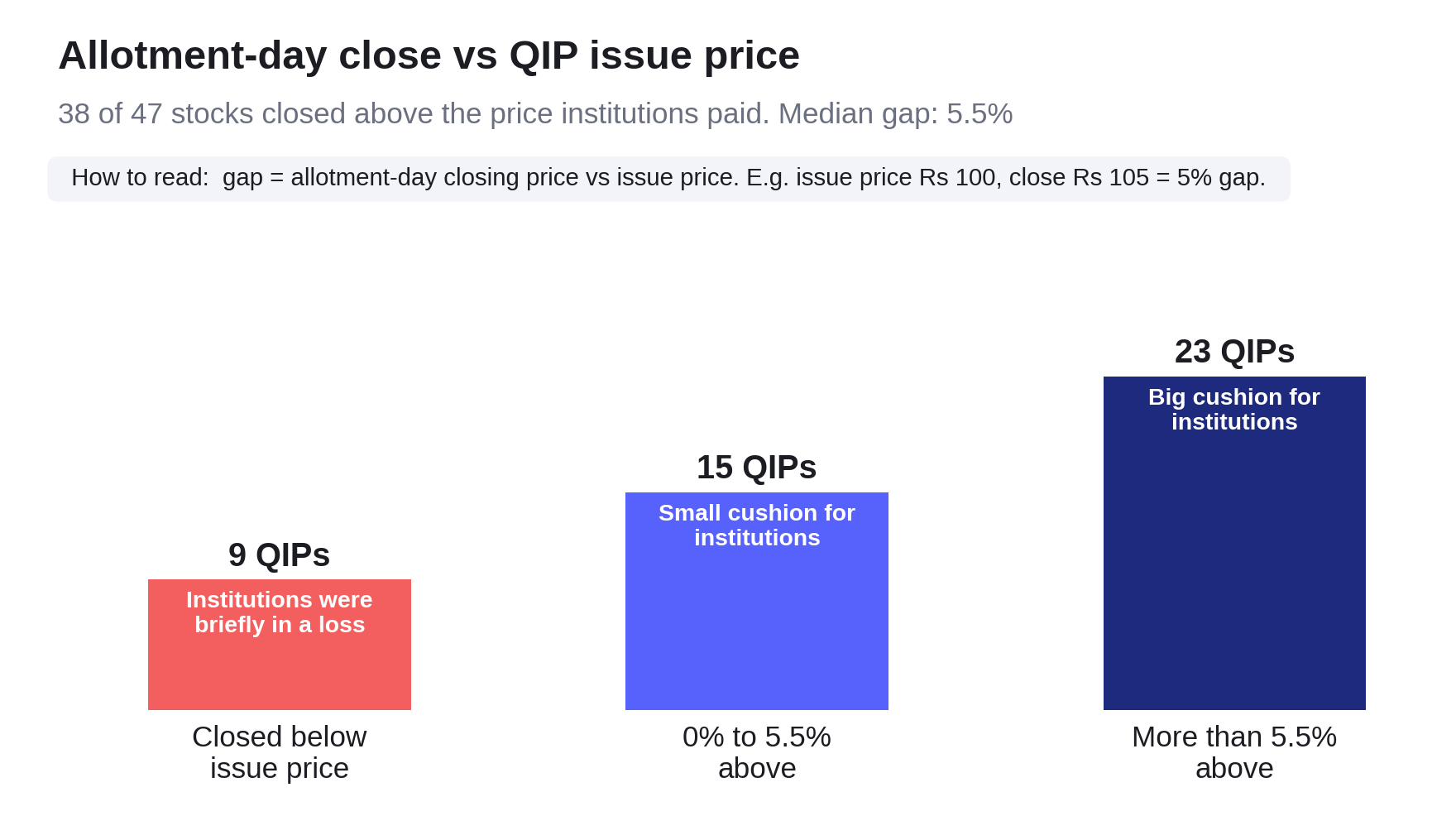
In 38 of 47 cases (81%), institutional investors had bought shares at a price which was lower than the price on allotment day.
The median gap between issue price and allotment day closing price was 5.5% for our study. This means institutional buyers entered with a price cushion of 5.5% over retail buyers who bought on allotment day.
Part of this is the discount. The gap was also much wider where the stock rose while the QIP was open. Where the stock rose between launch and allotment, the median gap was 10.4%; where it didn’t, it was 0.5%.
But while the direction was obvious, the size and exceptions were not.
For Adani Energy Solutions, this gap in prices reached 29.3%. Institutional investors had almost a 30% safety cushion in this case which is huge.
However, this is not guaranteed for the stocks in our data set.
9 out of 47 stocks closed below issue price on allotment day. All 9 fell between launch and allotment, by 0.8% to 5.1%. IDFC First was the extreme case where it closed 3.6% below its issue price on allotment day.
The Nifty also fell in 7 of the 9 windows. So market conditions could have played a role.
In all 9 cases, the issue price was close to the stock’s market price when the QIP was launched, at most 4.2% below it. That left institutions with very little cushion.
And some were already falling, 6 of the 9 had fallen in the month before launch.
For these 9, the allotment-day close was a median 0.8% below the issue price. On paper, institutions were briefly behind.
Retail investors could buy these 9 slightly below what institutions paid.
‘Follow the big funds’ can still work, since a stock can rise after you buy above the issue price. But retail investors usually start from a higher price than the institutions did.
That is the case at least for the short term. But did the results change over a longer period of time?
What happened a year later?
We looked at the performance of 46 QIPs (excluding Swiggy because it hasn’t completed a year since its QIP) over 1 year after allotment.
25 stocks were trading above their allotment-day closing price, while 21 had fallen below it.
The picture had changed quite a bit when it came to returns.
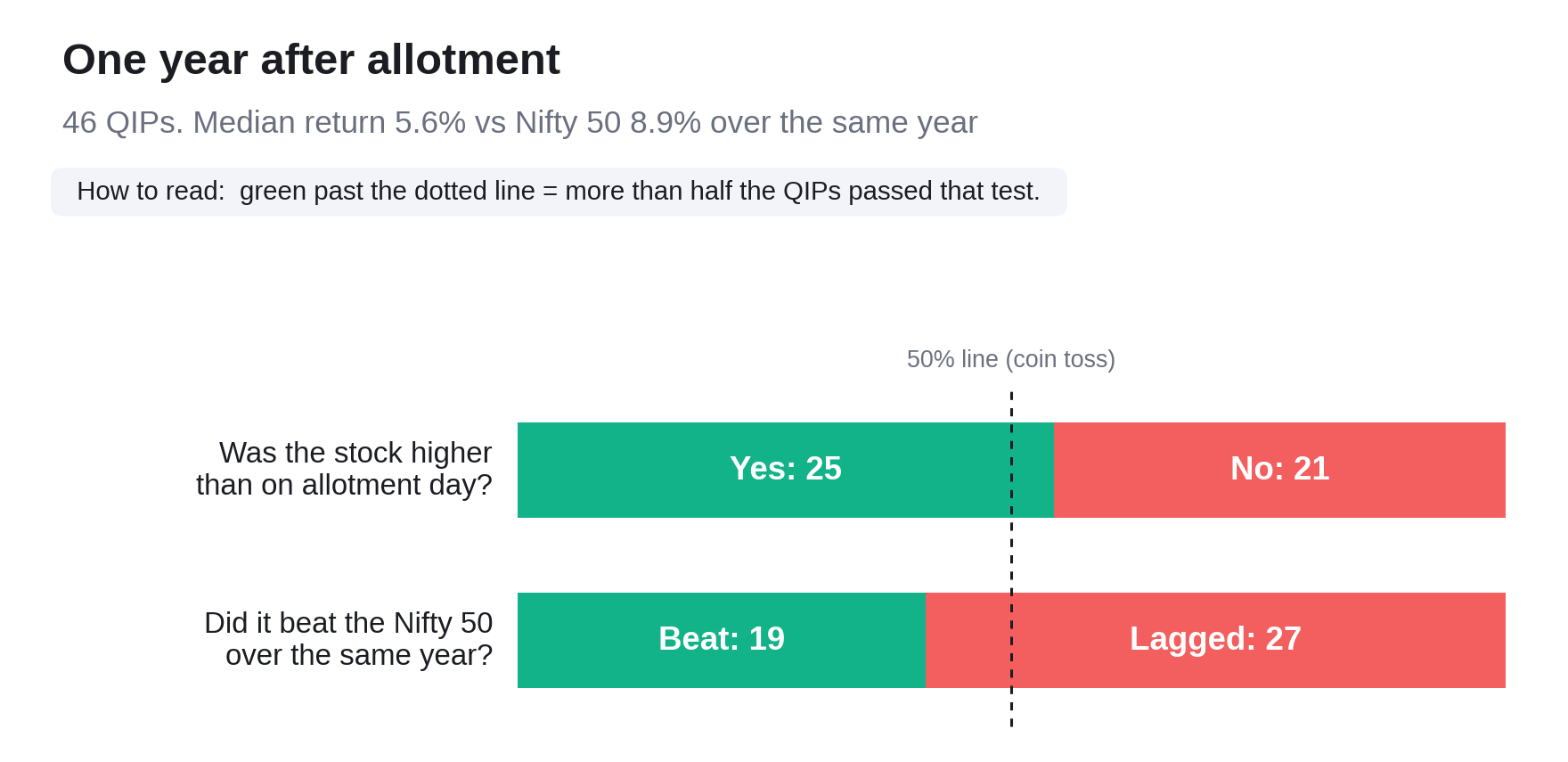
Only 19 out of the 46 QIPs managed to beat the Nifty 50 and the median QIP stock returned 5.6% in this period while Nifty gained 8.9%.
What had changed in a year?
The market cycle could have turned negative, or the company could have faced some crisis.
For example, Idea Cellular (now Vodafone Idea), which raised money through a QIP in 2018, was facing issues by early 2019. After Idea’s merger with Vodafone India, the combined company recorded losses of about Rs 5,000 crore each in its first two quarters, driven by a pricing war in the telecom sector.
When the stock closed more than 5.5% above the issue price, only 4 of 22 beat the Nifty over the next year.
Stocks that rose more than 5% in the month before launch beat the Nifty in 6 of 16 cases a year later, against 13 of 30 for the rest.
This means pre-launch gains were a weak indicator of 1-year returns post QIP.
Stocks that had risen the most did worse a year later
Now, we wanted to check something else.
Did stocks that were already trading much higher than the price big investors paid through the QIP perform better over the next year?
To find out, we divided 46 QIPs into three groups based on the difference between their market price on allotment day and the issue price.
Remember, the median price difference in our study was 5.5%. So, we used that to divide the stocks.
Here’s what we found.
15 stocks were trading up to 5.5% above their issue price. Of these, 13 beat the Nifty over the next year. Their median one-year return was 31.9%.
That’s quite good, right? But here’s where things get interesting.
22 stocks were trading more than 5.5% above their issue price. Only 4 of them beat the Nifty over the next year. Their median return was actually a loss of 14.4%.
And 9 stocks were trading below their issue price. Only 2 beat the Nifty, and their median return was a loss of 0.7%.
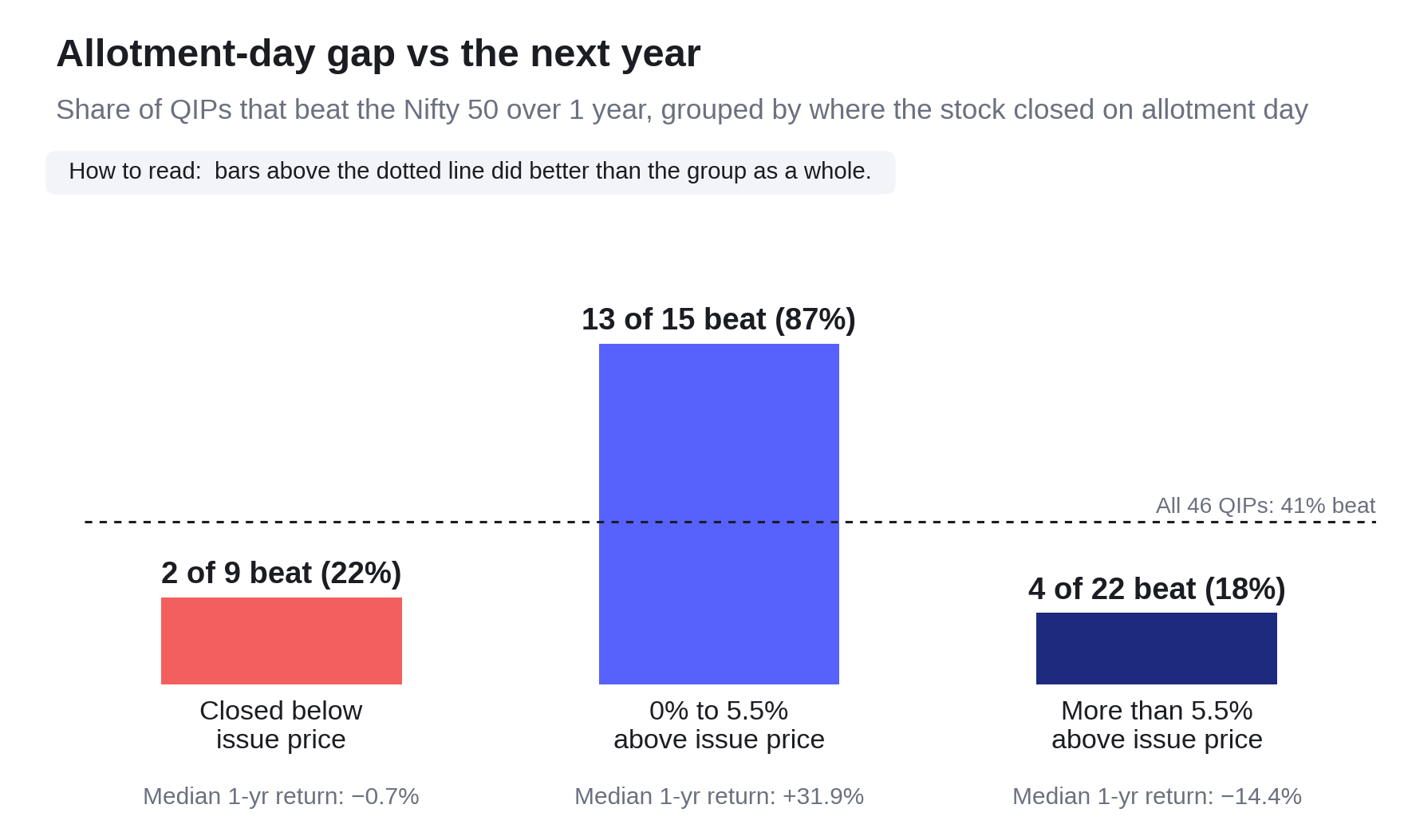
So, in our study, stocks that were already trading much higher than the price institutions paid performed the worst over the next year.
Interestingly, the stocks that were trading only slightly above the issue price did the best.
We also checked whether changing our 5.5% cut-off would change the result. Even when we used cut-offs anywhere between 3% and 10%, the overall pattern remained the same, although the exact numbers changed.
But this was only for the first year.
When we looked at returns from allotment until 5 October 2026, the difference between these groups became much smaller.
Of the stocks trading more than 5.5% above the issue price, 12 out of 22 beat the Nifty. Among the remaining stocks, 13 out of 22 beat it.
So, the pattern we saw over one year didn’t really continue over longer periods.
What if you held on for longer?
So far, we’ve looked at what happened around the QIP and one year after it.
But what if you had bought these stocks on allotment day and held them until 5 October 2026?
For this, we had to remove two companies, Samvardhana Motherson and Vedanta, because they later split parts of their businesses into separate companies, and our share price data didn’t fully account for those changes.
We also excluded Swiggy from the comparison with the Nifty because a year hadn’t passed since its QIP.
First, let’s look at whether the stocks went up at all.
Of the 45 QIPs we could track, 36 were trading above their allotment-day prices.
That’s a pretty good number. But just because a stock went up doesn’t mean it was a better investment than the Nifty.
So, we compared their returns with the Nifty over the same periods.
Since these QIPs happened in different years, we calculated their annualised returns to make the comparison easier.
Of the 44 QIPs, 25 performed better than the Nifty 50.
The median QIP stock gave an annual return of 8.8%, compared to 7.9% for the Nifty.
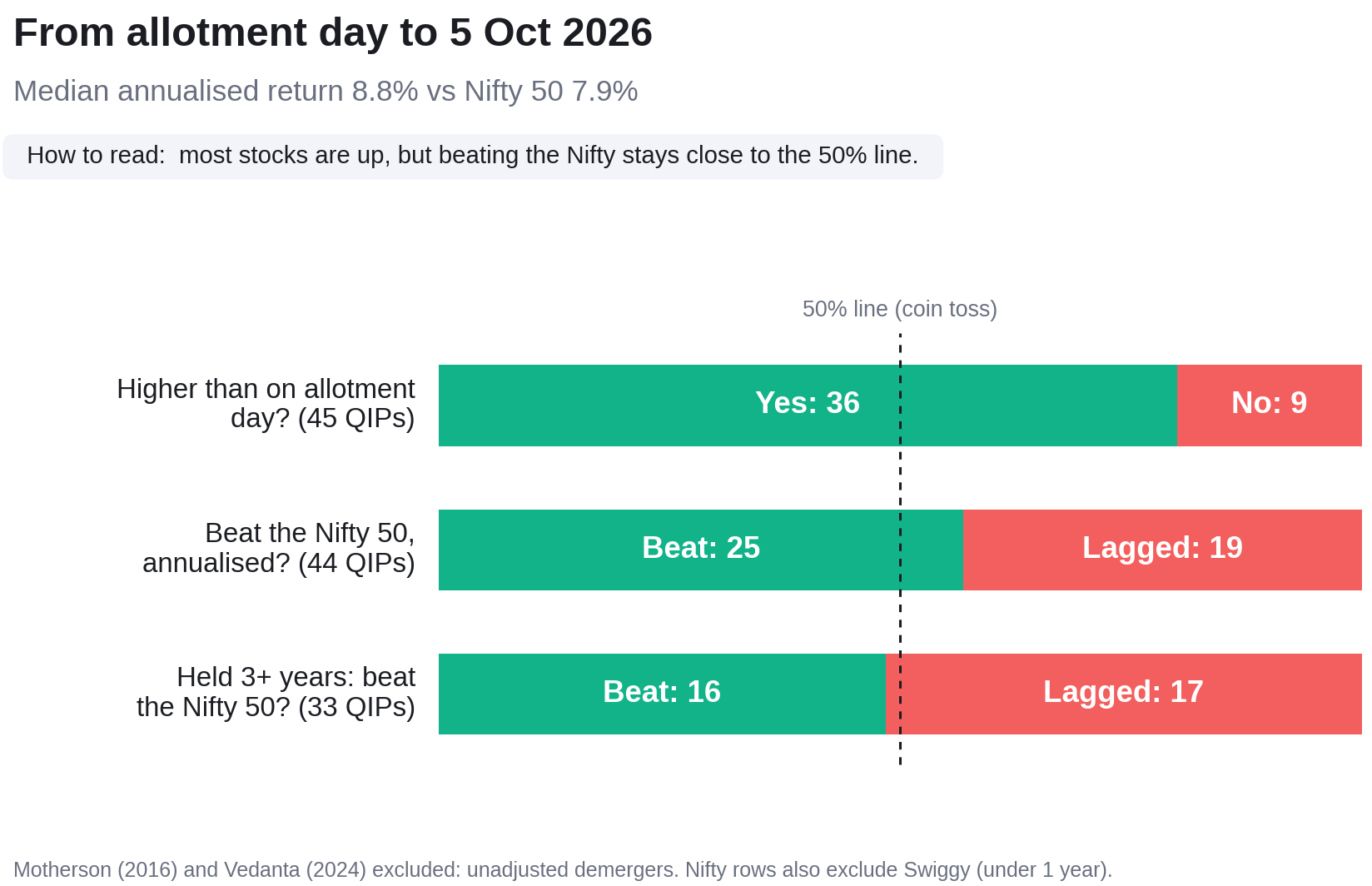
That’s better than what we saw after one year, but it’s still not a very strong result.
For example, when we looked only at QIPs that had completed at least three years, just 16 of the 33 beat the Nifty.
And the results also changed depending on when we measured them.
If we had ended our study on 30 March 2026 instead, only 18 of the 42 QIPs would have beaten the Nifty. We used 42 here because three QIPs had not yet completed a year at that point, while Vedanta was still included because its demerger came later.
So, even over longer periods, there wasn’t a clear pattern showing that stocks with big QIPs would consistently perform better than the market.
Takeaway
When a company raises thousands of crores from big investors, it’s easy to think those investors must know something that regular investors don’t.
But we saw from the study that it didn’t really matter.
And over longer periods, the results were close to 50-50.
But why isn’t there a clear pattern?
Think about it. A QIP only tells us that big investors were willing to put money into a company. It doesn’t tell us what will happen to that company next.
A company might raise money to expand its business, repay debt or fund new projects. But raising money is one thing. Using it well is another.
Some companies might use the money to grow their profits. Others might struggle because of competition, falling demand or problems within the business.
And even if the company does well, its stock might not. If investors have already pushed the share price too high, good business performance might not be enough to deliver good returns.
The overall stock market also matters. A company might perform well but still struggle to beat the Nifty if the broader market rises faster.
So, a big QIP tells you how much money a company managed to raise. It doesn’t tell you how much money you will make by investing in it.
Just because big investors are putting thousands of crores into a company doesn’t mean you should follow them.
Limitations
We used ACE Equity data, which may not include every QIP. For example, Axis Bank’s Rs 10,000 crore QIP in August 2020 was missing. Including it wouldn’t change our conclusions.
Our study covered only 47 QIPs. Also, some of the biggest QIPs were relatively small. In 2016, the fifth-largest raised just Rs 150 crore.
We considered share price changes, adjusted for stock splits, bonuses and rights issues. Dividends, taxes and transaction costs were excluded. We also used the Nifty 50 price index, which excludes dividends.
QIPs from 2024 and 2025 have less than two and a half years of performance data.
We excluded 3 QIPs because the companies merged (Bharat Financial Inclusion and HDFC Ltd twice). Swiggy was excluded from one-year and annualised comparisons, while Samvardhana Motherson and Vedanta were excluded from long-term calculations because our data didn’t fully account for their business splits.
Some companies raised money multiple times, so they had a greater influence on the results.
We didn’t separate other fundraising activities happening around the same time. For example, HDFC Bank’s 2018 QIP happened alongside a US share offering, while Indian Overseas Bank received government funding in the same financial year.
The study shows patterns, not exact reasons. We didn’t examine company valuations, business performance or how the money raised was used.