

Entering the market at the ‘right time’ is what many aim to do, but it is easier said than done.
Which is why SIPs are often recommended as an easy way to navigate the markets.
But what if you actually got a chance to invest at the right time, as in, when the market was at its lowest?
Could it give extraordinary results?
So we tried testing it out by running a 10 year simulation, where we invested Rs 1.2 lakh every year in the index funds representing the:
Nifty 100 (large-cap)
Nifty Midcap 150 (mid-cap),
Nifty Smallcap 250 (small-cap).
This means we hypothetically invested all of Rs 1.2 lakh for the day when the market touched its lowest in the year.
For instance, consider an investment of Rs 1.2 lakh made for the day the Nifty Smallcap 250 index reached its annual lowest point:
February 29th in 2016
January 2nd in 2017
October 9th in 2018
and so on for subsequent years…
Thus investing Rs 12 lakh in total over 10 years.
The amount chosen is Rs 1.2 lakh as we will compare this with regular SIP of Rs 10,000 each month, which would be Rs 1.2 lakh annually, and Rs 12 lakh in the decade (Jan 2016 to Dec 2025).
To make it even more interesting, we did it for 3 situations in total:
Investing only when market is at its lowest in a year
Investing only when market is at its highest in a year
Regular monthly SIP investing
By doing so, a total of Rs 12 lakh was invested in each strategy, here is what we found by the end of 2025:
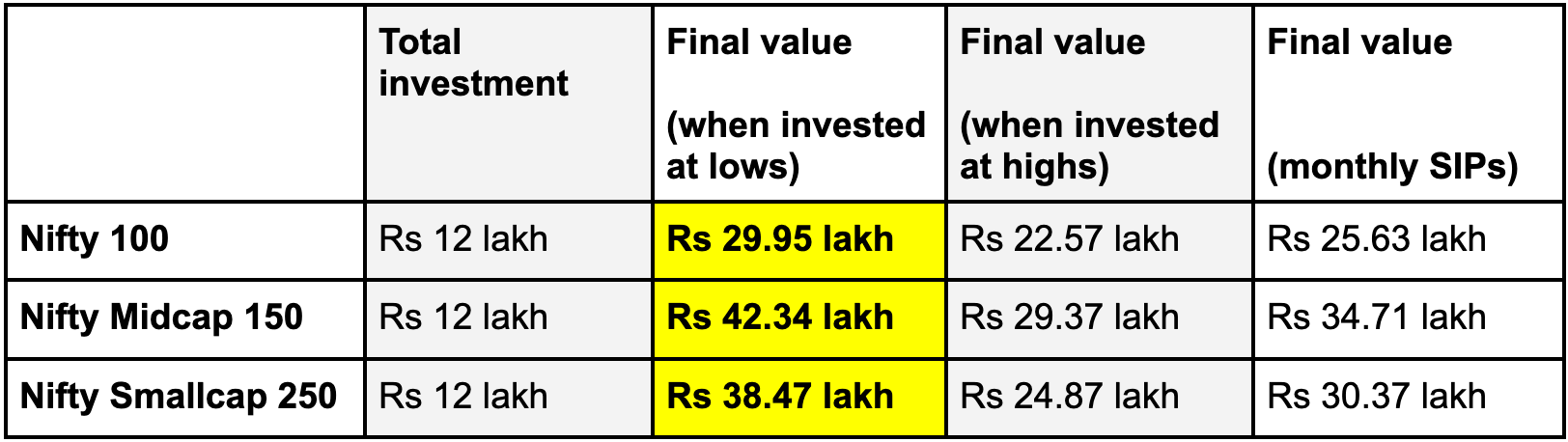
(All final values are as of 31st December, 2025)
As we see above, constantly investing at lows managed to outperform other strategies, with yellow markers highlighting the highest returns.
And the alpha generated is decent with respect to other strategies.
However, it’s important to realize that achieving those additional returns by timing the market would have required the impossible ability to predict every market low over more than a decade.
But considering the observed advantages of investing during market downturns, it shows why financial experts often recommend making lump sum additions to your existing SIP/investments whenever the market experiences a major correction.
And instead of trying to magically predict market lows, a much more ‘realistic strategy’ is to simply buy more of your existing investments when the market experiences a significant downfall.
What do you think?
Let us know in the comments, and share some ‘What If?’ scenarios you would like us to try out.
Limitations of the study:
The simulation ran between the period of Jan 2016 to Dec 2025, and the results may differ from what we have found if a different time period is chosen.
The analysis had the advantage of being run in hindsight with already established data, and no similar results can be guaranteed for future.
The SIP dates for the monthly SIPs were the first trading day of every month.
The calculations have been made using TRI (Total Returns Index) values of the respective indices, as there were no index fund/ETF based on Nifty Midcap 150 and Nifty Smallcap 250 in 2016.
The analysis ran around Nifty 100 TRI, Nifty Midcap 150 TRI, and Nifty Smallcap 250 TRI. The results may differ from what we have found if some other indices are chosen for comparison.
The simulation does not account for any transaction cost or taxes.