

In January 2012, Kodak filed for Chapter 11 bankruptcy protection.
It was a surprising moment because…
For most of the 20th century, Kodak was one of the world’s most recognised brands. At its peak, it controlled around 90% of US film sales.
Its business model was simple but powerful.
One might assume Kodak made most of its money from selling cameras. But the camera was only the starting point.
Once someone bought a camera, they kept coming back to buy film for every holiday, birthday or family event. And when the roll was finished, they paid again to get the photos developed.
Millions of customers repeated this cycle for years, making Kodak incredibly good at generating cash.
Then digital cameras started replacing film, and that cycle began to break.
Soon after, smartphones made taking photos even easier and more effortless. Buying film for photos became a thing of the past, and people no longer had to pay to develop pictures either.
Suddenly, people could take thousands of photos at almost no extra cost.
As this shift happened, the habit that had powered Kodak for decades began to fade.
People were taking more photos than ever, but Kodak was no longer part of the process.
Kodak was still a familiar name. Its brand, factories and patents were still intact, but the business that had supported the company for years was weakening.
As film sales and photo development declined, Kodak stopped generating cash the way it once did.
That created a much bigger problem.
Before filing for bankruptcy, the company had already warned that it might not generate enough cash to repay debt, run its day-to-day operations, invest in new products and meet its other financial commitments.
Cash Flow
A company can have a famous brand, great products, factories and valuable patents. But if it is not bringing in enough cash, the business may not be as strong as it looks
Profit tells you what a company earned on paper.
Cash flow tells you whether the money actually came in.
And the two don’t always match.
A company may record a sale today even if the customer pays months later. So the profit is already counted, but the cash has not yet reached the bank.
At the same time, money may be stuck in unsold inventory. The company still has to pay suppliers, employees and other expenses on time, even if customers have not paid yet.
So even if a business looks profitable on paper, it can still run into cash problems in real life.
That’s why investors care so much about operating cash flow.
When a company keeps generating more cash from its main business, it usually looks like a good sign. The company is not just reporting higher sales. It is actually turning those sales into money that can be used to grow, repay debt or reward shareholders.
That leads to a simple question.
If a company’s operating cash flow keeps rising, does that also make it a better investment?
So we decided to test it.
The experiment
Here’s how we tested the idea.
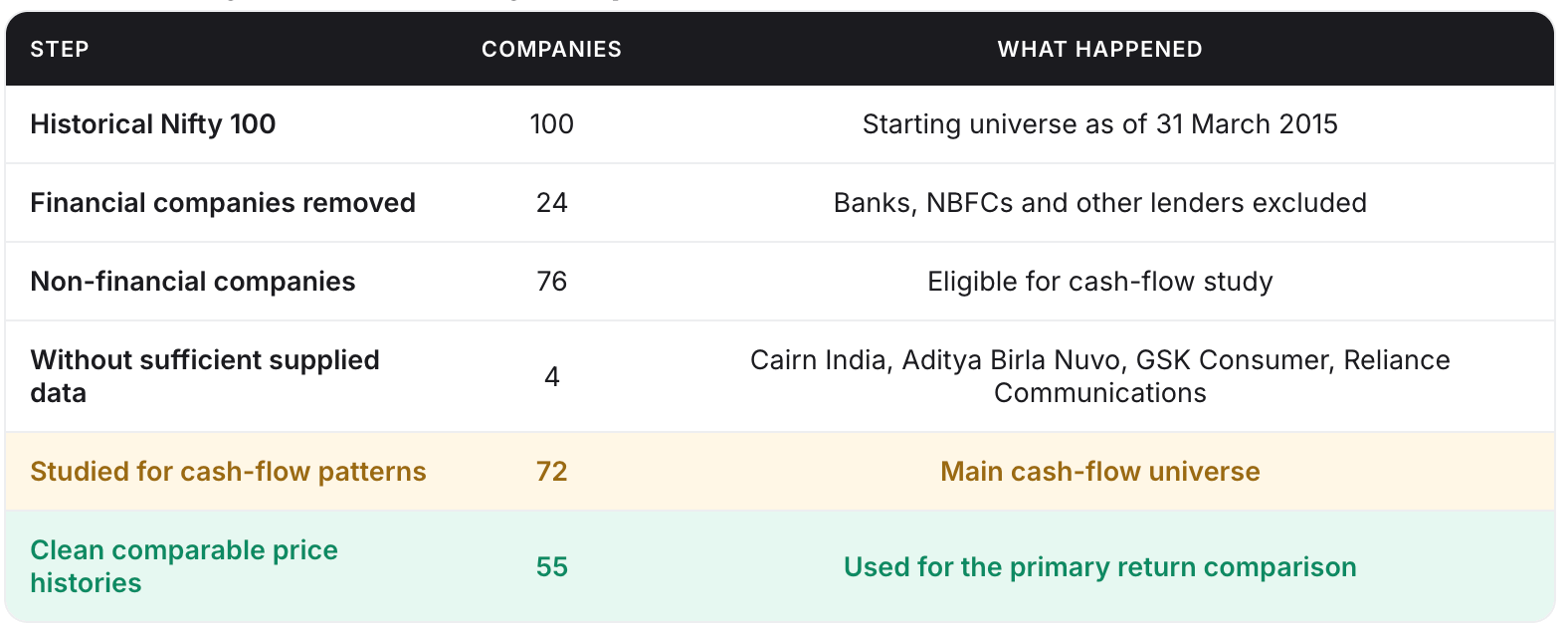
We started with the Nifty 100 as it stood on 31 March 2015. We used the historical list instead of today’s index so we wouldn’t benefit from hindsight by automatically excluding companies that later struggled or disappeared.
Next, we removed banks, NBFCs and other financial companies because operating cash flow works very differently for lenders.
That left us with 76 non-financial companies. Four companies didn’t have enough usable historical data—Cairn India, Aditya Birla Nuvo, GlaxoSmithKline Consumer Healthcare and Reliance Communications—leaving 72 companies for the study.
For each company, we looked at the last six years of operating cash flow available before July 2015 (FY2010-FY2015 for most companies).
We then divided the companies into four groups:
Continuously increasing: Cash flow stayed positive and increased every year.
Continuously decreasing: Cash flow stayed positive but declined every year.
Mixed: Cash flow rose in some years and fell in others.
Turnaround/Negative: One or more years had negative operating cash flow.
Finally, we assumed an investor bought all the stocks on 1 July 2015, after the financial statements were available, and tracked their returns until 24 July 2026.
Every stock was compared against the Nifty 100 Price Index over the same period. This is a price-return study, so dividends have been excluded from both the stocks and the benchmark.
Results
Perfect cash-flow growth was almost nonexistent
If you think great companies steadily generate more cash every year, the data tells a different story.
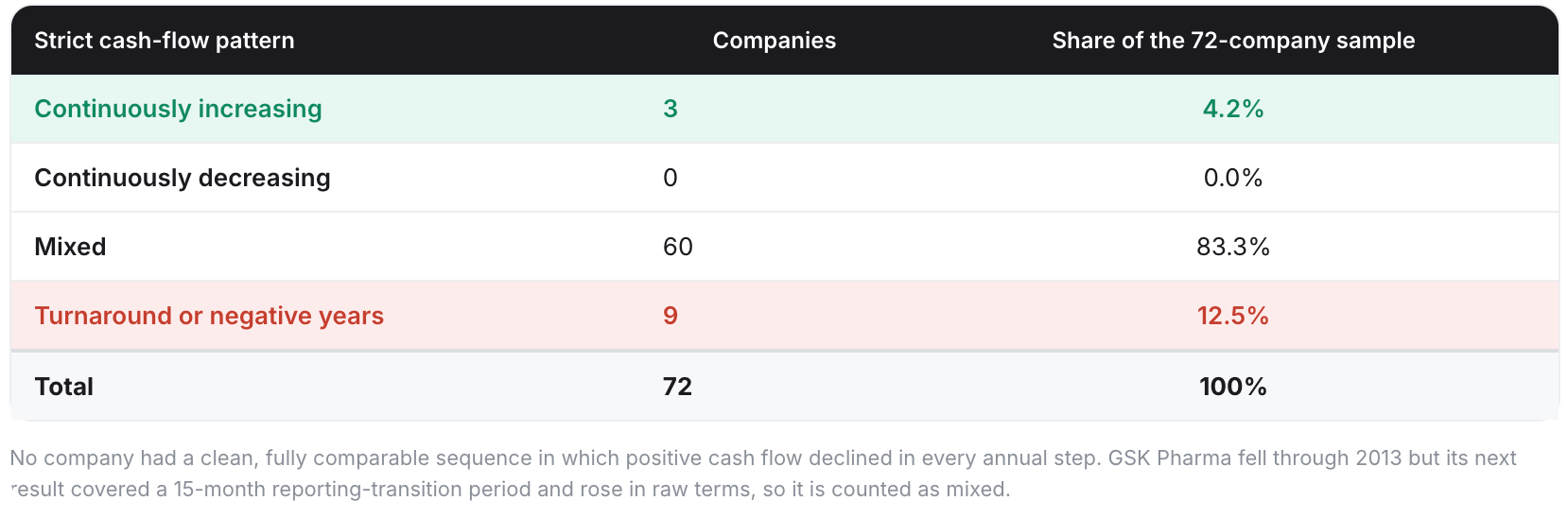
Out of the 72 companies we studied, only three managed to increase their operating cash flow every single year over the previous five annual changes:
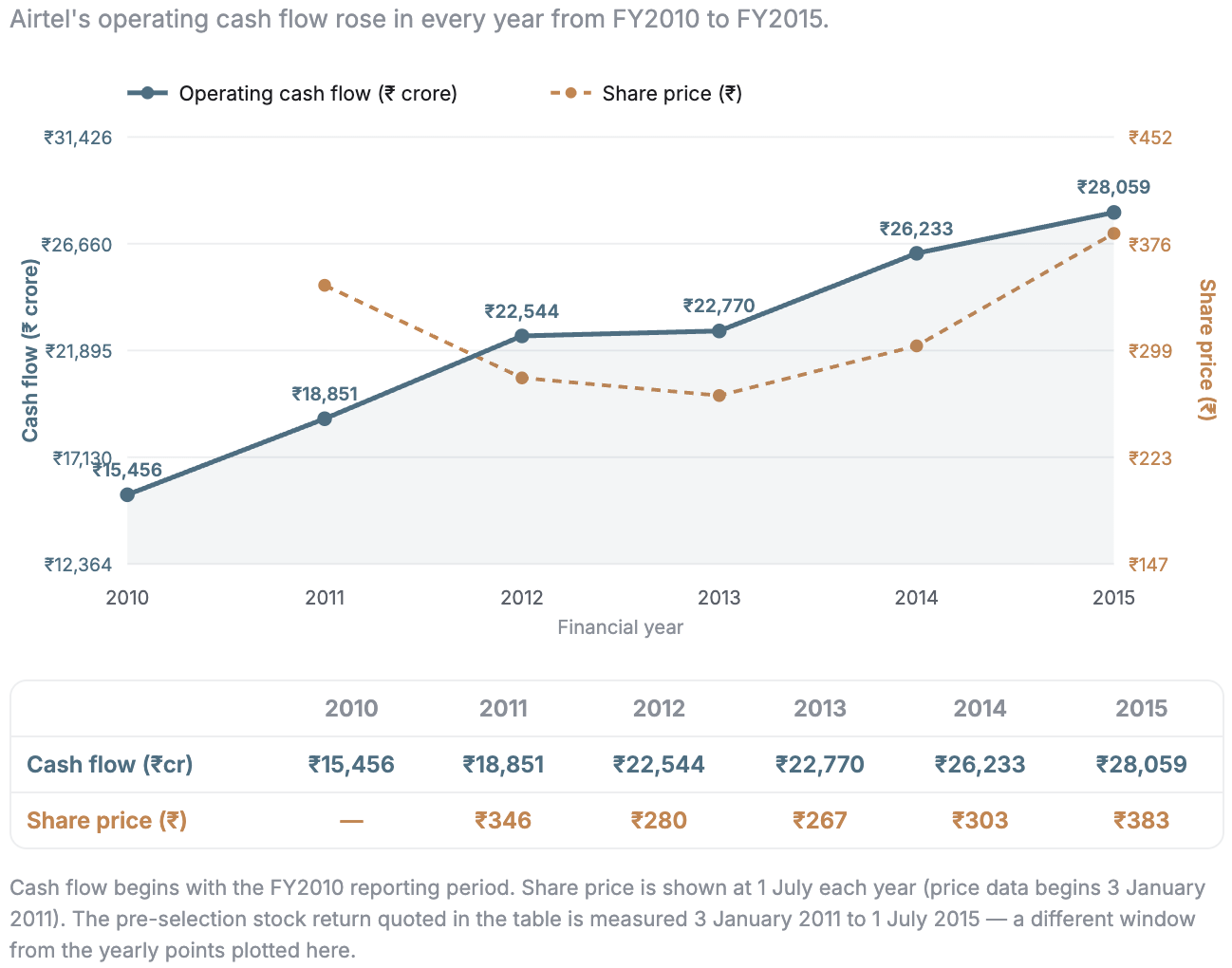
Bharti Airtel
ITC
Motherson Sumi
No company had a clean, uninterrupted decline. GlaxoSmithKline Pharmaceuticals came closest; its cash flow fell from 2010 to 2013, but its next reported figure covered a 15-month reporting-transition period and rose in raw terms, so a decline in every annual step cannot be confirmed.
Most companies fell somewhere in between.
How the 72 companies were distributed
As the table shows, 60 companies had mixed cash flows that rose in some years and fell in others. Another 9 reported negative operating cash flow at least once or were turnaround cases.
That was our first big takeaway.
Investors often picture a healthy business as one where cash flow rises smoothly year after year.
But real businesses rarely work that way.
Operating cash flow can rise or fall depending on when customers pay, how much inventory the company holds, when suppliers are paid and other short-term working-capital changes.
So even a strong company can have a weak cash flow year.
That is why an uninterrupted rise in cash flow is not normal.
It is rare.
The 3 companies with continuous cash-flow growth had very different stock outcomes
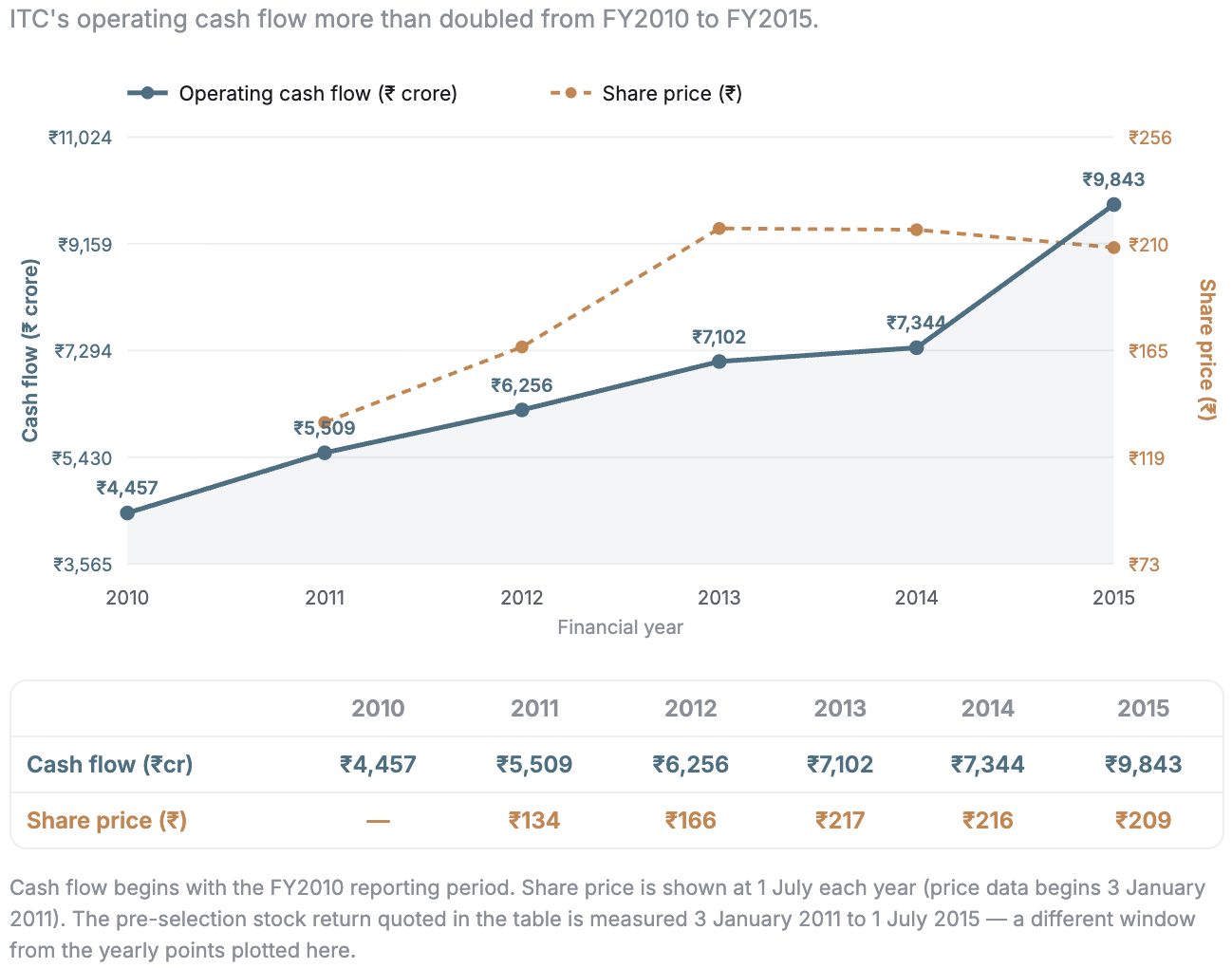
All 3 companies showed the same pattern before July 2015. Their operating cash flow increased in every annual step.
But their stock prices behaved very differently.
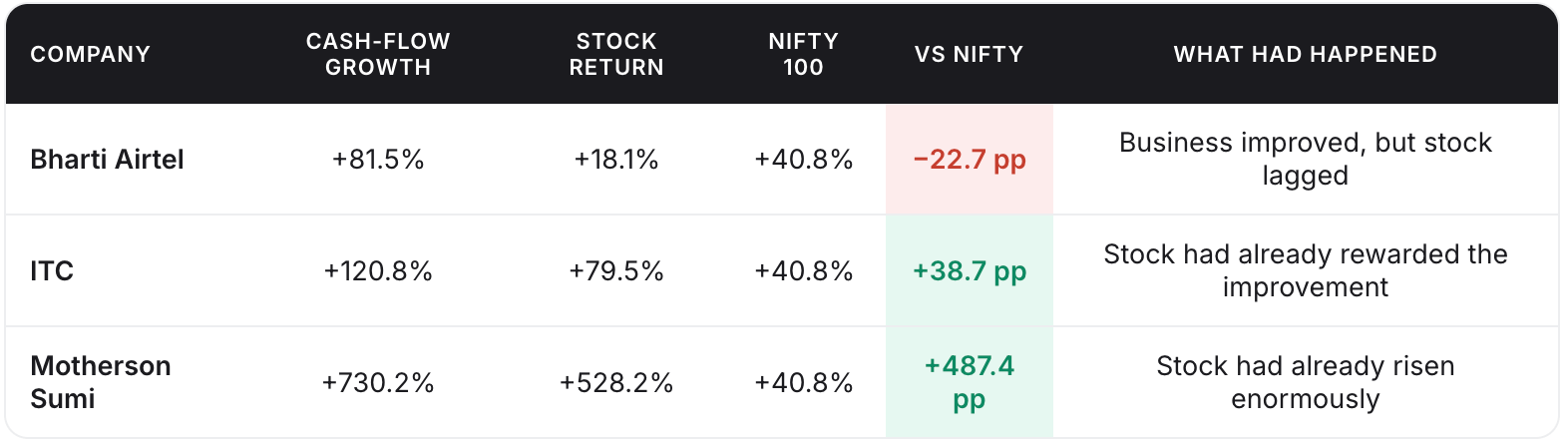
Motherson’s cash flow grew more than 8 times, while its stock had already risen more than 5 times.
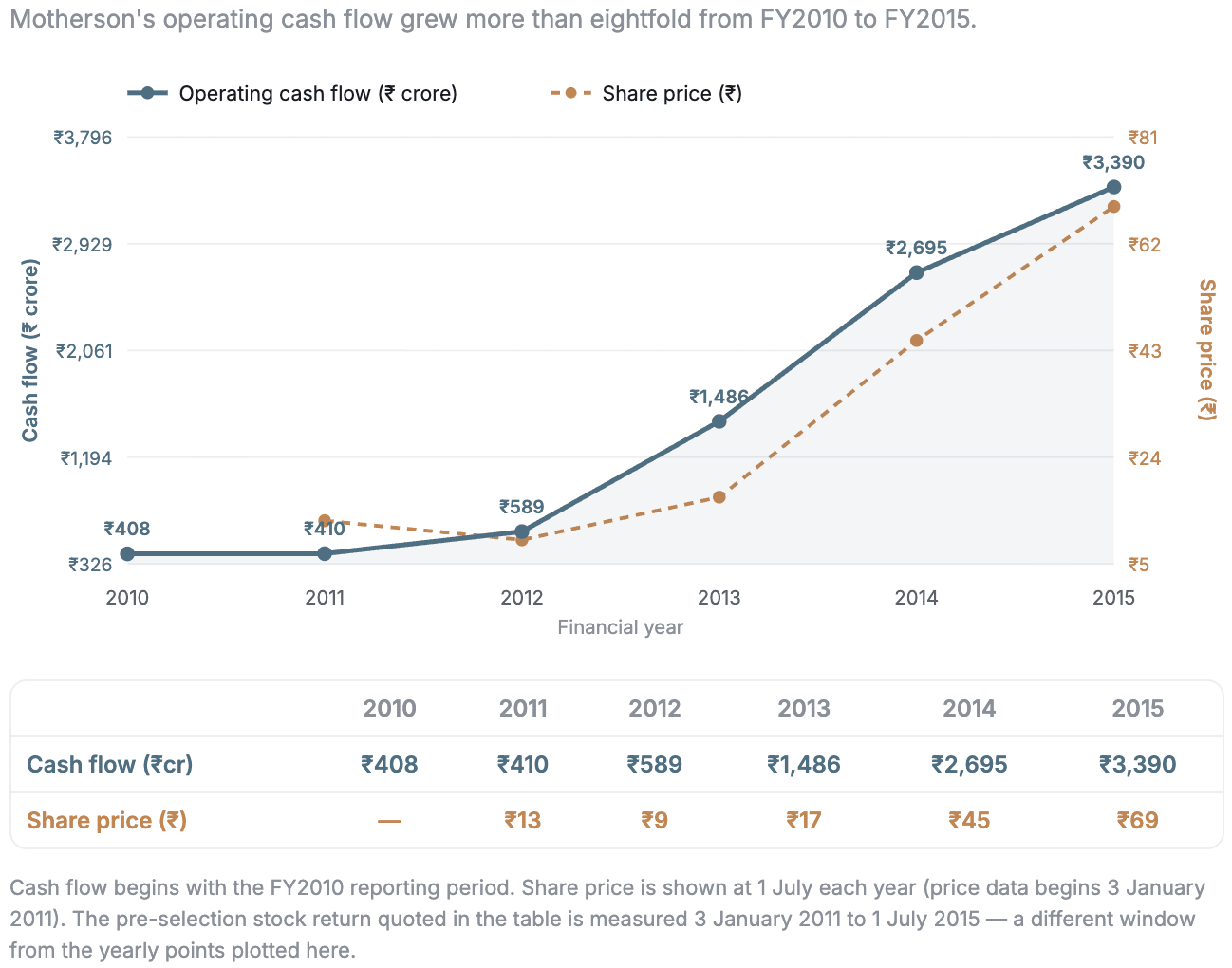
The same cash-flow pattern produced 3 very different market reactions.
In Airtel’s case, the stock lagged. ITC’s improvement was rewarded. Motherson’s stock had already risen sharply.
So even a perfect cash-flow trend was not enough to predict how the stock would behave.
Three companies were still too few to draw a broad conclusion. So we expanded the analysis.
What happened when we looked at more companies?
We first removed 9 companies that had negative operating cash flow in at least 1 year. That left 63 companies with positive cash flow throughout.
We then removed another 8 companies because their stock-price data was affected by major corporate actions or could not be compared properly.
That left us with 55 companies for the final analysis.
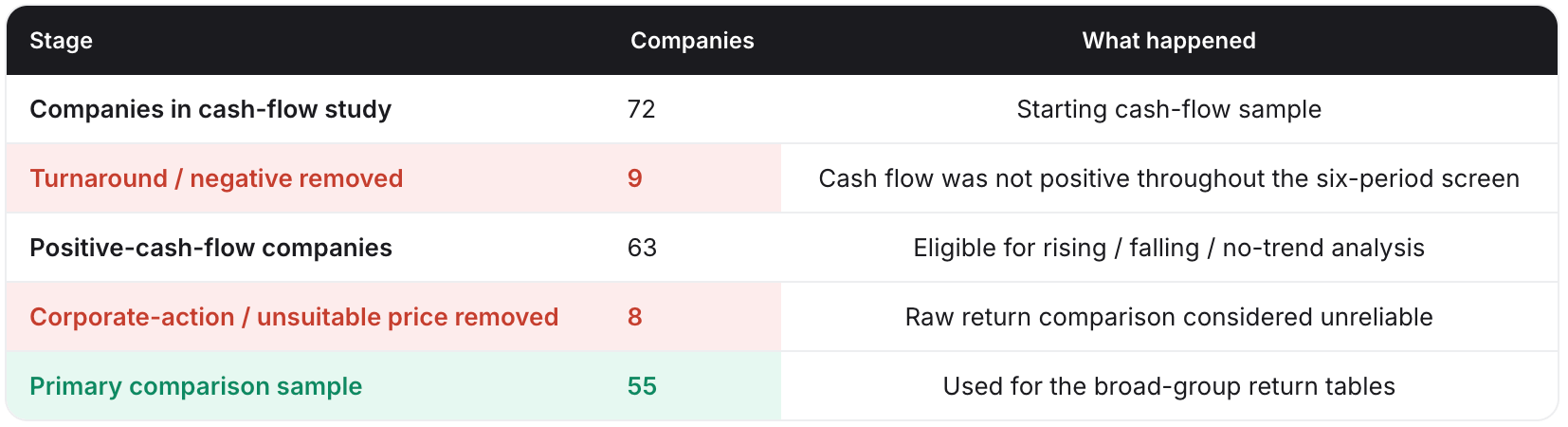
We grouped them based on the overall direction of their operating cash flow:

By July 2026, here’s what we found.
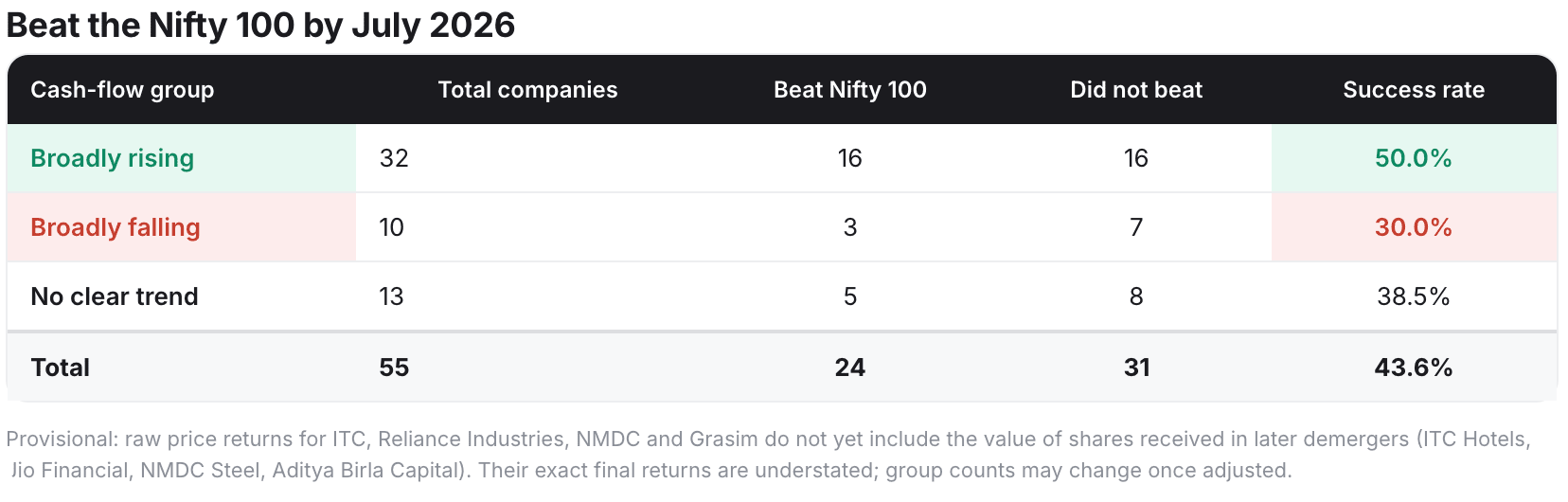
The companies with broadly rising cash flow performed the best overall. 16 out of 32 beat the Nifty 100, compared with just 3 out of 10 in the falling cash-flow group and 5 out of 13 in the no-clear-trend group.
In this study, companies with rising cash flow performed the best overall.
But the study included only 55 companies, and the difference between the groups was not strong enough to prove that rising cash flow can reliably predict better returns.
So it may be a useful observation, but it should not be treated as a dependable stock-picking rule.
But the advantage wasn’t overwhelming. Even in the best-performing group, 16 out of 32 companies still failed to beat the benchmark.
In other words, rising cash flow was a useful signal, but it wasn’t enough to consistently pick winning stocks.
The result changed depending on when it was measured
The table below shows how many companies in each group were beating the Nifty 100 at different checkpoints.
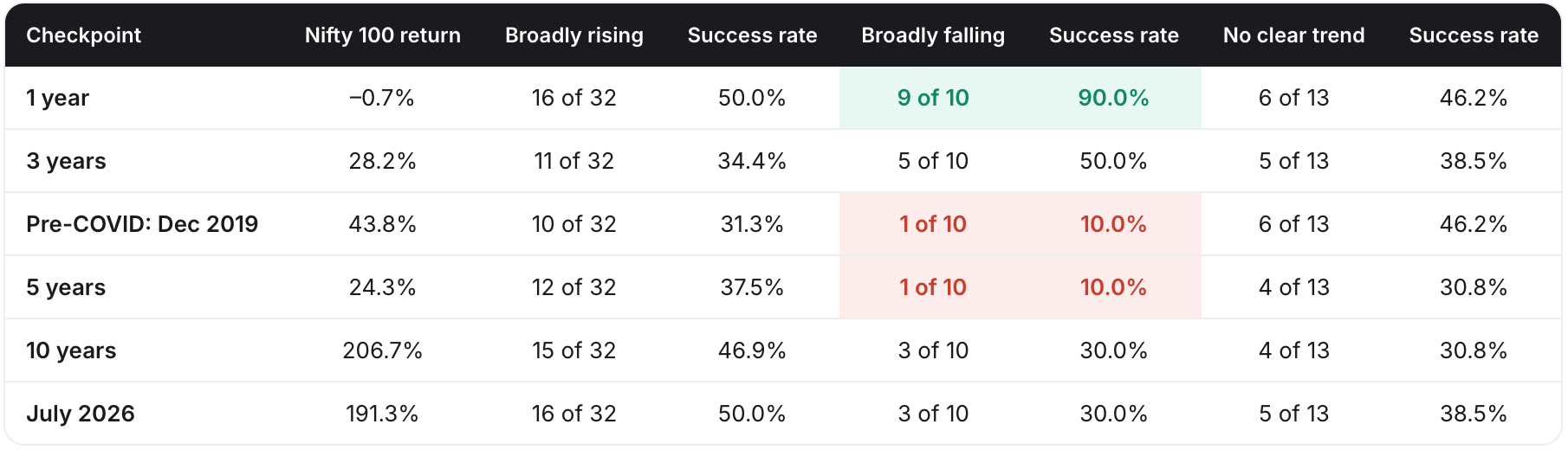
The 1-year results were actually quite surprising. 9 out of 10 companies with falling cash flow beat the Nifty 100. But that early lead didn’t last.
By the 5-year mark, only 1 out of 10 was still ahead of the index. By July 2026, the number had increased only slightly to 3 out of 10.
Companies with rising cash flow followed the opposite path. They performed better over longer holding periods. Even then, the signal wasn’t overwhelming. By July 2026, only 16 out of 32 companies, or 50%, had beaten the Nifty 100.
The stock’s earlier performance also mattered
We then looked at the 32 companies whose operating cash flow was broadly rising before July 2015. Out of these, 23 stocks had already beaten the Nifty 100, while 9 had lagged the index.

Among the 23 stocks that had already beaten the Nifty 100 before July 2015, only 10 beat the index again over the next 11 years.
The 9 stocks that had previously lagged did better. Of these, 6 went on to beat the Nifty 100.
So, in this small sample, companies with rising cash flow did better when their stocks had not already performed strongly.
But this needs to be read carefully.
There were only 9 companies in the lagging group. And a stock may lag the market for many valid reasons. The company may have weak profit growth, rising debt, industry problems or concerns about what happens next.
So this does not mean every stock with rising cash flow and weak past performance is automatically a good investment.
It only tells us that earlier stock performance may have mattered. The study did not directly check whether these stocks were cheap or expensive.
Conclusion
We started this study with a simple question.
If a company keeps generating more operating cash, does that make it a better investment?
The study clearly suggests that cash flow alone is not enough.
Companies with rising cash flow performed better overall than those with falling cash flow. But even in the strongest group, only around half managed to beat the Nifty 100 over the next 11 years.
That is because cash flow tells us only one part of the story. It shows whether the business is bringing in real money from its operations. But it does not tell us whether the stock is expensive, how much debt the company has, whether margins are improving, how management uses the cash, or what investors are already expecting.
That is why a company can keep generating more cash and still disappoint shareholders. The opposite can happen too. Cash flow may weaken for some time while the stock performs well because expectations or future prospects improve.
So cash flow is a good place to begin analysing a company. But it should not be used alone.
Cash flow helps us understand the business. To understand the investment, we also need to look at valuation, debt, competition, capital allocation and future expectations.
Very insightful. Keep posting such articles.
Very deep analysis