

Some investors connect rising oil prices with falling stock markets.
And there is a reason for that.
India imports more than 80% of the crude oil it uses. So when oil gets expensive, India has to spend more dollars on imports.
That can put pressure on the rupee, increase fuel and transport costs, push up inflation and raise costs for companies.
But oil shocks usually come with something else too.
Wars, sanctions, supply cuts and recessions can push crude prices higher while also creating fear across global markets.
So when oil shoots up, investors are often dealing with expensive oil and a broader crisis at the same time.
One of the clearest examples is what happened in 2008.
Oil prices had surged due to concerns about the global economy. On 3 July, Brent crude closed at $143.95 a barrel, its highest price ever at the time.
Goldman Sachs was even talking about oil reaching $200.
For India, the worry was obvious. Oil was extremely expensive. The rupee was weakening. Companies were facing higher costs.
And the stock market was already falling.
Nifty had already fallen over 36% from the start of the year. It fell another 20% over the next six months. A big spike in oil prices meant a sharp fall in the stock market.
This pattern has repeated multiple times, both before and after 2008. Many investors are faced with this dilemma when oil prices rally a lot.
The news is alarming, and the markets are falling. The panic can nudge the investors to sell their positions.
In a situation like that, it is easy to feel like things could get worse.
The logic here is that if higher oil prices can hurt companies by raising costs, and if profits come under pressure, stocks could fall further.
So selling your portfolio and waiting for things to calm down can feel like the safer move.
But does panic-selling during an oil shock actually end up doing you good?
Or do you end up selling after the fall has already happened and then miss the recovery?
We decided to test this belief. First, does a massive oil shock really mean your portfolio is doomed over the long run? And second, did the belief on the most vulnerable sector and the safer sectors hold?
The Study
We looked at 25 years of Brent Crude spot prices from the US Energy Information Administration (EIA) and found 8 oil shock events.
These 8 events signified any time oil prices surged by 25% or more from a local trough to a peak within a short timeframe.
Why 25% specifically?
Because a slow rise in oil over a long period usually gives people and businesses time to adjust. What tends to create more panic is when oil suddenly jumps in a short period of time.
We also kept a six-month gap between two oil shocks, so the same volatile period would not get counted more than once.
This way of shortlisting gave us 8 distinct oil shock events from 2000 to 2023.
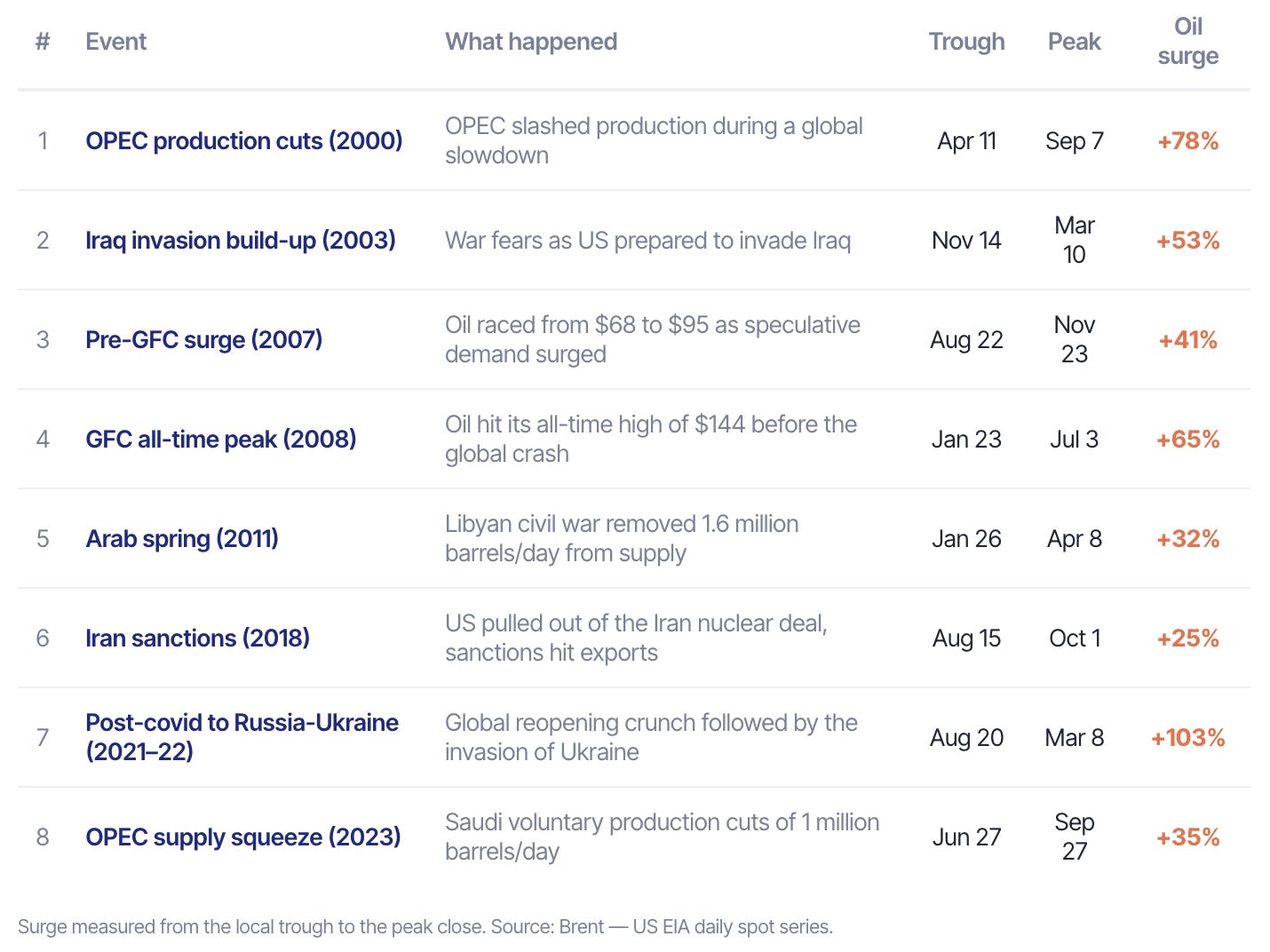
For each oil shock, we picked two dates using EIA daily Brent data:
Trough: the lowest Brent price before the sharp rise began.
Peak panic date: the highest Brent closing price during that shock.
From the peak panic date, we tracked the Nifty 50 and four sector indices after 1 month, 6 months, and 12 months.
If the date fell on a weekend or market holiday, we used the next trading day’s closing price.
All index data came from NSE daily closing prices.
What happened to the Nifty 50?
The average oil surge across these 8 events was 54%.
These weren’t small moves. Each one dominated headlines and triggered real fear in the market.
The first month was usually weak
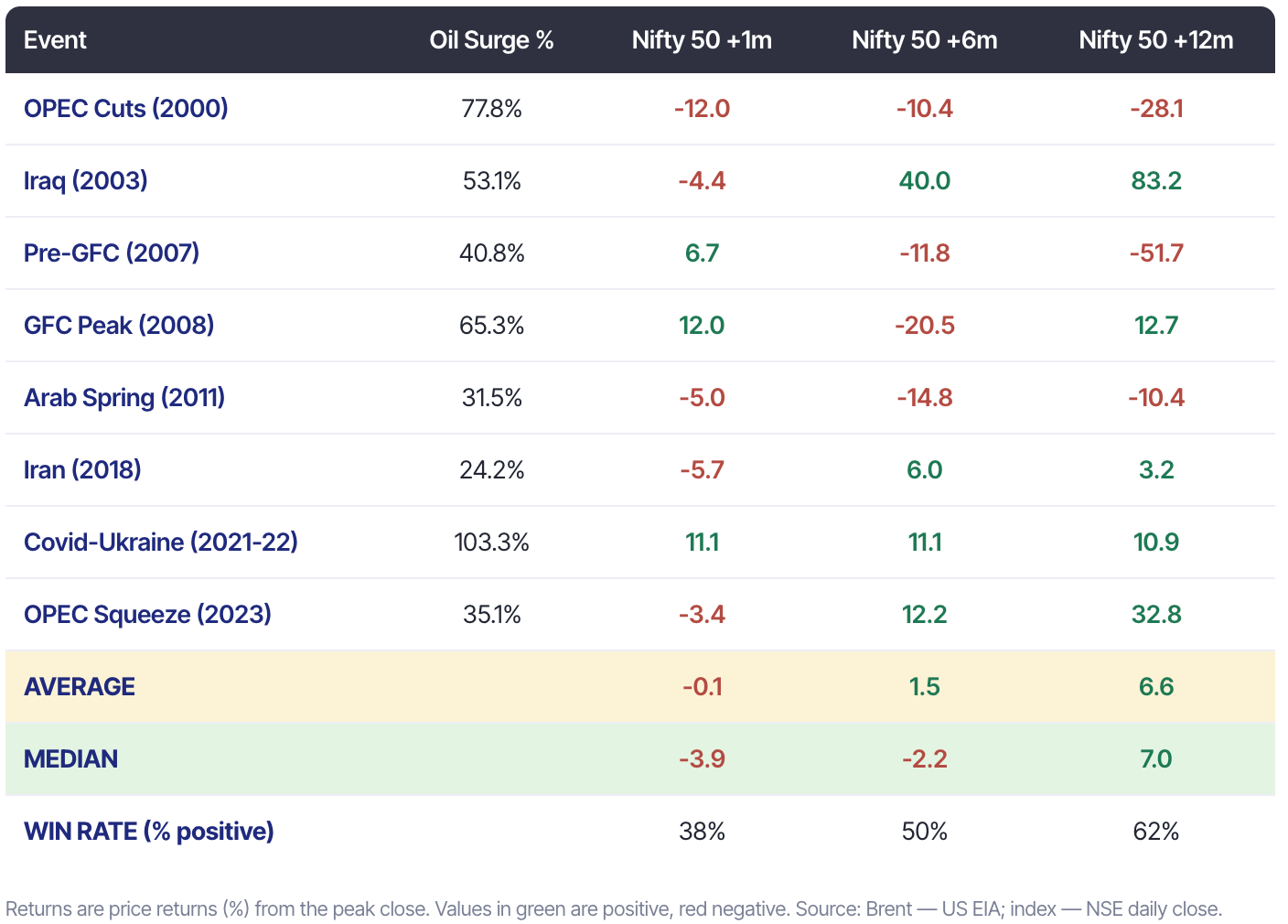
One month after oil prices peaked, Nifty was lower in 5 out of 8 events. The median return was around -4%.
So, even after oil had stopped rising, the market often remained weak for some time.
There are several possible reasons. India imports a large part of the crude oil it needs. So higher oil prices can increase the country’s import bill, put pressure on the rupee and make transport and other costs more expensive.
Companies may also have to spend more on raw materials and transportation. If they cannot pass these higher costs on to customers, their profit margins can come under pressure. Consumers may also cut spending as prices rise.
But we cannot say that oil alone caused the market to fall. These periods also had wars, recessions, policy changes and several other events affecting markets.
All the data tells us is this: one month after oil peaked, Nifty was down more often than up.
Six months later, there was no clear trend
Six months after the oil peak, Nifty was higher in 4 out of 8 events and lower in the other 4.
By then, many other things were affecting the market too. Interest rates, company profits, economic growth, liquidity and demand had all started to matter.
Oil was still important, but it was no longer the only major factor.
One year later, Nifty was higher more often than not
One year after the oil peak, Nifty was higher in 5 out of 8 events.
That is quite different from the first month, when Nifty was lower in 5 out of 8 events.
But this does not mean markets always recovered.
Nifty was still down after one year in 3 events. Two of those falls were very large. It was down 28.1% after the 2000 oil shock and 51.7% after the 2007 oil surge.
But oil was not the only reason for these falls. The 2000 period came around the dot-com crash, while the 2007 event was followed by the global financial crisis.
The same applies to the strong years. Nifty rose 83.2% after the 2003 oil peak and 32.8% after the 2023 event. Those gains also happened because of many factors, not just because oil prices had peaked.
What does this tell us?
A sharp rise in oil prices can create real pressure on the Indian market, especially in the short term.
But an oil shock alone does not tell us where Nifty will be one year later.
The market may recover, stay weak or fall further depending on what else is happening in the economy and the world.
What happened across sectors?
The Nifty shows what happened to the overall market. But different sectors can react very differently when oil becomes expensive.
So we looked at four major sectors: Auto, Banks, IT and Pharma.
Auto can be affected because higher fuel prices can hurt vehicle demand and increase input costs. Banks can be affected if higher inflation leads to changes in interest rates and borrowing conditions.
IT and Pharma earn a large part of their revenue from outside India, so a weaker rupee can sometimes help them.
For this part, we looked at the six oil shocks from 2007 onward because we had consistent data for all four sectors from this period.
Auto was not always the worst hit
Auto looks like one of the most obvious sectors to suffer when oil prices rise.
Higher fuel prices can make owning and using a vehicle more expensive. At the same time, materials such as plastics and synthetic rubber can also become costlier.\
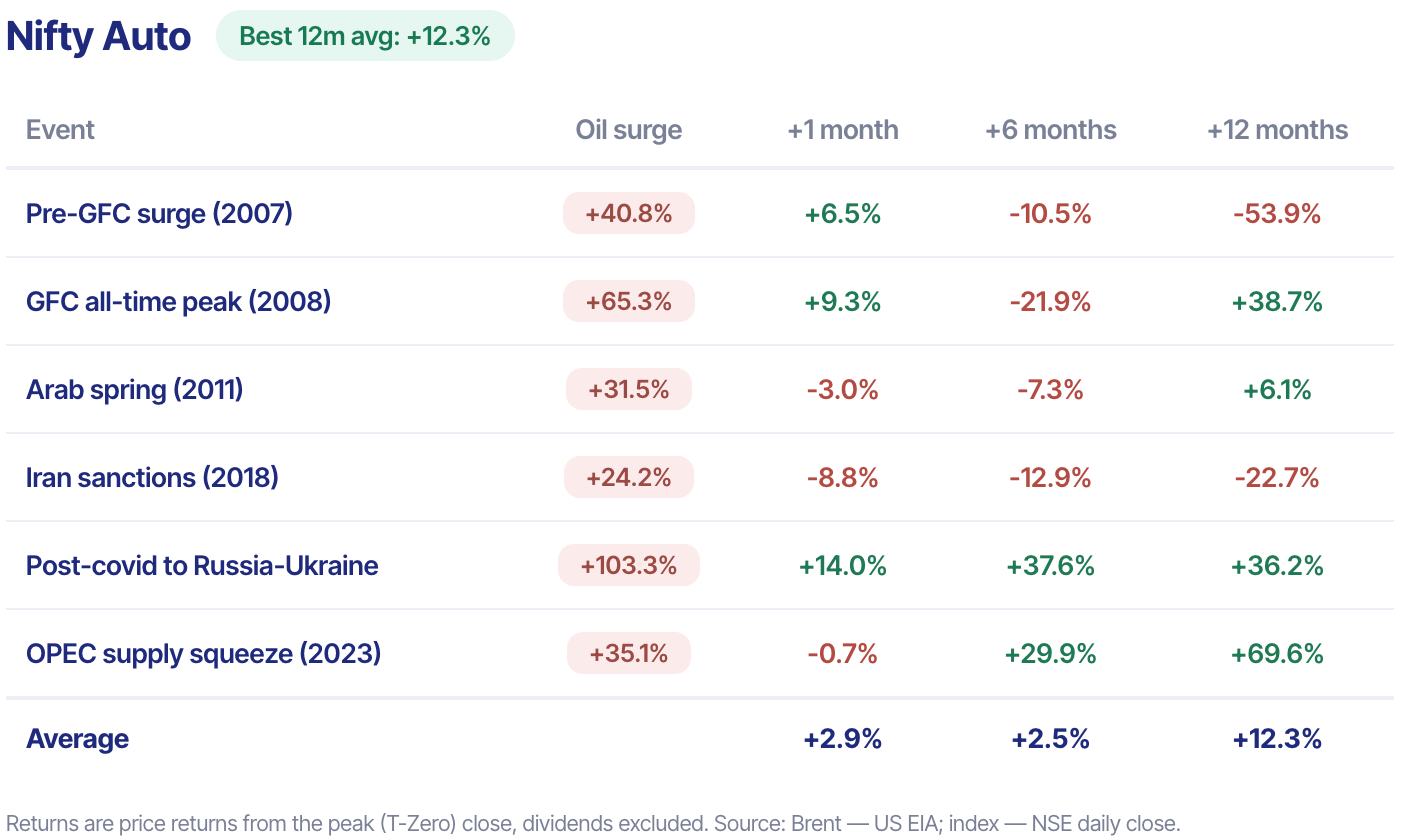
But one year after the oil peak, Nifty Auto was actually higher in 4 out of 6 events.
The returns after a year, were very different from one event to another. Auto fell 53.9% after the 2007 oil peak and 22.7% after the 2018 event. But it rose 38.7% after the July 2008 peak and 69.6% after the 2023 oil squeeze.
This does not mean auto stocks are safe when oil prices rise.
It simply shows that a sector being badly affected by expensive oil does not automatically mean its stocks will perform badly over the next year. A lot depends on other factors and events in the economy and markets.
Banks depended a lot on what else was happening
Banks showed a similar pattern.
Nifty Bank was higher one year later in 4 out of 6 oil shocks. But the returns differed sharply across events.
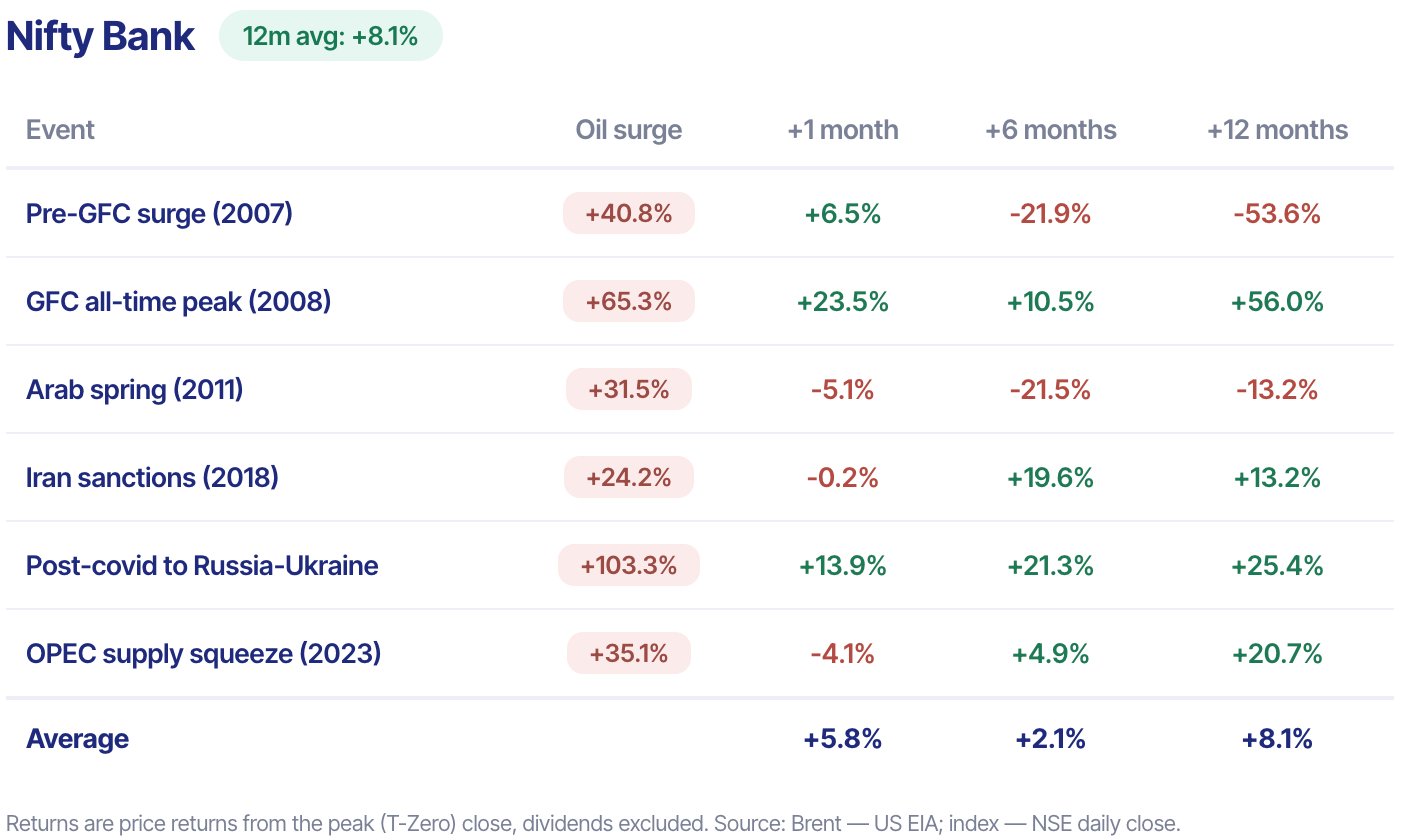
The best examples are 2007 and 2008.
After the November 2007 oil peak, Bank Nifty fell 53.6% over the next year.
After the July 2008 oil peak, it rose 56% over the next year.
Oil prices were a concern in both periods. But the overall situation was very different.
By late 2007, the global financial crisis was getting worse. By July 2008, banking stocks had already fallen sharply.
We cannot say exactly how much of these returns came because of oil. But one thing is clear: oil alone could not explain what happened to banking stocks.
IT was not much of a shield
IT is often expected to benefit when the rupee weakens because large Indian IT companies earn a lot of money in dollars.
But that did not lead to strong stock returns in these oil shocks.
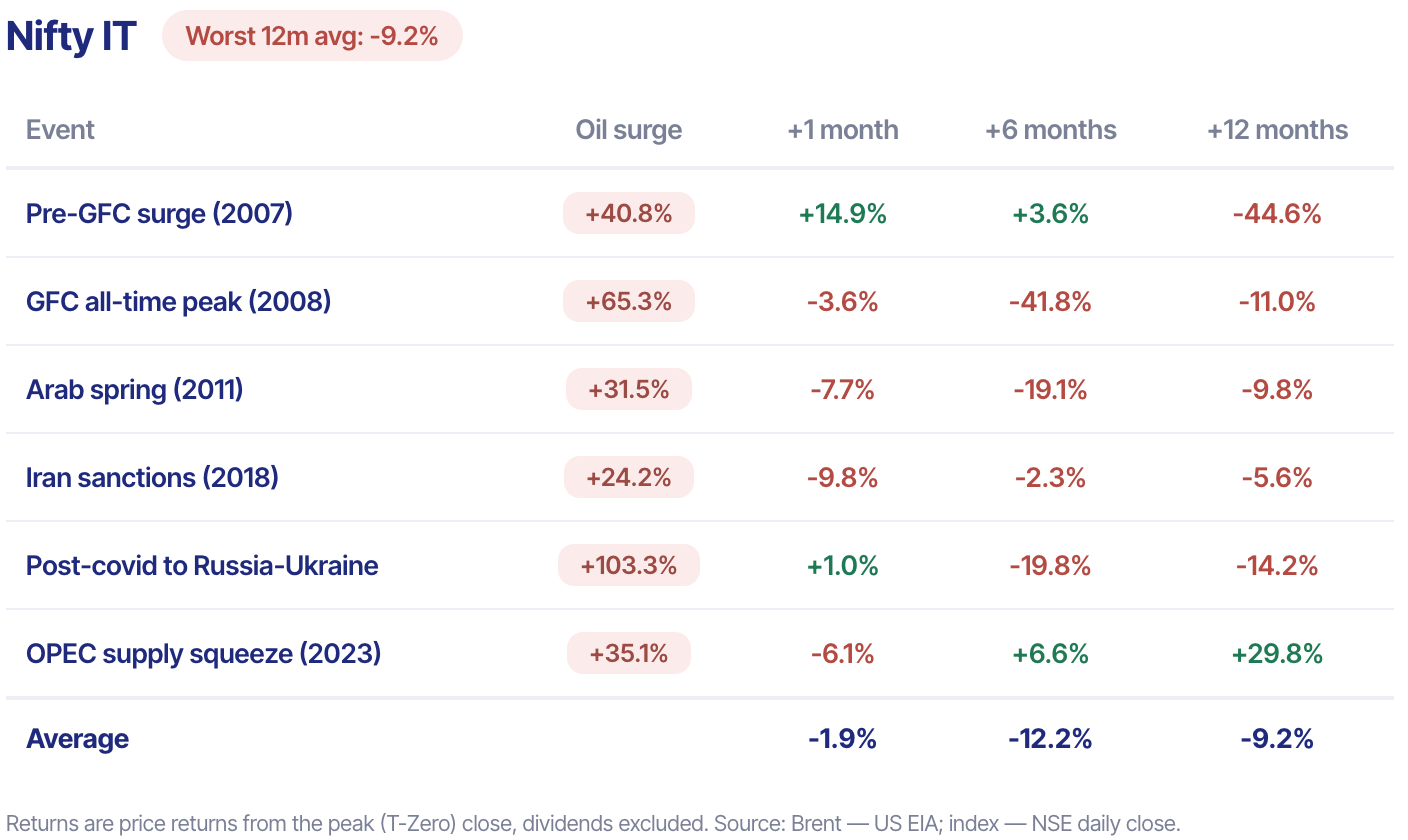
Nifty IT was higher one year later in only 1 out of 6 events.
It was also higher after one month in only 2 out of 6 events and after six months in only 2 out of 6.
A weaker rupee can help IT companies. But many other things matter too, such as global technology spending, company profits and stock valuations.
So a weaker rupee alone was not enough to protect IT stocks.
Pharma was mixed too
Pharma is also seen as a relatively defensive sector.
People still need medicines even when the economy slows down, and many Indian pharma companies also earn money overseas.
But the results were mixed.
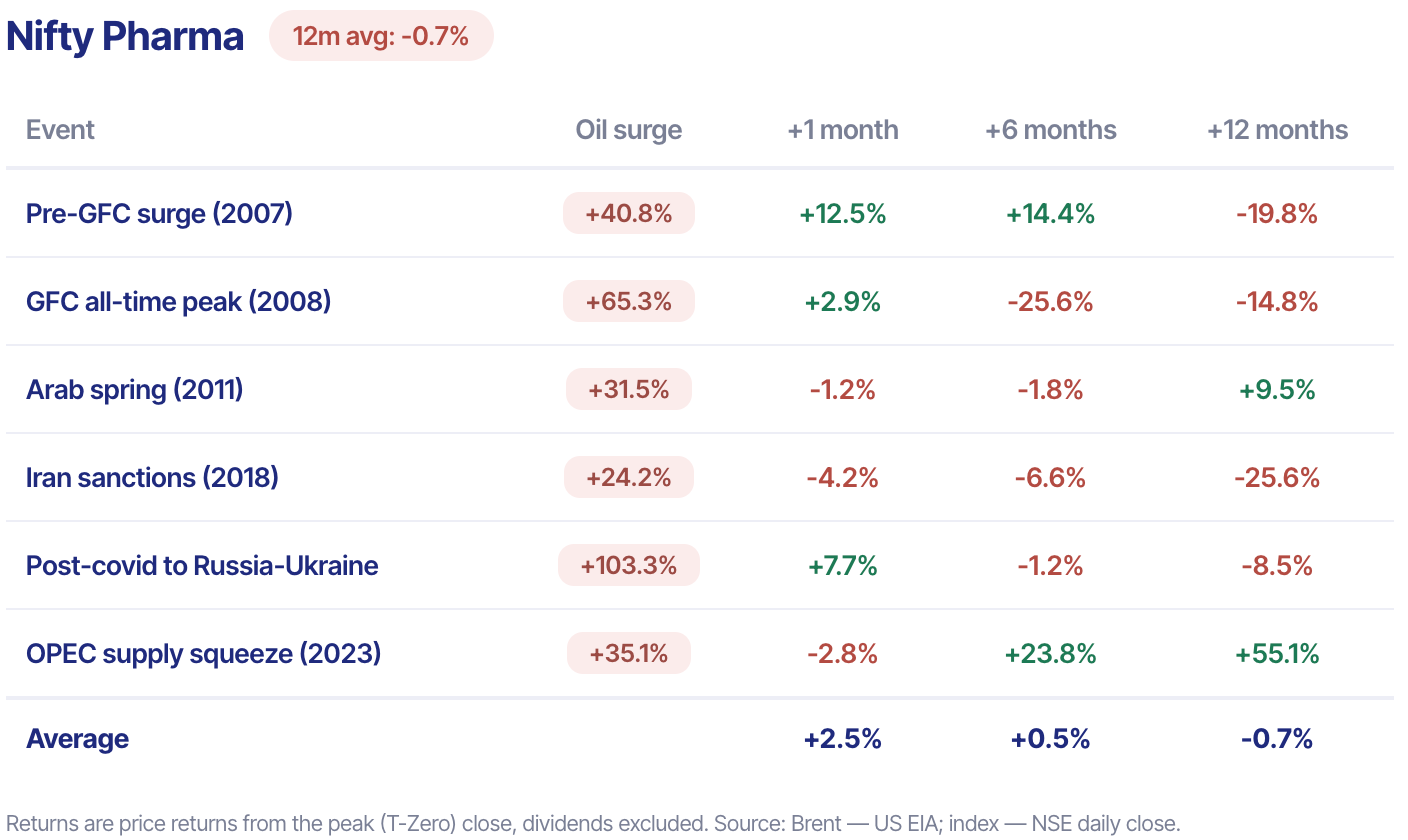
Nifty Pharma was higher one month later in 3 out of 6 events.
One year later, it was higher in only 2 out of 6.
So neither IT nor Pharma worked as a reliable protection against oil shocks. Sometimes they performed well and sometimes they did not.
Conclusion
So what if you had sold your entire portfolio every time oil prices peaked?
If you sold and stayed out of the market for the next 12 months, you would have missed gains in 5 out of 8 events because Nifty ended the year higher.
But selling would have helped in the other 3 events, including the huge market falls after the 2000 and 2007 oil shocks.
So selling was not always a bad decision. It was simply not a strategy that worked consistently.
In the short term, markets were usually weak. One month after the oil peak, Nifty was lower in 5 out of 8 events.
But over longer periods, oil alone became less useful in telling us where the market would go. Other things such as the economy, interest rates, company earnings and global events started to matter much more.
The sector data tells the same story.
Auto looks like one of the obvious losers when oil gets expensive. Yet it was higher one year later in 4 out of 6 events.
IT can benefit from a weaker rupee. Yet it was higher one year later in only 1 out of 6.
So a sharp rise in crude oil is definitely something Indian investors should pay attention to, especially because India imports a large part of the oil it uses.
But history does not show that a rise in oil prices, by itself, was a reliable reason to sell Indian stocks.
And there is one more important point.
In this study, we assume that an investor somehow managed to sell on the exact day oil reached its peak.
In real life, you do not know that it is the peak until much later.
Notes
Brent crude oil prices are taken from the US Energy Information Administration (EIA). Nifty and sector index levels are based on NSE daily closing data.
All returns are based only on changes in index prices. Dividends are not included.
We have used closing prices, so intraday movements are not captured.
The 2018 Iran oil shock rose 24.2% in our data. So the 25% oil-shock filter should be treated as an approximate cutoff, not an exact one.
The Nifty analysis covers 8 historical oil shocks. The sector analysis covers 6 events from 2007 onward. Since the sample is small, these results should be treated as historical observations, not as a prediction of what will happen in the next oil shock.
The study does not assume when an investor would buy back into the market after selling. It also does not include returns earned on cash, taxes or transaction costs.
Past performance does not guarantee future results. A future oil shock could play out very differently, especially if the supply disruption is larger or lasts much longer.