

Sears declared bankruptcy on 15 Oct 2018.
It had to pay back a $134 million loan that day.
Filing for bankruptcy was formally saying they wouldn’t be able to pay or needed more time.
Sears was a department store in the USA that touched its peak some time in the 1980s.
In the 2010s, it was a struggling company with a large debt on its head.
Investors were aware of the company’s condition. It didn’t happen all of a sudden. It was a slow march downwards.
Its shares had been trading at a peak of around $115 in 2007. Since then, it had been on a downward path with some upward pulls in between.
When the company announced bankruptcy, it was not a shock to the investors. They saw it coming.
Long before Oct 2018, the share price had fallen below $1.

After the announcement, the share price more or less stayed in the same range. Somewhere moving above and below the $0.50 mark.
Why?
Why did it not fall to $0?
Well, it had fallen to a very low value because most investors thought it was not going to recover. So they sold and sold and sold.
Then, it reached a price that was incredibly low. At these levels, the only investors who were still holding the stock (or buying it) were those that believed that the company would turn around.
Many didn’t necessarily believe the turnaround would happen. But they bought anyway just in case (because the price was so low, they didn’t mind losing it).
Some were buying and selling every day (they didn’t care about the company). All they cared about was how the price was behaving. They were playing more on the human psychology of fear and greed.
The final nail in the coffin came a year later in 2019.
It was declared that the shareholders would get nothing. The company would be shut down. Its assets would be sold to recover the debt dues.
Shareholders would get nothing.
And yet, the share price did not fall to $0. It kept hovering somewhere in the $0.20 to $0.40 range.
Why?
It was declared that shareholders would not get anything. Why were there investors who were still buying these shares? Why didn’t all buyers vanish and the price fall to $0?
Different investors. Different ideas.
A very tiny portion of shareholders were still hoping for a miracle. Some did not understand the gravity of the situation and expected a bounce back.
Some didn’t care. They were just trading and speculating using the stock — playing games like passing a ball between two players.
Eventually, the shares were delisted and taken off the share markets. They were cancelled on 31st Oct 2022.
The last traded price was $0.10 (and not $0).
The message here is that the stock markets are filled with many different kinds of investors and traders. They all have different philosophies and timelines.
Those philosophies and timelines might not match. And that’s the beauty of the markets.
Because everyone is thinking in different ways, the buyer almost always thinks they are making a good deal. The seller (who is literally selling the same stocks to the buyer) is also thinking they are making a good deal.
The funny thing is, they both can be right in their own ways!
Types of Market Participants: Long Term
That heading, it’s just a fancy way of saying “Types of Investors in the Stock Markets”.
There are a few different types of ‘market participants’. They all may be in it for different durations, different goals, different returns, and different philosophies.
The one thing that unites them, though, is this: make money.
Let’s look at the major investing groups.
Promoters:
They are the founders or owning family of the companies that are listed. In India, they often command large portions of the share market.
That is, a large portion of Indian shares are owned by promoters. It is not uncommon to see promoters own 40-50% of a company. In the case of Western companies, this number is usually lower (closer to 10-20%).
This category of shareholders tends to stick around the longest. They almost never sell. They may sell small portions of their holdings during overvalued bull phases and buy the same shares back during undervalued bear phases.
Sometimes, they may sell or buy for other reasons.
But the point still holds. They do not usually sell. For them, it’s more about control over the company.
By the way, the Government can also be a promoter of a company. It’s not always a private player. That’s what happens in the case of PSU (Public Sector Undertaking).
Pension Funds:
In the case of India, this would be EPFO.
They blindly invest in index funds or ETFs. They are buying every month. They don’t care if the markets are undervalued, overvalued, or fairly valued.
They don’t even care if the company they are investing in has good future prospects or otherwise. Index investing only.
For that reason, they are incredibly long term investors. Running for decades. When a company falls out of an index is when they also sell.
SWFs:
SWFs or Sovereign Wealth Funds, are funds that are government-owned. It’s like a mutual fund with only one customer: a government body.
Different countries have different SWFs that invest across the globe. Norway’s SWF is one of the biggest in the world. Singapore’s SWF is also quite huge. There are many like that.
They often do actively choose the companies they want to invest in. But again, they are very patient investors. They do not invest in and exit companies very fast.
It is common to see them hold on to stocks for more than a decade.
Mutual funds:
Mutual funds usually hold stocks long-term. When they buy a stock, they do so with an aim of holding for a few years at least.
Yes, they do exit before that if some negative event happens or they feel the stock has reached an overvalued state and profit booking is possible.
But it is possible that they sell before that as well.
PMS:
PMS or Portfolio Management Services are similar to mutual funds, but for higher amounts.
They are allowed to accept a minimum of Rs 50 lakh. This is clearly designed for an investor comfortable with risk.
PMS tend to behave similar to mutual funds. But they can be more opportunistic. Which means, they can sell much sooner than mutual funds.
It is not uncommon for them to sell within 1-3 years of holding. Sometimes, they sell even before that.
Family Offices:
These investors are usually investing for one family. They tend to stick around long term, usually.

UHNIs (Ultra High Net Worth Individuals) and family offices are often the same thing or behave similarly.
Their investments could be held for any period from a few years to decades.
Types of Market Participants: Short Term
So far, we spoke about the kind of investors who buy and usually hold a stock for months, years, and decades.
When you go to buy or sell a stock, most large stocks are available almost all the time. Which means, someone is selling or buying those stocks all the time.
This is possible only if there are many different long term holders. So, inevitably, there is always someone buying or selling.
Or, there are other investors who buy and sell over much shorter periods of time.
Which do you think is the case?
Yes, there is a class of investors buying and selling over much shorter periods of time.
The reality is that we are easily able to buy or sell stocks because both long term and short term investors are plentiful in the markets.
Let’s look at some of the short term investor types.
Arbitrage Traders:
These are some of the fastest traders in the market. They do not care about what the company’s shares are, or how the company is doing.
They simply use arbitrage opportunities to trade.
The simplest example of this is if a stock is trading on two different exchanges (NSE and BSE), they monitor the shares’ price on both. If the price is even slightly different, they buy shares from the cheaper exchange and sell on the more expensive exchange.
This actually causes the share price to rise (where it used to be cheaper) and fall (where it used to be more expensive).
This is why shares of the same company have a very similar share price even on different exchanges. The difference is negligible.
This is how they earn their profit.
They can buy and sell shares in a matter of seconds or even milliseconds.
HFTs:
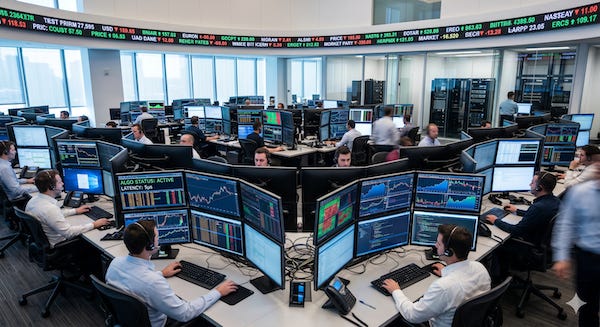
Similarly, High Frequency Traders (HFTs) rely on various strategies to buy and sell shares. They usually buy and sell within milliseconds.
HFTs can use a multitude of strategies that vary from HFT to HFT.
But the common theme across them is their speed.
Retail Traders:
These are individual traders. If you have a job or business, while also trading stocks, and you operate individually (not as a team), you come under this category.
This segment of investors tends to hold anywhere from a few minutes to a few hours (in case of intraday trading).
Many retail traders also take positional bets which may last a few days to few weeks.
Retail Investors:
These are individual stock market investors (not traders) who pick their own stocks.
This segment is very varied — there are all sorts of different investors, and they invest differently.
They usually hold a stock for anywhere from 1 year to a couple of years.
The Other Side
If there’s one thing you need to understand from this write up, it’s this: you never know who is on the other side of the trade.
And you do not need to.
There is an exception to this though.
Block Deal:
A block deal is a trade where both parties know each other. This is more like a traditional deal. Two parties meet. One is the seller. The other is the buyer. They agree on the number of shares, and the price per share.
At a fixed hour, their trade is settled. The shares change hands.
In India, this happens during two windows: 8:45 AM to 9:00 AM and 2:05 PM to 2:20 PM.
Block deals can only take place if the value of the deal is worth more than Rs 25 crore or a large number of shares are changing hands.
Since the price is fixed, it does not affect the share’s demand and supply in the open markets. So, it does not change or affect the live share price.
But when the news of a block deal gets out, many investors get influenced. Some might see it as a good event. Some might see it as a bad event. Buying/selling because of the news of a block deal can certainly affect the share price.
This must not be confused with another type of a deal called bulk deal.
Bulk Deal:
A bulk deal happens when one investor (or investing entity) buys/sells more than 0.5% of a company’s shares.
This happens during market hours and the buyer/seller does not need to know each other. It is an open market buy/sell order just like any other buy/sell order.
It’s just that this order is so big, it can affect the share price (increased demand leads to increased price and vice versa).
So there you go.
When you sell, you have no clue who the buyer is. When you buy, you have no clue who the seller is.
Maybe the other side is selling because they know something bad is going to happen. Or maybe, it’s all good but they need that money for a personal reason.

Maybe they found another better investment while this one continues to be very good.
They have their reasons to do what they are doing. You have yours. Win-win.
Quick Takes
+ India’s annual inflation rate rose marginally to 3.48% in April (vs 3.40% in March).
+ The Indian Rupee reached an all time low, falling beyond Rs 95.5 per USD.
+ India’s equity mutual funds inflows rose 58% year-on-year to Rs 38,440.20 crore in April (vs an inflow of Rs 40,450 crore in March). Debt funds inflows rose 12.9% to Rs 2.47 lakh crore (vs an outflow of Rs 2.94 lakh crore in March): AMFI
+ The government approved a scheme worth Rs 37,500 crore to support coal and lignite gasification projects, aiming to reduce India’s dependence on imports like LNG, urea, ammonia, and methanol.
+ India has signed an MoU with South Korea’s HD Korea Shipbuilding & Offshore Engineering to develop a mega greenfield shipyard at Thoothukudi, Tamil Nadu.
+ India’s wholesale inflation rose 8.3% year-on-year in April (vs 3.88% in March). Wholesale fuel and power inflation rose to 24.71% (vs 1.05% in March).
+ The Indian Rupee hit a fresh all-time low, crossing Rs 96 per USD during the day before settling at Rs 95.92 against the US dollar.
+ India’s merchandise exports grew 13.79% year-on-year in April and imports grew 10.03%. The merchandise trade deficit rose to $28.38 billion.
+ India’s forex reserves rose by $6.3 billion to $696.99 billion in the week that ended on 8 May.
+ India’s unemployment rate rose marginally to 5.2% in April, (vs to 5.1% in March).
+ India’s passenger vehicle sales rose 25.4% year-on-year to 4.37 lakh units in April: SIAM
The information contained in this Groww Digest is purely for knowledge. This Groww Digest does not contain any recommendations or advice.
Team Groww Digest