
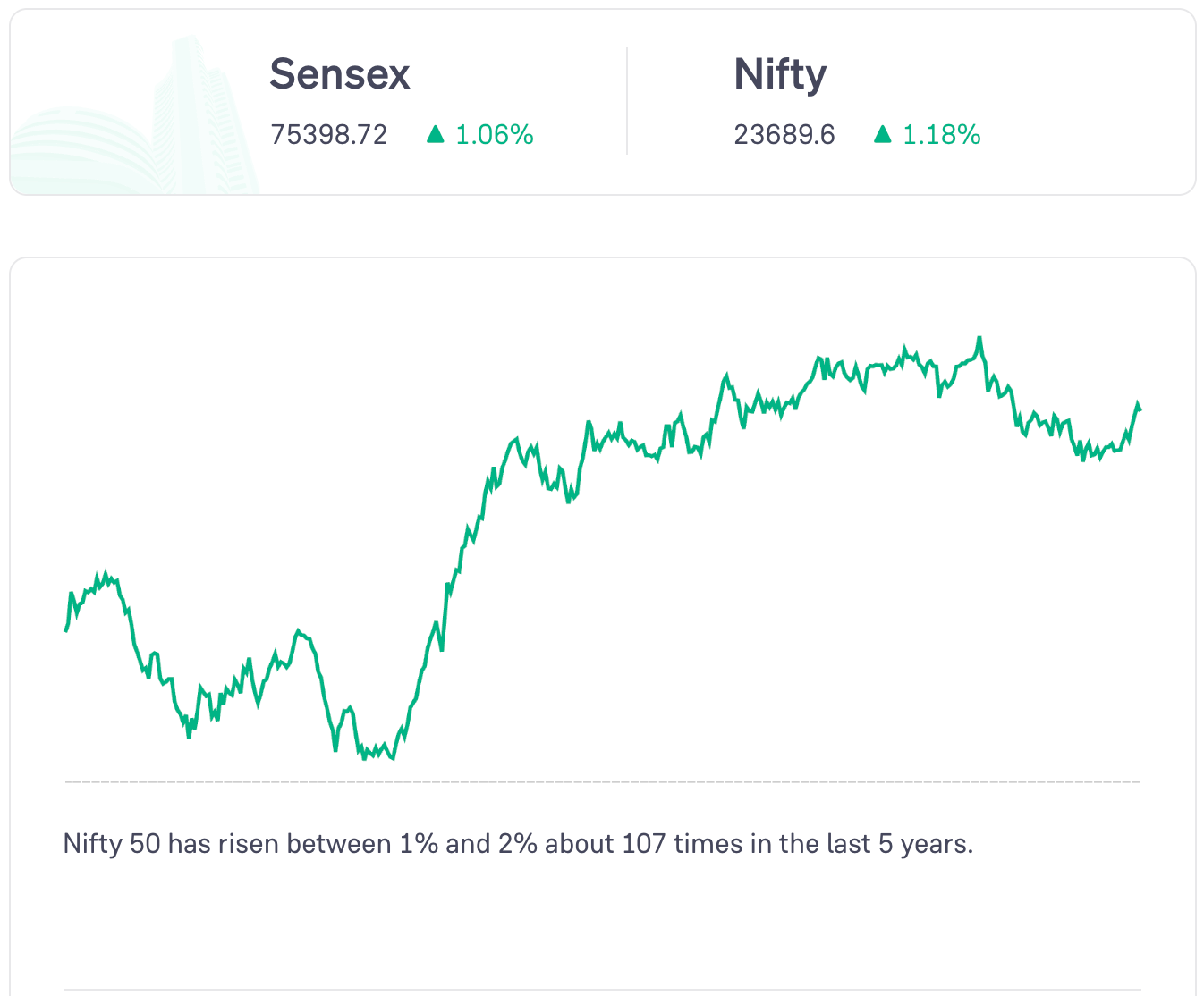
Markets opened above yesterday’s closing point.
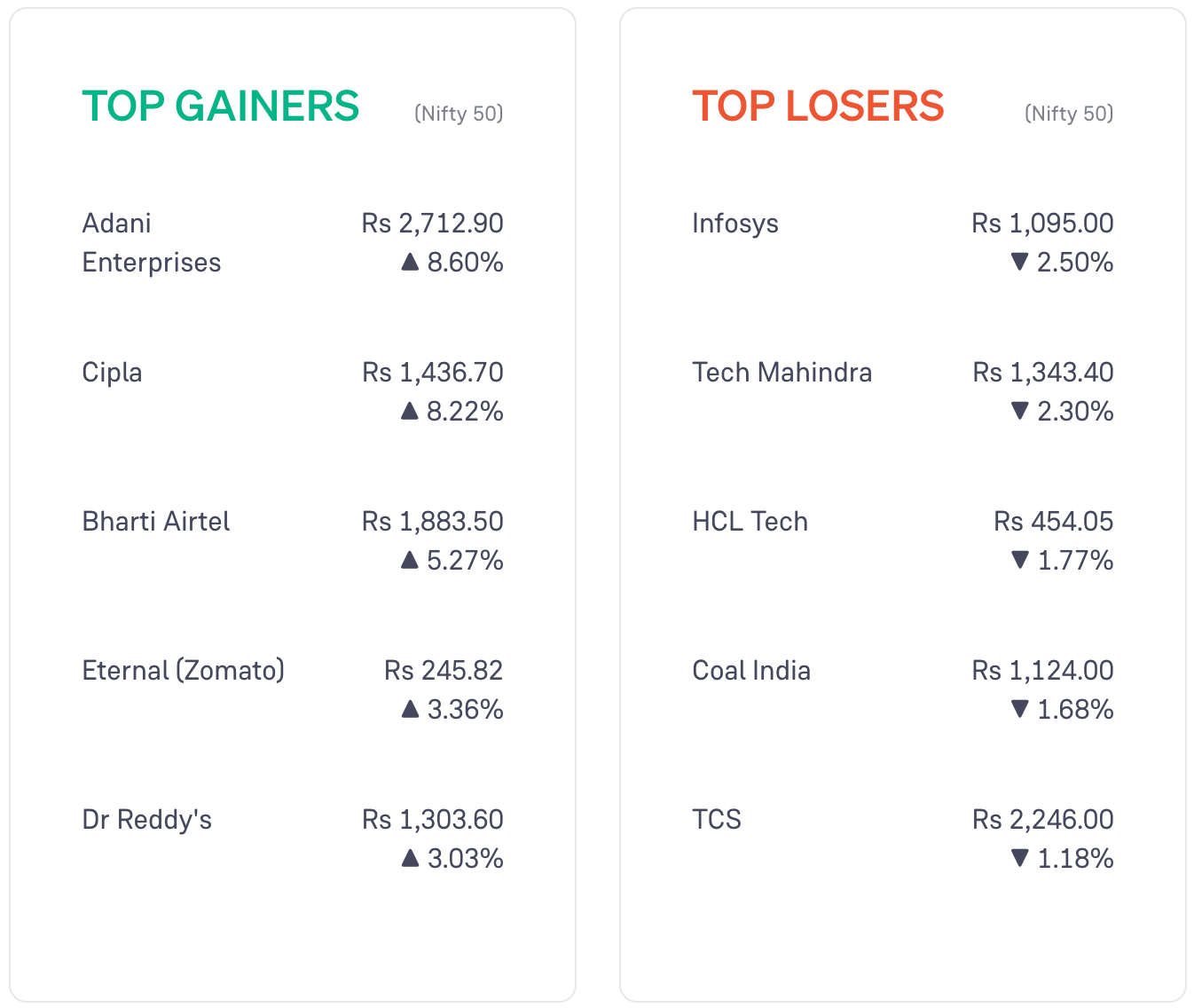
All sectors’ stocks rose today except for the IT stocks. Pharma stocks and healthcare stocks rose the most.
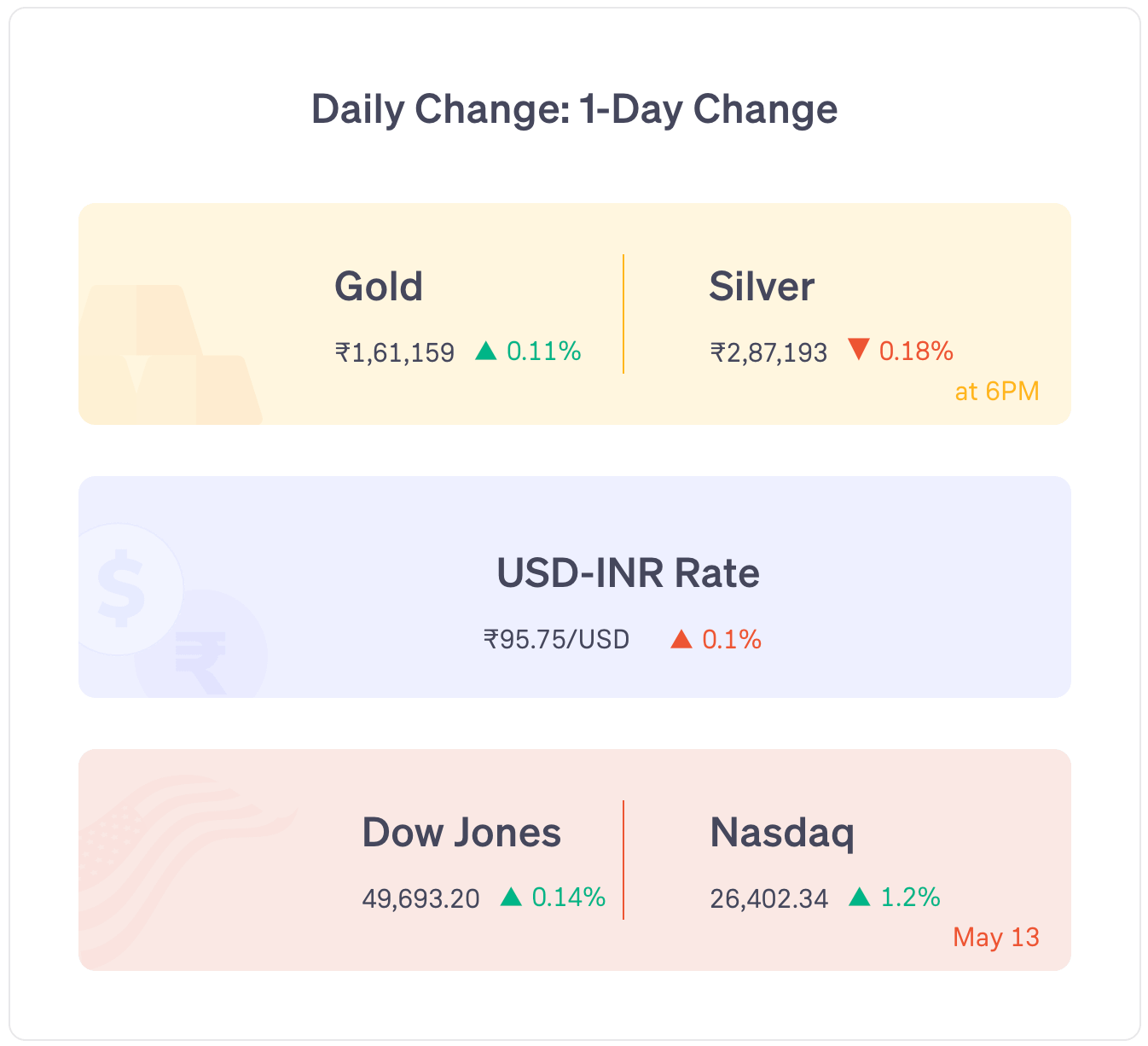
Global markets: US markets showed a mixed trend. Most Asian markets and European markets rose (as of 6 pm IST).
News
India’s wholesale inflation rose 8.3% year-on-year in April (vs 3.88% in March). Wholesale fuel and power inflation rose to 24.71% (vs 1.05% in March).
SEBI has proposed changes to the municipal bond framework to make it easier for urban local bodies to raise funds from the bond market.
Stocks Updates
L&T: partnered with France-based Exail to develop unmanned mine countermeasure systems for the Indian Navy, with L&T as prime contractor and Exail as technology partner.
NTPC: subsidiary, NTPC Green Energy Limited, declared commercial operation of 62.5 MW solar capacity in Rajasthan, taking total group capacity to around 89,868 MW.
Muthoot Finance: net profit rose 126.67% year-on-year to Rs 3,349.47 crore in the Jan-March quarter.
IRFC: net profit rose 0.14% year-on-year to Rs 1,684 crore in the Jan-March quarter.
M&M: wholly owned subsidiary, Mahindra Overseas Investment Company (Mauritius) sold the remaining 3.58% stake in CIE Automotive for about EUR 126 million.
Tata Motors Passenger: net profit fell 31.72% year-on-year to Rs 5,783 crore in the Jan-March quarter. Dividend announced: Rs 3 per share.
Siemens Energy: net profit fell 52.21% year-on-year to Rs 3,746 crore in the Jan-March quarter.
HAL: net profit rose 5.52% year-on-year to Rs 4,196.08 crore in the Jan-March quarter.
JSW Steel: net profit rose 989.15% year-on-year to Rs 16,370 crore in the Jan-March quarter. Dividend announced: Rs 7.10 per share, with 7 July as the record date.
United Spirits: net profit rose 27.9% year-on-year to Rs 541 crore in the Jan-March quarter. Dividend announced: Rs 11 per share, with 8 July as the record date.
Lupin: received USFDA approval for Famotidine Injection used for gastric and ulcer treatment. The product had estimated annual US sales of about $8.7 million.
Word of the Day
Debt-to-Equity Ratio
It is a financial ratio that compares a company’s total debt with its shareholders’ equity.
It shows how much of the company’s business is financed through debt versus owners’ funds.
A higher debt-to-equity ratio means the company relies more on debt, which can increase financial risk. A lower ratio generally indicates a more conservative financial structure.
Example: if a company has Rs 200 crore debt and Rs 100 crore equity, the debt-to-equity ratio is 2:1.
6 Day Course
Theme: making sense of MF returns
Day 4: Thursday
Different mutual fund managers structure their investments differently.
Some are more aggressive, some are more conservative, some try to strike a balance between the two.
This shows in the returns too.
Some mutual funds’ returns tend to be more volatile. They fall more in bad times, and rise more in good times.
This leads to those mutual funds appearing very bad in bearish times, and similarly, they appear very good in bullish times.
What this means is that if they are good, their long term returns will also be higher than other mutual funds in the same category.
But if things don’t work out well, the returns can be low even in the long run.
This is why mutual funds that show a long term history of poor performance must be avoided. They have a track record of non-performance and are not being careful.
Featured Question
Q. “what is the difference between bonds and NCDs then? from what im reading It seems as though NCDs act just like bonds”Yes.
NCDs are a type of bond.
There are many types of bonds. Some bonds allow the option to convert the bond to shares.
This allows the bond-holder to convert the bond to shares (if they want). So instead of being paid back the principal and interest, they would get shares in the company.
NCDs stand for Non Convertible Debentures. These are corporate bonds that do not have the option to convert to shares.
The payout is only in the form of principal + interest.
Did you like this edition?
Leave a feedback here!
Great
haha