

In 2008, senior executives from a global consumer goods company came to India with a simple question:
Why weren’t they leading one of the world’s largest shaving markets?
During their visit, they saw something that surprised them. A man was shaving while sitting barefoot on the floor of a small hut. There was no sink. No running water. Not even a mirror. Just a small bowl of water beside him.
Turns out this was not unusual.
Men in India shaved regularly. But most did not use modern cartridge razors.
Nearly 500 million Indian men depended on traditional double-edged safety blades. These blades were extremely affordable, easy to find, and deeply familiar. But they required practice and control. Cuts were common. The shave was careful and slow.
Shaving in India looked very different from shaving in the West.
In developed markets, razors had evolved into multi-blade systems promising smoother skin and faster results. Innovation meant adding another blade.
In India, affordability and safety mattered more than adding a blade.
There was a clear gap between global product design and the local way of doing it.
And one company decided to close it.
Gillette.
If you grew up in India, you’ve likely seen one hanging in a bathroom. A simple plastic razor near the mirror or inside a mug.
That object represents one of the most dominant consumer franchises in the country.
India has over 600 million adult men. Even if only half shave regularly, it is one of the largest shaving populations in the world.
Today, Gillette controls roughly 45-50% of India’s organised razor and blade market. In cartridge razors, its share is even higher (around 60-70%). In many stores, asking for a razor often means being handed a Gillette.
But this dominance did not happen overnight.
It was built through failure, learning, redesign, distribution muscle, pricing discipline, and patient market development.
The early mistake: Copy-paste strategy
Gillette entered India in 1984 as Indian Shaving Products Limited (ISPL), a joint venture. For nearly two decades, it followed a global template. Premium systems like 7 O’Clock (1990) and the triple-blade Mach3 (2004) were introduced at prices up to 50 times higher than traditional alternatives.
Sales did not take off.
The company misread the Indian consumer. The challenge was not just lower income levels. It was also different shaving habits and conditions.
A good example was the Vector razor, launched in 2002. It was designed specifically for Indian men and even had a push-bar feature to clear hair stuck between the blades. On paper, it looked like a smart innovation.
But there was a fundamental testing error. The razor was tested on Indian students at MIT in the United States, where men shave with running tap water.
In reality, millions of Indian men shaved using a mug or bowl of water. Without strong water flow, the Vector clogged easily and stayed clogged. What worked well in a lab did not work well in a village.
The problem was not technology. It was context.
That experience changed Gillette’s thinking. The company realised it could not simply bring Western products into Indian bathrooms. It had to design for Indian habits, Indian incomes, and Indian infrastructure.
Once that shift happened, the focus moved from selling expensive razors to building the entire shaving category step by step..
And that is where the real moat began to form.
Trust as the foundation
Shaving is not like buying biscuits or soap. A razor touches your face. If it fails, the consequence is immediate. The cuts, irritation, razor burn, and even bleeding.
Because the downside is so personal, consumers hesitate to experiment.
In categories where the downside is so personal, consumers naturally move toward the brand they trust the most.
In shaving, that brand is Gillette.
Over decades, Gillette has built this trust carefully and consistently.
Over the years, Gillette has shaped how Indian consumers think about shaving. Its name is linked to a smooth shave, fewer cuts, better technology, and higher quality. The line “The Best a Man Can Get” helped position shaving as more than a routine. It became associated with confidence and looking presentable.
This positioning was supported by steady spending. Advertising increased from about Rs 73 crore in FY2009 to Rs 176 crore in FY2013 and nearly Rs 199 crore in FY2019.
And that is only advertising.
Beyond ads, the company spends heavily on retailer incentives, distributor margins, freight, warehousing, shelf displays, and sales systems. When you add all of this together, the real investment behind the brand is much larger than the advertising number alone.
Very few competitors can afford to invest at that scale consistently, year after year.
But it was not only about how much money was spent. It was also about how intelligently it was used.
Gillette built creative authority. Campaigns like “India Votes: To Shave or Not” won Gold and Silver Lions at Cannes, which is global recognition in advertising. That matters because it shows the brand was not just loud; it was influential and culturally relevant.
Later campaigns such as “Shaving Stereotypes” and “Barbershop Girls of India” moved beyond talking about sharper blades or better technology. They entered social and cultural conversations.
The “Shave India Movement” was not simply about selling razors. It tried to shape how people think about shaving and masculinity.
This matters because India is a price-sensitive market. Yet Gillette has continued to lead the category and maintain a high market share.
In a shaving market estimated at around Rs 3,300 crore, the company has been able to price above many competitors and still grow. That suggests consumers are not choosing on price alone. They are choosing reliability and trust.
When it comes to something that touches your face, most people don’t want to experiment. Saving Rs 3 or Rs 5 doesn’t feel worth the chance of getting cuts or irritation.
That simple thinking is what allows Gillette to charge more, even in a price-sensitive market.
When something works well, most people don’t overthink it. They just buy it again. Over time, this becomes a habit. And habits are powerful.
When millions of people keep making the same choice, the brand becomes strong without needing to convince them every time.
For competitors, this is hard to break. Even if they offer similar quality, they still have to convince people to switch from something that “worked fine last time.” Most consumers don’t see a strong reason to change.
Shaving in India is also largely an offline purchase. People buy razors and blades from kirana stores, chemists, supermarkets, and small shops. In such a market, brand recall matters a lot.
That is why this is Gillette’s most important moat.
Technology, factories, and distribution are important. But this advantage is different. It sits in the customer’s mind.
Gillette is not just available on the shelf. It is already present in the consumer’s mind.
Availability
If a brand creates demand, distribution makes sure that demand turns into sales.
A person may prefer Gillette. But if he goes to a store and the refill is not available, the habit can break. In a repeat category like shaving, running out of stock is risky. It is not just one lost sale. The customer may switch to another brand and continue using it for months. Winning him back is not easy.
That is why distribution is so important for Gillette.
Gillette is part of Procter & Gamble (P&G), one of the world’s largest consumer goods companies. Because of P&G’s scale, it has built a wide distribution network in India. As early as 2011, P&G had direct reach to around 1.3 million retail outlets.
This means Gillette products were supplied directly to kirana stores, chemists, general trade shops, supermarkets, and later modern retail and e-commerce platforms — not just in big cities, but also in smaller towns and semi-urban areas.
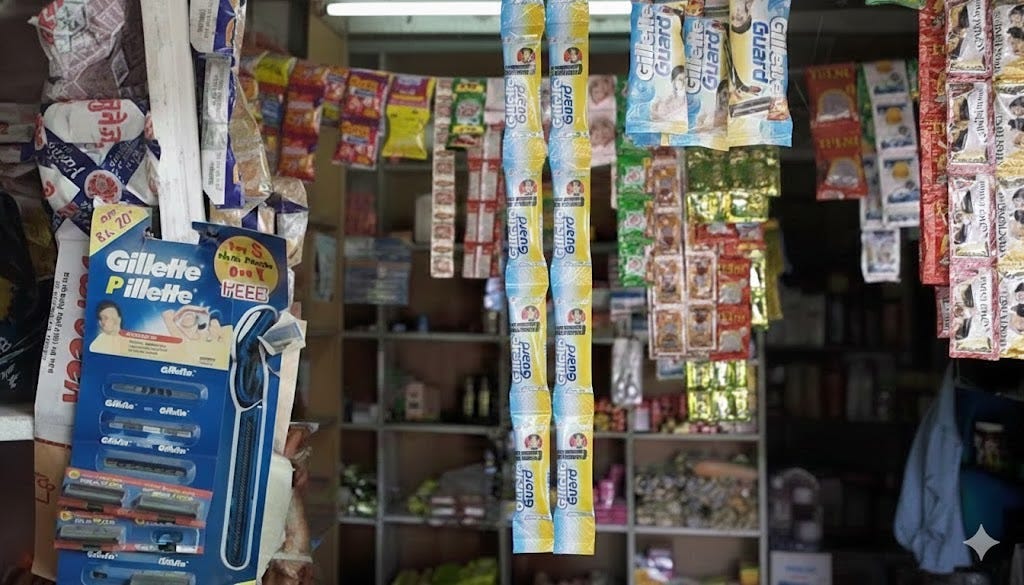
In India, a large share of refill purchases happen in small neighbourhood stores. These kirana shops are where many people buy blades regularly. If a brand is consistently available in these stores, it gains a clear advantage. When the customer walks in, Gillette is already on the shelf.
But maintaining this presence is expensive.
It requires steady spending on retailer margins, distributor incentives, logistics, warehousing, and sales teams on the ground. The company’s financial statements show this clearly.
Around FY2009, trade incentives and freight/distribution costs were each roughly in the Rs 40 crore range. Advertising spend was around Rs 70 cr to 80 cr.
By FY2013, trade incentives had increased to about Rs 120 to Rs 130 cr. Freight and distribution costs rose to around Rs 60 cr. Distributor coverage expenses were roughly Rs 35 cr- 45 cr. Advertising had also grown to around Rs 170 to Rs180 cr.
This shows that the company was not only spending more on advertising to build brand awareness. It was also increasing investments in retailer incentives and distribution to ensure the product was both visible and consistently available at the store level.
Even in FY2019, trade incentives were around Rs 55-65 crore, freight/distribution around Rs 70-75 cr, and advertising close to Rs 190-200 cr.
This shows that over time, the company increased spending not just on advertising, but also on trade incentives and distribution. It strengthened demand from consumers and ensured strong presence in stores.
Retailers stock products that sell. But they also care about margins, schemes, display support, and reliable supply. Gillette consistently invests in all of this. As a result, it often gets better shelf space, stronger visibility, and steady execution at the store level.
Manufacturing also plays a key role here.
Gillette has factories in Bhiwadi and Baddi, and it also works with third-party manufacturers in India. This reduces dependence on imports. By producing locally, the company can restock faster and avoid delays caused by global supply disruptions. Shorter lead times mean stores are less likely to run out of stock.
This is very important in a refill business. Once someone buys a Gillette razor, he needs matching cartridges. If those refills are not available, he may switch to another brand. So steady supply helps protect long-term customers.
The company has also introduced AI-based ordering systems for distributors. These systems help predict demand more accurately and reduce stockouts.
Over time, distribution itself becomes a strong advantage.
For competitors, copying this system is not easy.
Building nationwide distribution in India is expensive and complex. It requires:
Large sales teams
Strong distributor relationships
Extending credit to retailers
Efficient logistics
Continuous trade spending
A new brand might grow online or in a few big cities. But reaching urban, semi-urban, and rural India, especially millions of small kirana stores, takes years of investment and disciplined execution.
Basically, Gillette’s strength is in making sure the product is available everywhere, all the time.
Over years, that consistency becomes very hard to challenge.
One Razor, Many Purchases
If the brand builds trust, and strong distribution ensures the product is always available, the refill model makes customers stay.
Gillette is not just selling a razor. It is creating a long-term buying habit.
The idea is simple.
A customer buys a razor handle once. That handle fits only a specific type of cartridge. After that first purchase, the real business begins. The customer needs to keep buying refill blades regularly.
So the first sale is only the starting point. What follows is repeated buying over many years.
This approach goes back to the early 1900s. Even then, the razor handle was not the main source of profit. It helped bring customers in. The steady income came from selling blades again and again.
The idea is to sell the handle once and sell the blades many times.
It works a bit like a subscription, but without any contract. Customers are free to switch. However, most people continue buying the same brand because:
The handle already fits those cartridges.
They are used to the shaving experience.
The product is easily available.
That logic works only if customers enter the system in the first place.
When Gillette first struggled in India, the problem was simple: prices were too high.
Premium razors meant fewer people bought the handle. Without enough users, blade sales could not grow. This model needs wide adoption first.
The turnaround came when Gillette introduced more affordable products suited to Indian needs. Once more people started buying the handle, repeat blade purchases followed.
Today, Gillette is part of P&G’s Grooming division, which generates around $6.5-7 billion in annual revenue. A large share comes from blades and cartridges that customers must replace regularly. That repeat demand makes the business steady and predictable.
The numbers tell the same story.
Gillette’s gross margins have usually been around 56–59%. But the important part is this: blades make more money than handles. The razor handle is mostly a way to get the customer started. The real profit comes from selling blades again and again.
Think about how people actually use it. A person may buy a handle once and use it for years. But they replace the blade every few weeks. So over time, most of the money comes from refills, not the original razor.
In India, this becomes even more powerful because shaving is a regular habit. Once someone starts using Mach3, Fusion, or Guard, they usually stick with it. The handle fits only those cartridges, and they get used to the same shaving feel.
So what looks like a small everyday purchase slowly turns into steady, repeat income for the company.
In India, this model became even stronger because Gillette built a large base of users across different price levels.
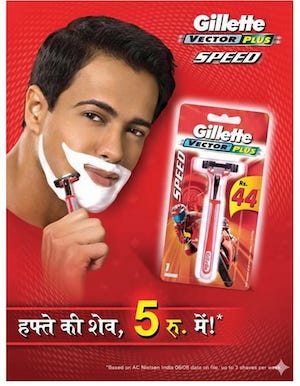
At the mass end, the Gillette Guard launch in India was explicitly priced to make system entry feel safe and affordable: introductory pricing was reported as Rs 15 for the reusable razor with one blade and Rs 5 for blades marketed as “5 shaves” (i.e., roughly Rs 1 per shave).
Whole-Market Coverage
In India, many FMCG companies have faced limits because they focused on only one part of the market.
Premium-focused brands like Revlon built strong appeal among urban, higher-income consumers. But they remained relatively small in scale compared to mass brands. Even L’Oréal, which is successful today, grew much faster after offering products at different price points through brands like Garnier, instead of staying only in the premium segment.
On the other hand, Nirma became very large by offering low-priced detergents in the 1980s and 1990s. It captured huge volumes in rural and price-sensitive markets. But as incomes increased, many consumers shifted to premium brands like Surf Excel and Ariel, which promised better performance. Nirma found it harder to move up with those consumers at the same scale.
Premium-only brands limit volume, and mass-only brands limit margins.
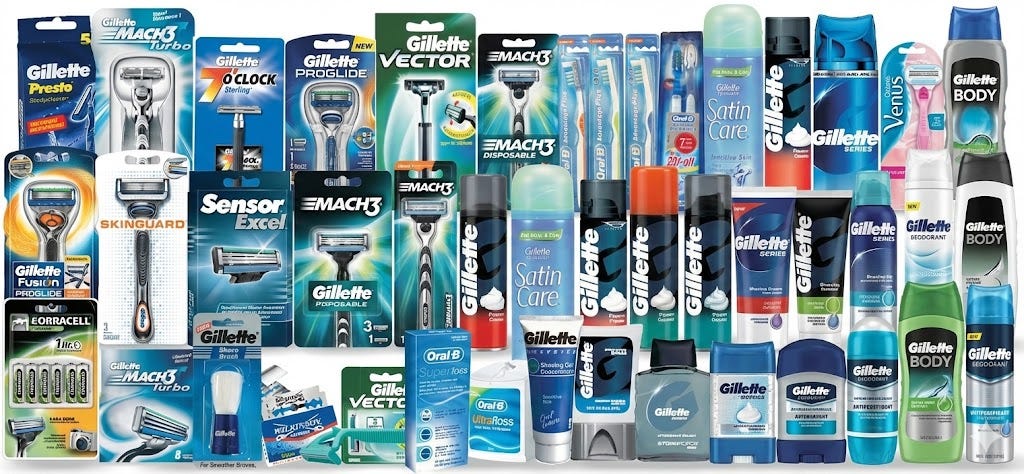
Gillette avoided this trap by building a structured price ladder from bottom to top.
At the mass end, it launched Gillette Guard in October 2010 at around Rs 15 for the razor and roughly Rs 5 per refill. This was designed specifically for Indian conditions. The limited water usage, thicker hair, and high price sensitivity.
Guard helped move many users from cheap double-edge blades to cartridge razors.
In the middle range, Vector offered better shaving performance at a reasonable price. It suited people who wanted an upgrade but did not want to pay for premium razors.
At the top end, Mach3 and other multi-blade razors targeted urban consumers who were ready to pay more for a smoother shave and better technology.
Because Gillette has products at low, mid, and high prices, it covers most of the market. A cheap competitor finds it hard to compete because Guard is already affordable. A premium competitor has to match both quality and brand trust.
In a category estimated at around Rs 3,300 crore, where grooming contributes roughly 80% of Gillette India’s business, being present at every major price point reduces opportunities for competitors. If one company already serves low, mid, and premium segments, it becomes harder for another brand to focus on just one profitable niche and grow from there.
Retailers also prefer this setup.
It is simpler to stock one trusted brand that offers products at different prices. It uses shelf space more efficiently and can increase overall sales from that space. When one brand already covers most price points, there is naturally less room left for competing brands.
Everything works together. The brand builds trust. Distribution makes sure products are available everywhere. The refill system creates repeat buying. And the price ladder makes sure no big gap is left open.
Together, this creates a strong and stable business structure.
Sir..day by day the quality of blades become worst..Gillete concentrate on only costly blade of fusion (5 blade) .This blades costs around Rs.1100-1200.The quality of gillet victor is now worst,which is used by middle class people..I think they know that they have monopoly in market.If the quality remains poor day by day and any good competitor came in market..they will lose their goodwill.
Nice one