
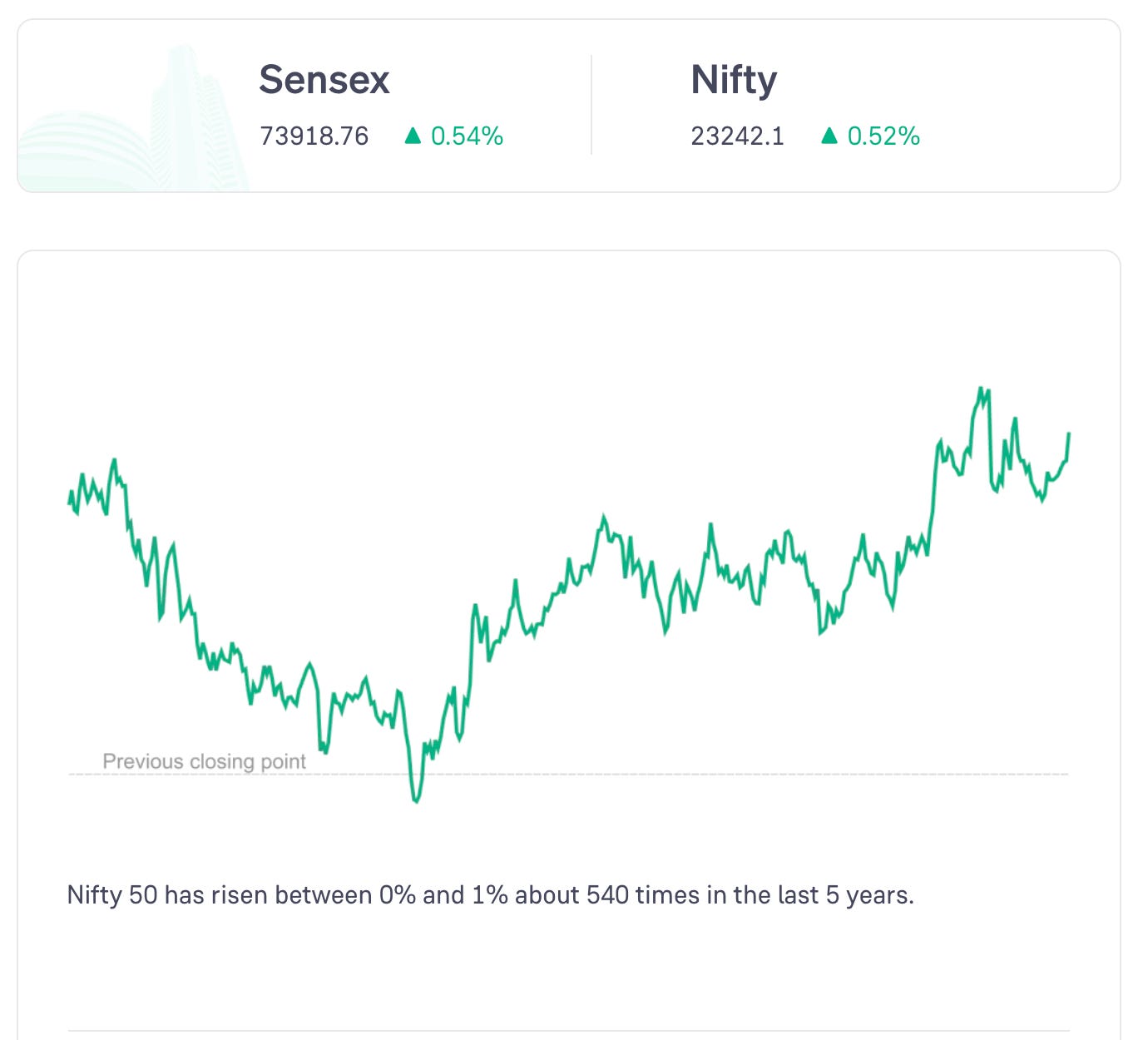
Markets opened above yesterday’s closing point.
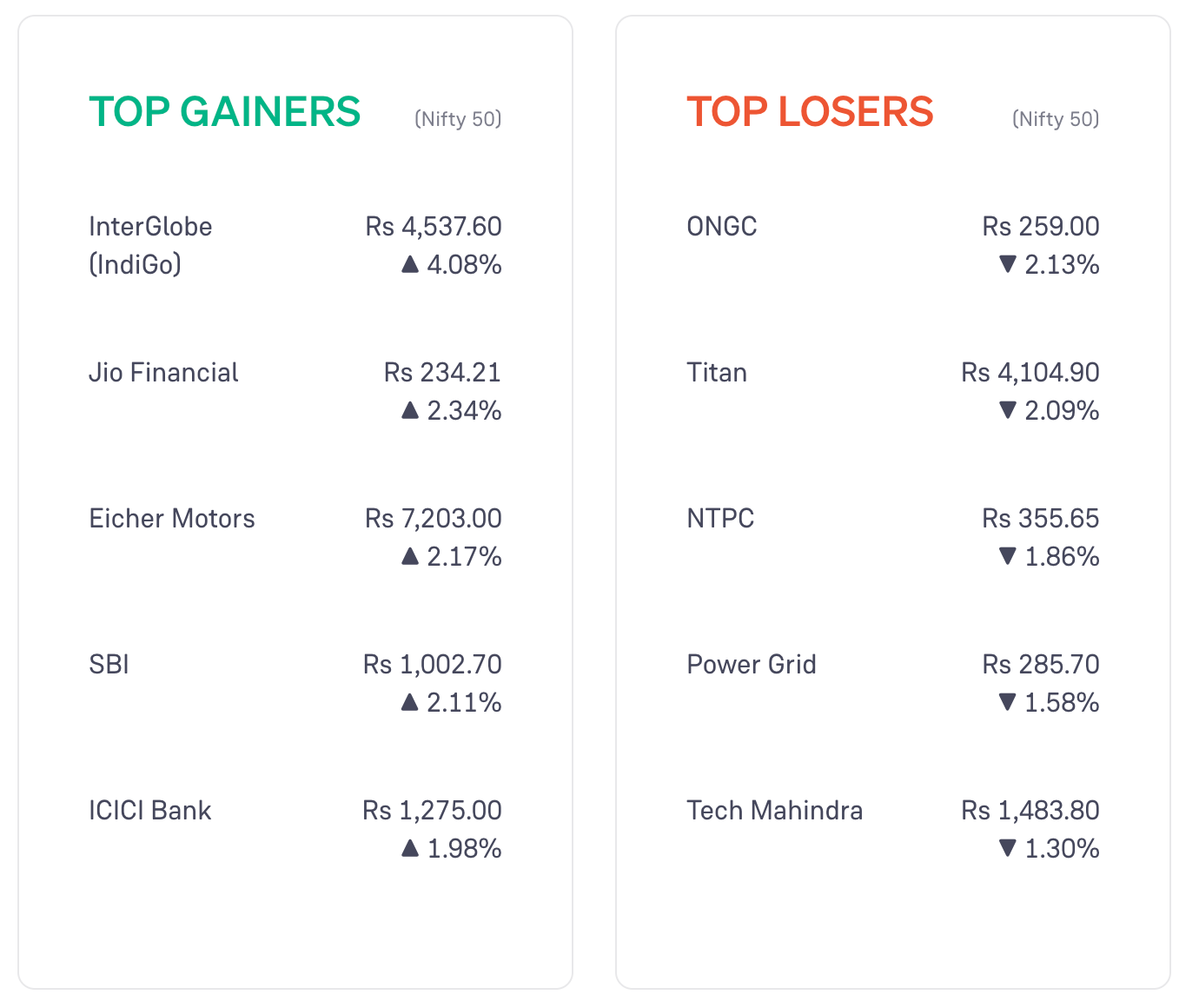
PSU bank stocks and private bank stocks rose the most today. IT stocks and media stocks fell the most.
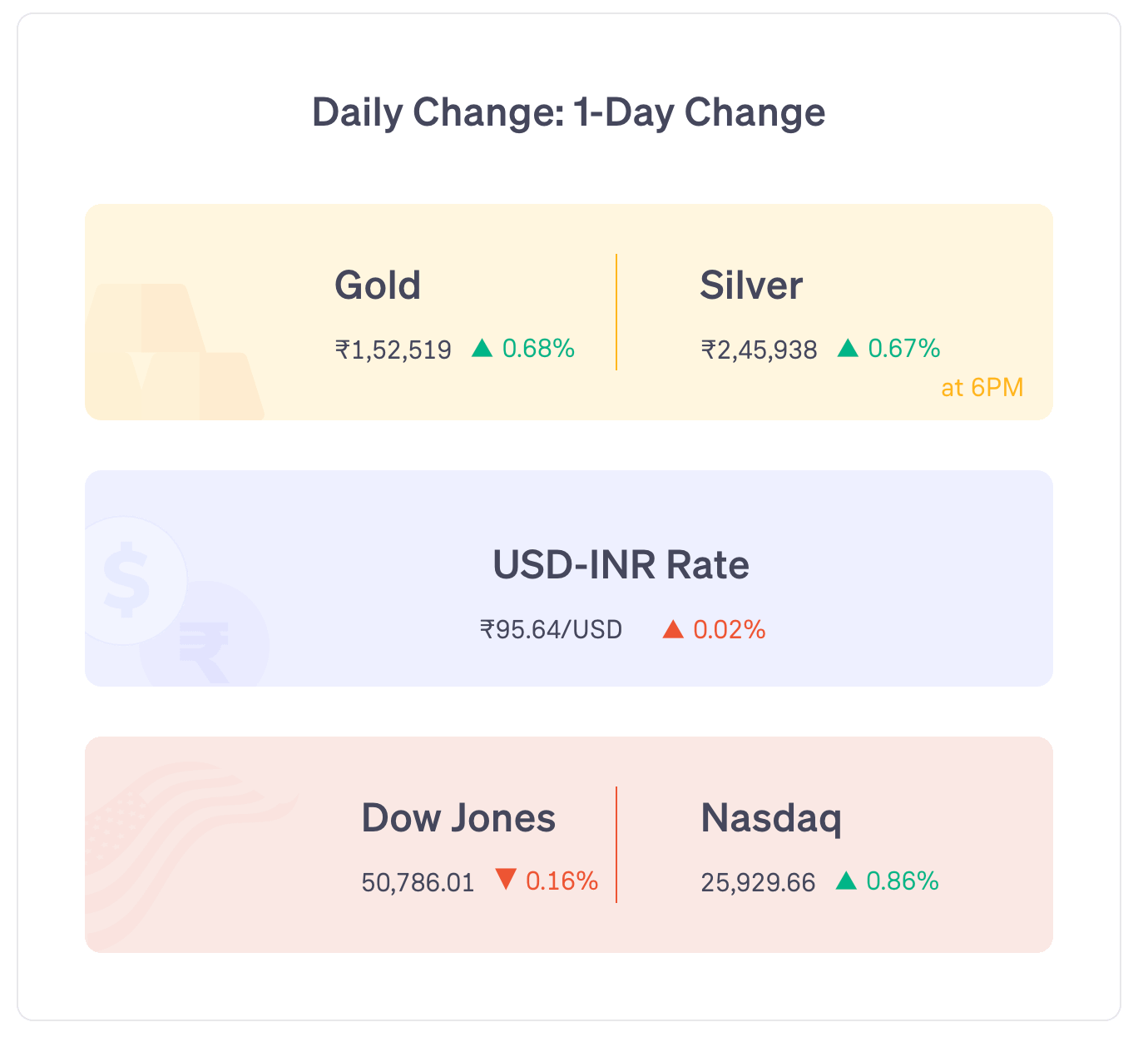
Global markets: Most US markets rose. Most Asian markets and European markets rose (as of 6 pm IST).
News
India’s current account surplus narrowed to $7.1 billion (0.7% of GDP) in the Jan-March quarter (vs $13.7 billion or 1.4% of GDP in the same quarter last year).
The Indian Railways has approved multiple infrastructure projects. This includes Rs 285 crore to upgrade the 141 km Mahbubnagar-Secunderabad-Medchal electric line in Telangana and Rs 220.5 crore for doubling the 10.65 km Mararikulam-Alappuzha track section in Kerala and Rs 162.57 crore to upgrade the 120 km Bengaluru-Tumkur electric line in Karnataka.
China’s exports rose 19% year-on-year in May (vs 14.1% in April) and while imports rose 27.4% (vs 25.3% in April). It recorded a trade surplus of $105.43 billion.
Zepto has filed an updated DRHP (Draft Red Herring Prospectus) for a Rs 8,010 crore IPO.
Stocks
Airtel: Bombay High Court has ruled in favour of the company in the long-running One-Time Spectrum Charge (OTSC) dispute. The court quashed the DoT’s demand of Rs 8,414 crore and set aside the related notices.
Vodafone-Idea (Vi): Bombay High Court quashed DoT’s one-time spectrum charge demand of Rs 2,113 crore and ordered DoT to return the bank guarantees submitted by the company.
Adani Enterprises: subsidiary Adani Airport City Ltd will acquire a 100% stake in Portus Ventures Pvt Ltd, a real estate and hospitality entity, for Rs 1.4 lakh to undertake real estate, hotel and resort development activities.
Adani Energy Solutions: will acquire a 100% stake in IntelliSmart Infrastructure Pvt Ltd (a smart metering company) for Rs 3,050 crore, subject to regulatory approvals.
Word of the Day
Fresh Issue
It is when a company issues new shares typically as part of an IPO or follow-on public offer (FPO).
The money raised goes directly to the company and can be used for purposes such as business expansion, debt repayment, working capital requirements, etc.
A fresh issue increases the total number of shares in the market, which may lead to dilution of existing shareholders’ ownership.
A fresh issue is different from OFS or offer for sale where existing shareholders of the company (like founders) are the ones to sell the shares.
6 Day Course
Theme: economy vs stock markets
Day 2: Tuesday
Let’s talk about measuring both.
The stock markets are vast. We use indices to measure the performance of the markets.
Example: Nifty 50 is often used as an indicator of market performance.
Nifty 50 is made up of the 50 biggest companies on the markets only. But since they are the biggest 50, they have an outsized impact on the overall market.
Hence, measuring their performance is a good proxy for the overall markets’ performance. It is not perfect, but still good enough.
So if Nifty 50 goes up by x% in a day, we say ‘the markets were up x% today’.
On the other hand, the country’s economy is measured using GDP.
GDP (Gross Domestic Product) is a measure of the value of all the goods and services of a country.
Change in GDP tells us about GDP growth.
Example: India’s GDP grew by 7.7% in the financial year 2025-26.
Featured Question
Q. “Is our Indian stock market mostly dependent on Foreign investors? Mostly we see the major ups and downs when FIIS buy or sell in huge amount. Market is at the same place where it was before two to three years. No return generated at all. What’s the solution?””
The Indian stock markets have many different kinds of investors.
Yes foreign investors are a significant group of investors. But there are others also.
So in case they start selling/buying in big numbers, it does have an impact on the markets.
But they are not the biggest group. So it is not fair to say that the Indian markets are ‘mostly dependent’ on them.
These are the biggest players in the stock markets:
+Promoters of companies: ~40%
+Domestic Institutional Investors (DII): ~19%
+Foreign Institutional Investors (FII): ~16%
+Government: ~11%
+Individual Investors: ~9%
+NRIs, Trusts, other bodies: ~5%
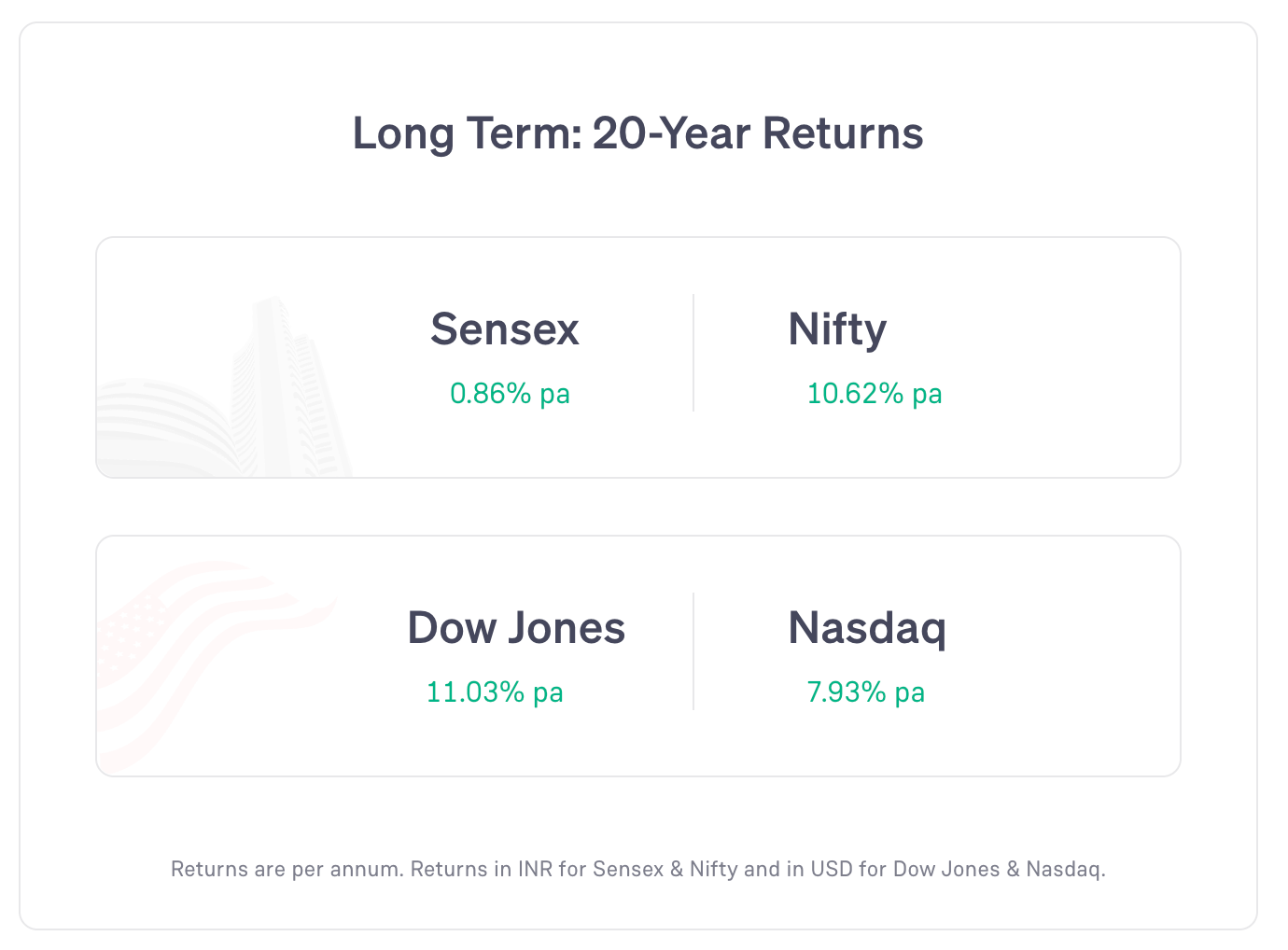
The stock markets are affected by various factors. Periods of low returns and even negative returns are common.
This is why investing for the long term is suggested. In the shorter periods, returns can vary and even be negative.
The information presented in this post has been compiled and prepared by Groww Invest Tech Pvt Ltd and is intended solely for informational purposes. It is not tailored to any specific investment objectives, financial situations, or needs of any individual investor. The content should not be construed as investment, financial, legal, or tax advice and should not be relied upon as a substitute for professional consultation.
Investing in securities markets involves inherent risks. Investors are advised to carefully review all relevant documents and consider their own risk tolerance before making any investment decisions.
Mutual fund investments are subject to market risks; please read all scheme-related documents carefully. Past performance of financial instruments, schemes, or markets is not indicative of future results.
Groww Invest Tech Pvt Ltd is registered with the Securities and Exchange Board of India (SEBI) under Registration No: INZ000301838, as a Research Analyst under No: INH200008662, as a Depository Participant under No: IN-DP-417-2019, and with the Association of Mutual Funds in India (AMFI) under ARN-111686.
SEBI registration details: View registered name and registration numbers
Research Analyst Disclaimer: View Research Analyst disclaimer
Did you like this edition?
Leave a feedback here!