
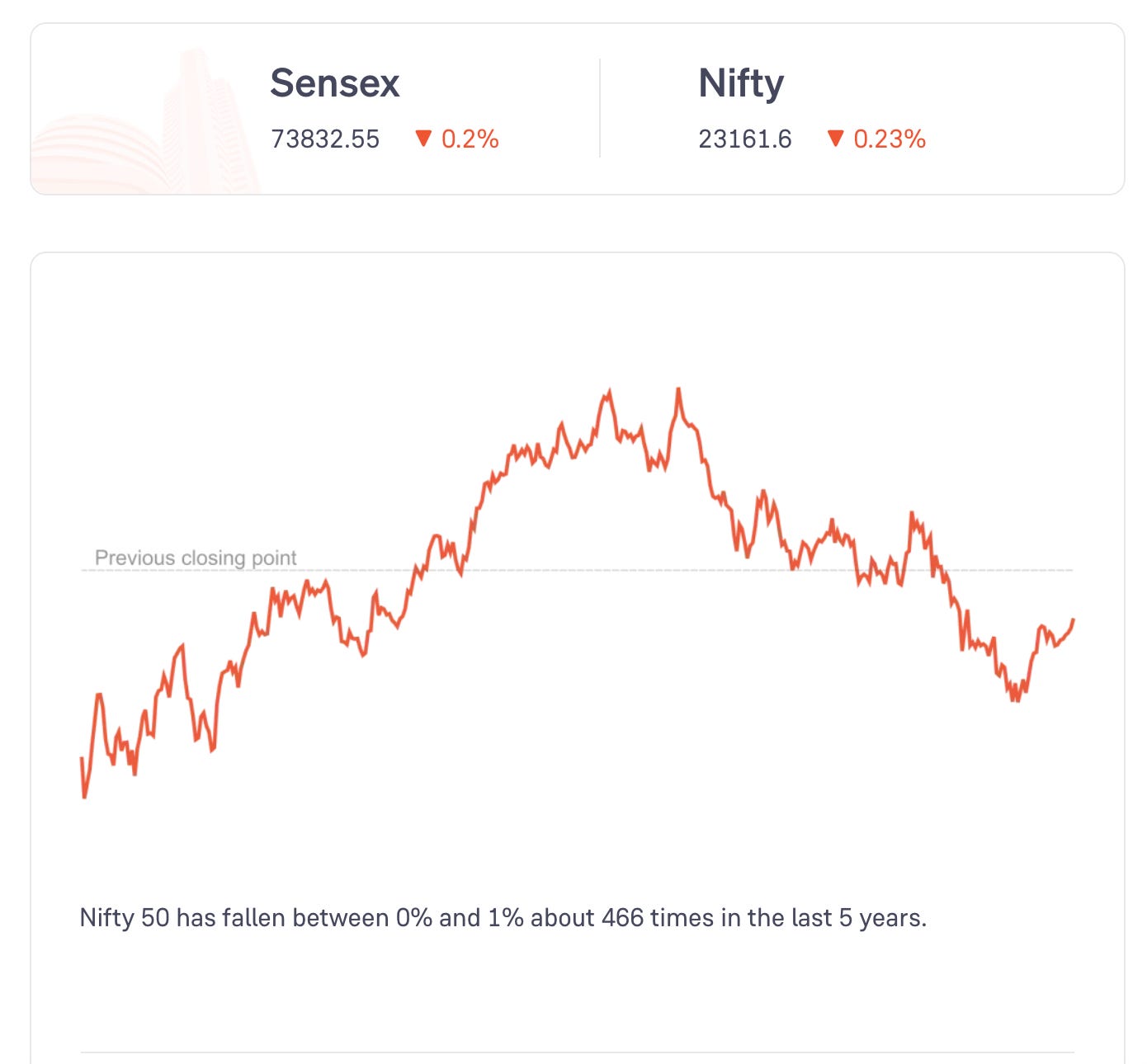
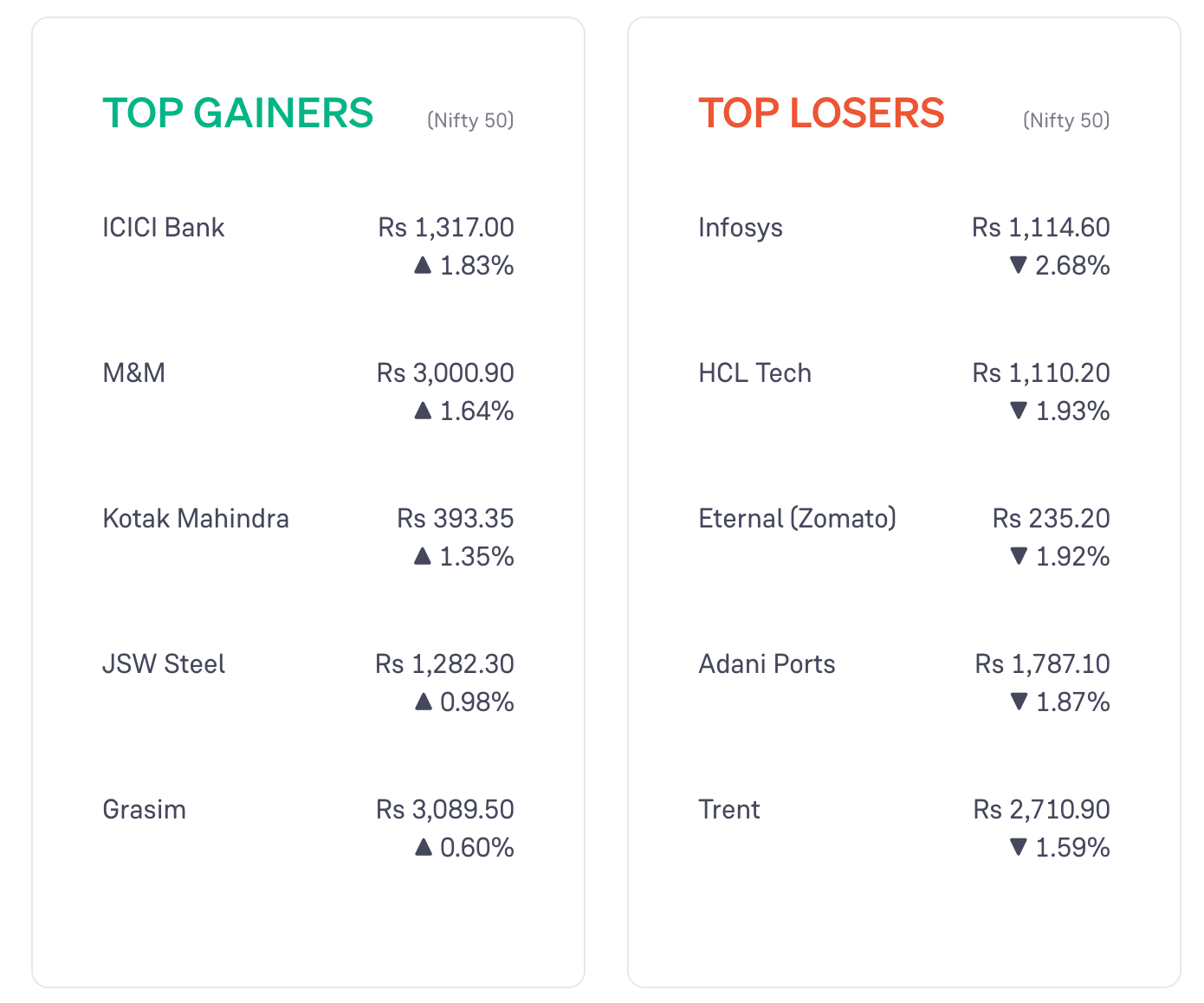
Markets opened below yesterday’s closing point.
Media stocks and pharma stocks rose the most today. IT stocks and chemicals stocks fell the most.
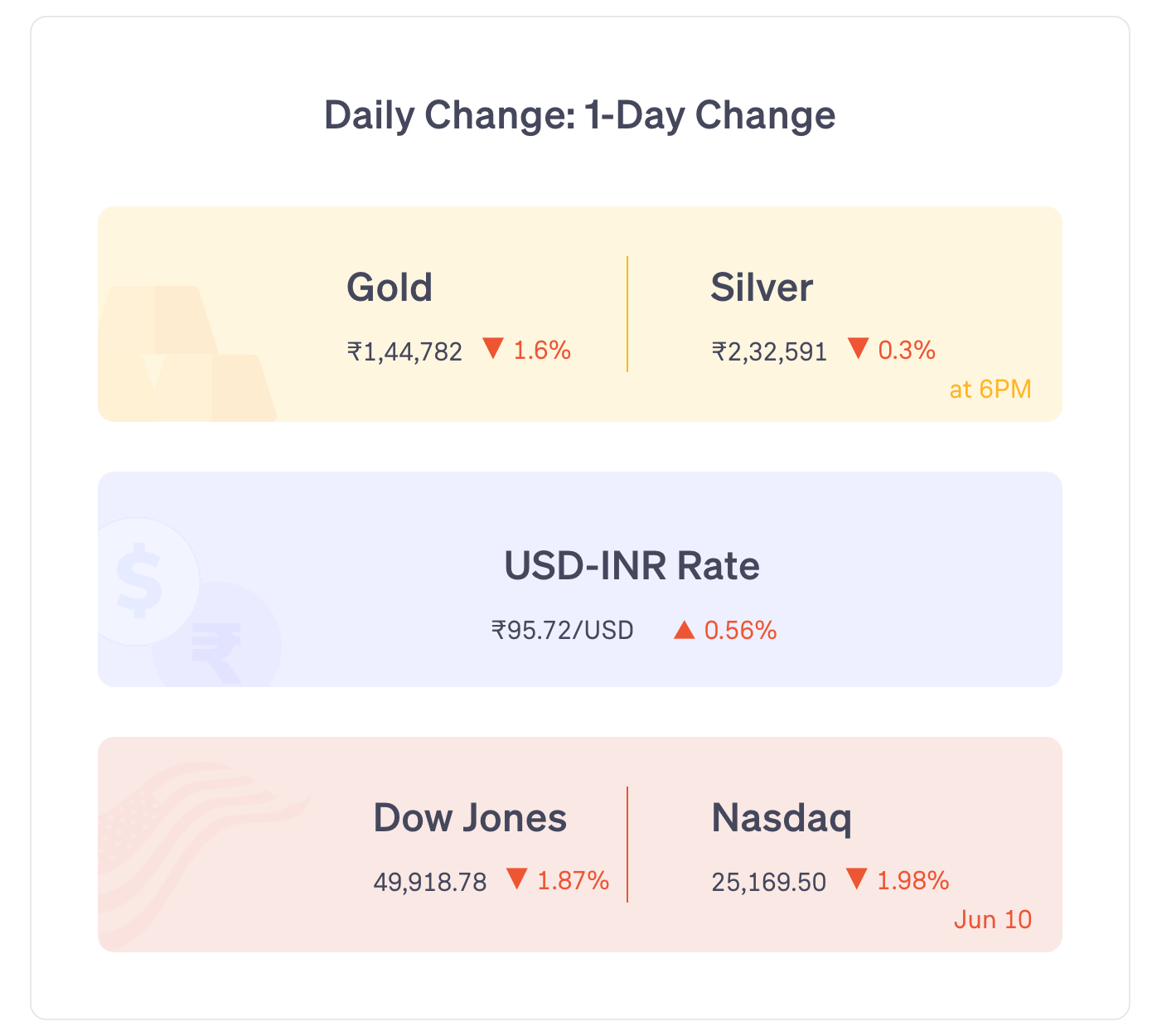
Global markets: Most US markets fell. Asian markets showed a mixed trend. European markets rose (as of 6 pm IST).
News
The government has extended its zero-tax (no excise duty) exemption on petrol blended with higher levels of ethanol from E22 up to E30.
The government has approved 96 companies under round-3 of the Textile PLI Scheme, bringing in a total committed investment of Rs 12,822.67 crore.
India and Nepal have launched a peer-to-peer (P2P) cross-border remittance mechanism directly linking India’s UPI with Nepal’s National Payments Interface (NPI), allowing citizens of both countries instant money transfers using mobile apps.
Stocks
UltraTech Cement: will acquire a 13.99% stake in FPEL Services Pvt Ltd, a 15.70 MW AC wind power SPV in Tamil Nadu, for Rs 12.09 crore to meet green energy requirements. Its subsidiary, India Cements, will acquire a 12.48% stake in the same company for Rs 10.78 crore.
Power Grid: approved a Rs 485 crore project to upgrade its SCADA systems, which help monitor and manage its power transmission network. It also approved a JPY 80 billion through an unsecured term loan from JBIC and other partner lenders.
Adani Enterprises: subsidiary, Adani Airport City Ltd, completed acquisition of 100% stake in Portus Ventures Pvt Ltd.
Hindalco: subsidiary, Novelis Inc. restarted operations at its Oswego hot mill in New York, which had been shut following a fire incident last year.
Power Finance: received approval from the President of India, conveyed via the Ministry of Power for the proposed merger of REC Limited into PFC.
BHEL: received a Letter of Intent (LOI) from Damodar Valley Corporation (DVC) for the 1x800 MW Durgapur supercritical thermal power station.
TCS: partnered with Anthropic to help enterprises scale AI adoption and jointly develop AI solutions for regulated sectors including financial services, healthcare, and telecom.
Infosys: partnered with IHH Healthcare for a multi-country AI-powered ERP transformation programme across key markets including Malaysia, Singapore and Hong Kong.
Word of the Day
Joint Venture (JV)
It is an arrangement where two or more companies come together to undertake a specific project or business activity.
The companies pool their resources but continue to remain separate, independent legal entities.
They share the investment, risks, responsibilities, and profits based on the agreed terms.
Usually, a JV is discontinued once the project’s specific goal is achieved.
6 Day Course
Theme: economy vs stock markets
Day 4: Thursday
So, it is clear so far that the economy represents a much larger portion of the country’s activity.
Stock markets are within that.
One part that the stock markets don’t capture well is the informal economy.
The stock markets are filled with registered and governed companies that are above a certain size.
They do not capture the informal economy — gig workers, freelancers, agriculture, small businesses, etc.
Yes, there are some stocks that are directly affected by some informal sectors — like fertilisers are affected by the agriculture sector.
And overall, if the people in the informal economy aren’t doing well, consumption also starts falling which affects listed companies.
This is why investors tend to keep a close eye on economic performance numbers. Even more so in case of stocks from certain sectors like consumer stocks, agriculture stocks, auto stocks, etc.
It can tell them about the potential future performance of those stocks.
Featured Question
Q. “Exit loads are often presented as a mechanism to protect existing investors from the costs generated by short-term redemptions. Since both significant inflows and outflows can affect a fund’s portfolio management and cash allocation decisions, could you explain the economic rationale behind charging a load only on exits? What specific costs or risks are unique to redemptions that justify this treatment?”
Great question.
You’re right about sudden inflows and outflows affecting a fund manager’s plans.
So to discourage sudden outflow, a small exit load is put in place for some period from the date of investment.
Why not the same for inflow also? Why not an entry load?
This is because when new money gets invested, the investor gets the latest NAV but the fund manager can choose to wait and not invest that cash.
This way, the investor does not miss out on returns (he already has been given the units and will get appreciation benefits like any other investor in the mutual fund).
So the fund manager can wait till the right time to invest the cash. It’s a win-win for both the investor and the fund manager.
When an investor withdraws money, the fund manager is forced to sell stocks to give money back.
This is what hampers the long term plans of the fund manager.
This is why there is an exit load in place, but not an entry load.
Yes, all mutual funds keep some cash buffer so it’s not like the mutual fund manager needs to sell stocks for every withdrawal.
But if too many investors start withdrawing, the fund manager will be forced to sell.
So to discourage this behaviour, an exit load is kept.
The information presented in this post has been compiled and prepared by Groww Invest Tech Pvt Ltd and is intended solely for informational purposes. It is not tailored to any specific investment objectives, financial situations, or needs of any individual investor. The content should not be construed as investment, financial, legal, or tax advice and should not be relied upon as a substitute for professional consultation.
Investing in securities markets involves inherent risks. Investors are advised to carefully review all relevant documents and consider their own risk tolerance before making any investment decisions.
Mutual fund investments are subject to market risks; please read all scheme-related documents carefully. Past performance of financial instruments, schemes, or markets is not indicative of future results.
Groww Invest Tech Pvt Ltd is registered with the Securities and Exchange Board of India (SEBI) under Registration No: INZ000301838, as a Research Analyst under No: INH200008662, as a Depository Participant under No: IN-DP-417-2019, and with the Association of Mutual Funds in India (AMFI) under ARN-111686.
SEBI registration details: View registered name and registration numbers
Research Analyst Disclaimer: View Research Analyst disclaimer
Did you like this edition?
Leave a feedback here!