
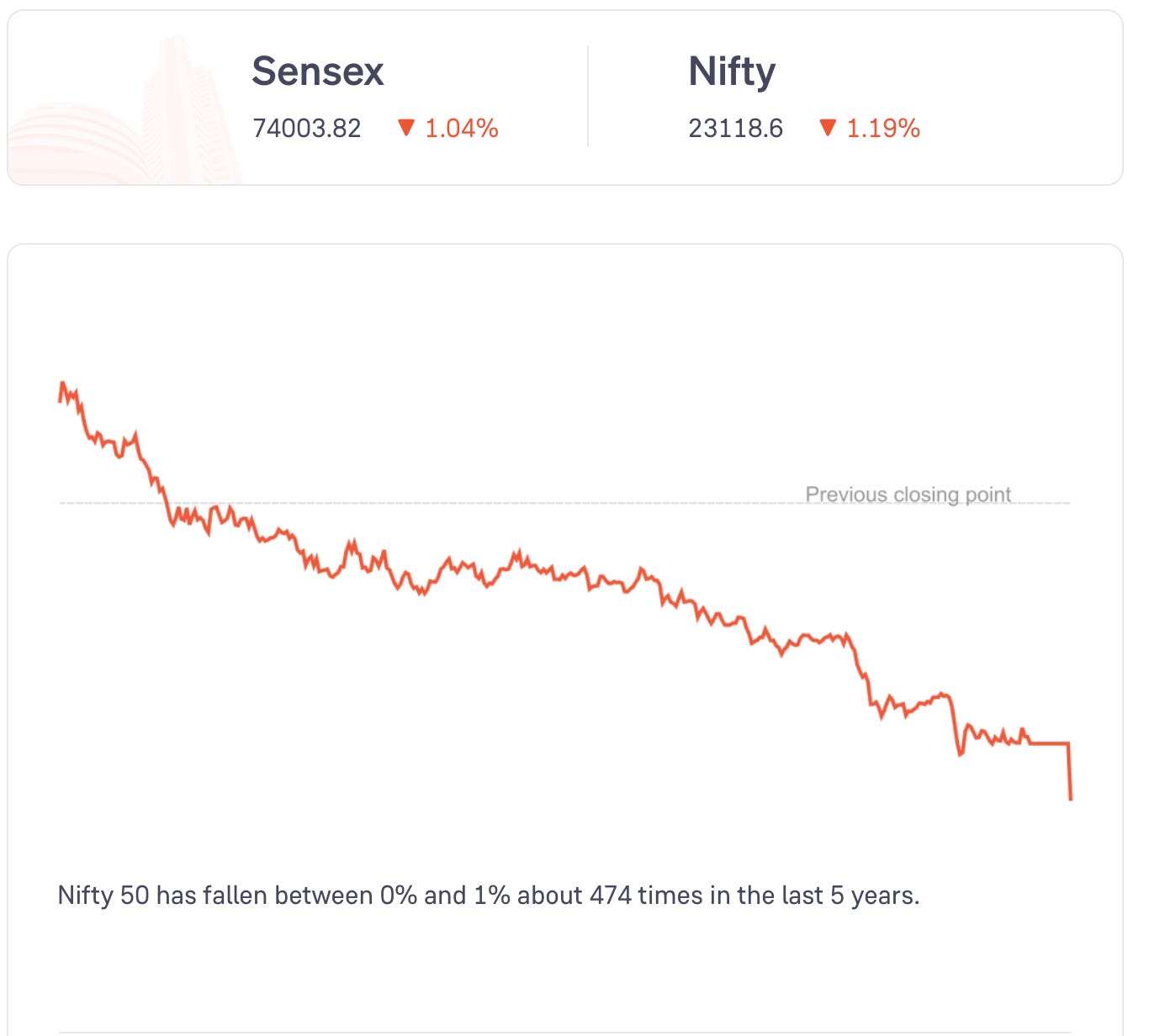
Markets closed lower than Friday’s closing point.
The markets fell throughout the day and this may have been mainly due to geopolitical tensions in the Middle East (supply of oil from Saudi Arabia has been cut).
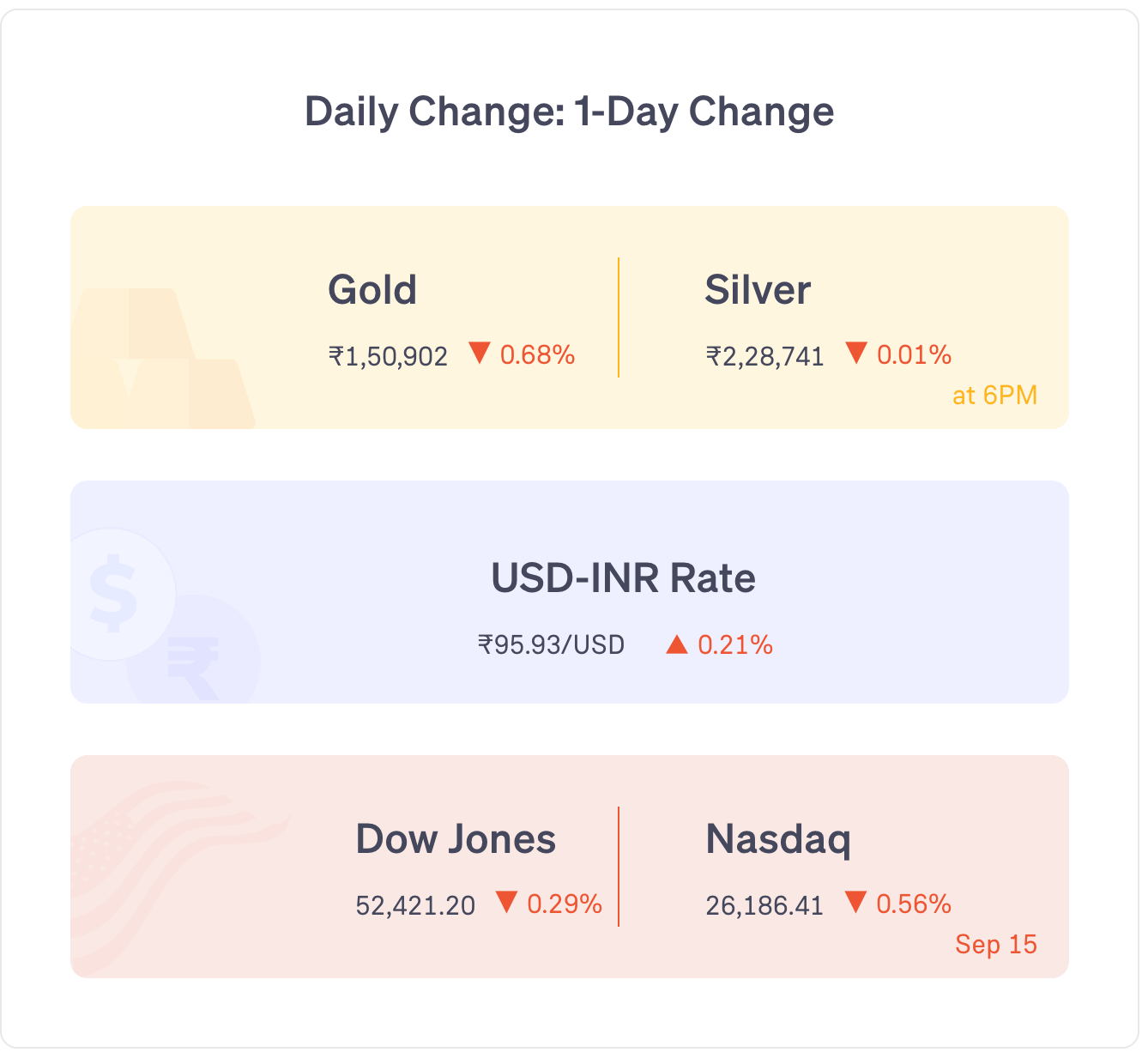
Oil prices rose to $108 and US bond yields rose to the highest level since 2007 (5.04%). Such events typically indicate increased expectations of an interest rate hike in the US which could have added to negative sentiments in the market.
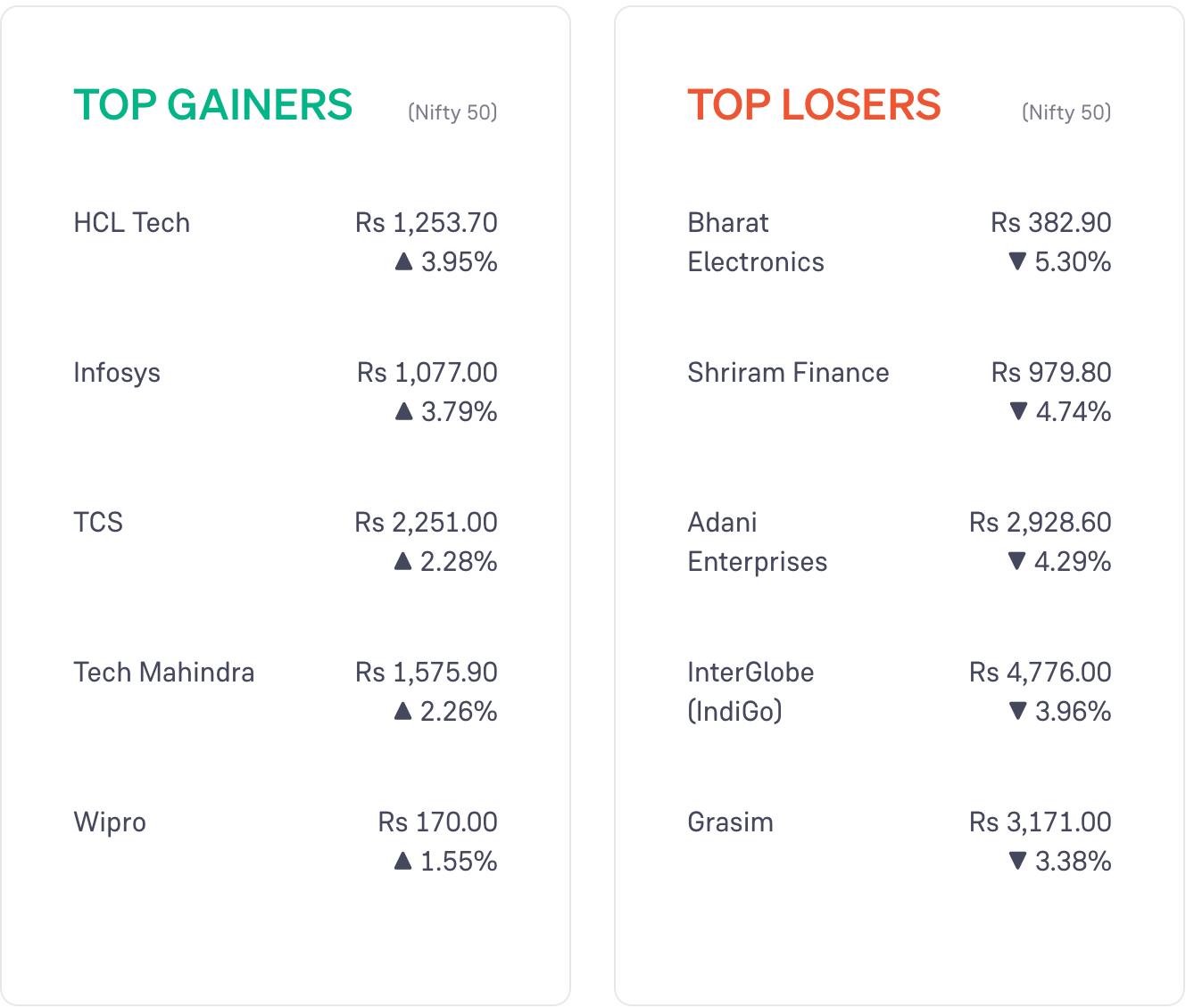
All sectors’ stocks fell, except for the IT stocks. Realty stocks and chemical stocks fell the most today.
Global markets: US markets fell on Monday. Most Asian markets fell on Tuesday. Most European markets also traded in red (as of 6 pm IST).
News
India’s unemployment rate fell to a 6 month low of 5.00% in August compared to 5.10% in July.
The government introduced Merchant Discount Rate (MDR) of 0.4% on person-to-merchant UPI transactions above Rs 2,000 from 15 Oct. The MDR will be capped at Rs 300 for transactions above Rs 75,000. There will be no charges whatsoever on person-to-person UPI transactions.
India’s trade deficit decreased to $26.86 billion in August compared to $31.98 billion in July.
Passenger vehicle sales rose 36.5% year-on-year to 4.39 lakh units in August, according to SIAM data.
The CMs of Uttar Pradesh, Uttarakhand, Himachal Pradesh, Rajasthan, Delhi and Haryana signed the Kishau Multipurpose agreement under which 97,000 hectares of land will be irrigated and hydropower of 1,476 million units will be generated.
Stock Updates
TCS: partnered with the Dubai Gold & Commodities Exchange to upgrade its trading systems. It also partnered with Germany’s Aareal Bank to modernise its IT systems using cloud and AI.
BHEL: approved another Rs 65 crore investment in its 50:50 Joint Venture (JV) with NTPC. It also formed a JV with Titagarh Rail Systems to maintain Vande Bharat Sleeper trains for 35 years.
Bajaj Holdings: declared an interim dividend of Rs 65 per share. The record date is 21 September.
Canara Bank: paid Rs 159.80 crore interest on its Rs 2,000 crore AT1 bonds. RBI also allowed it to repay Rs 1,500 crore of AT1 bonds early, meaning the bank can return the money to bond investors and close the bond issue.
Bharat Forge: entered a strategic aerospace-engine partnership with Pratt & Whitney Canada to study the use of its turboprop engines in DRDO’s indigenous high-altitude UAV programme.
Aurobindo Pharma: received USFDA approval for a respiratory inhaler, a generic version of Teva’s QVAR used for asthma treatment. The US market is estimated at $301 million.
Word of the Day
NCLT
It is an authority in India that hears disputes and legal proceedings for companies in India
NCLT = National Company Law Tribunal
Matters like mergers, acquisitions, company dissolution, bankruptcy, etc are approved by NCLT.
Disputes like share transfer, shareholder grievances, etc are also handled by them.
If parties are not satisfied with NCLT’s decisions, they can appeal to NCLAT (National Company Law Appellate Tribunal). If still not satisfied, they can appeal to the Supreme Court.
6 Day Course
Theme: finding correct valuation
Day 2: Tuesday
So yesterday, we discussed PE Ratio.
Let’s go deeper. Why is PE Ratio only the starting point?
If a company is growing fast, its future earnings will be much higher than today even though its earnings might not be that high today.
Seeing the future potential of immense growth, investors are willing to pay a higher price for a company’s share.
Think about this:
Company A:
Profits: Rs 1,000 cr.
Potential profits after 3 years: Rs 7,000 cr.
Current PE Ratio of stock: 25
Company B:
Profits: Rs 1,000 cr.
Potential profits after 3 years: Rs 1,600 cr.
Current PE Ratio of stock: 19
Which of the stocks would make for a better investment?
Company A will grow more. So despite having a higher PE Ratio, its chances of giving higher returns are more.
That is, despite having a higher PE, Company A can be considered not overvalued.
————
What If
When markets become volatile, prices can move sharply in a very short period of time.
And when that happens, the price of the same stock in the cash market and futures market can end up having a difference between them.
The difference between these two prices is called an arbitrage opportunity. And there are mutual funds, called arbitrage funds, that try to earn from these price differences.
Now, when markets become more volatile, these price gaps may also end up changing.
So we wanted to know if arbitrage funds actually earn more when market volatility rises?
In today’s What If, we looked at all the arbitrage funds and India VIX data from 2013 to 2026 to see whether higher volatility really helped arbitrage-fund returns.
Did you like this edition?
Leave a feedback here!