
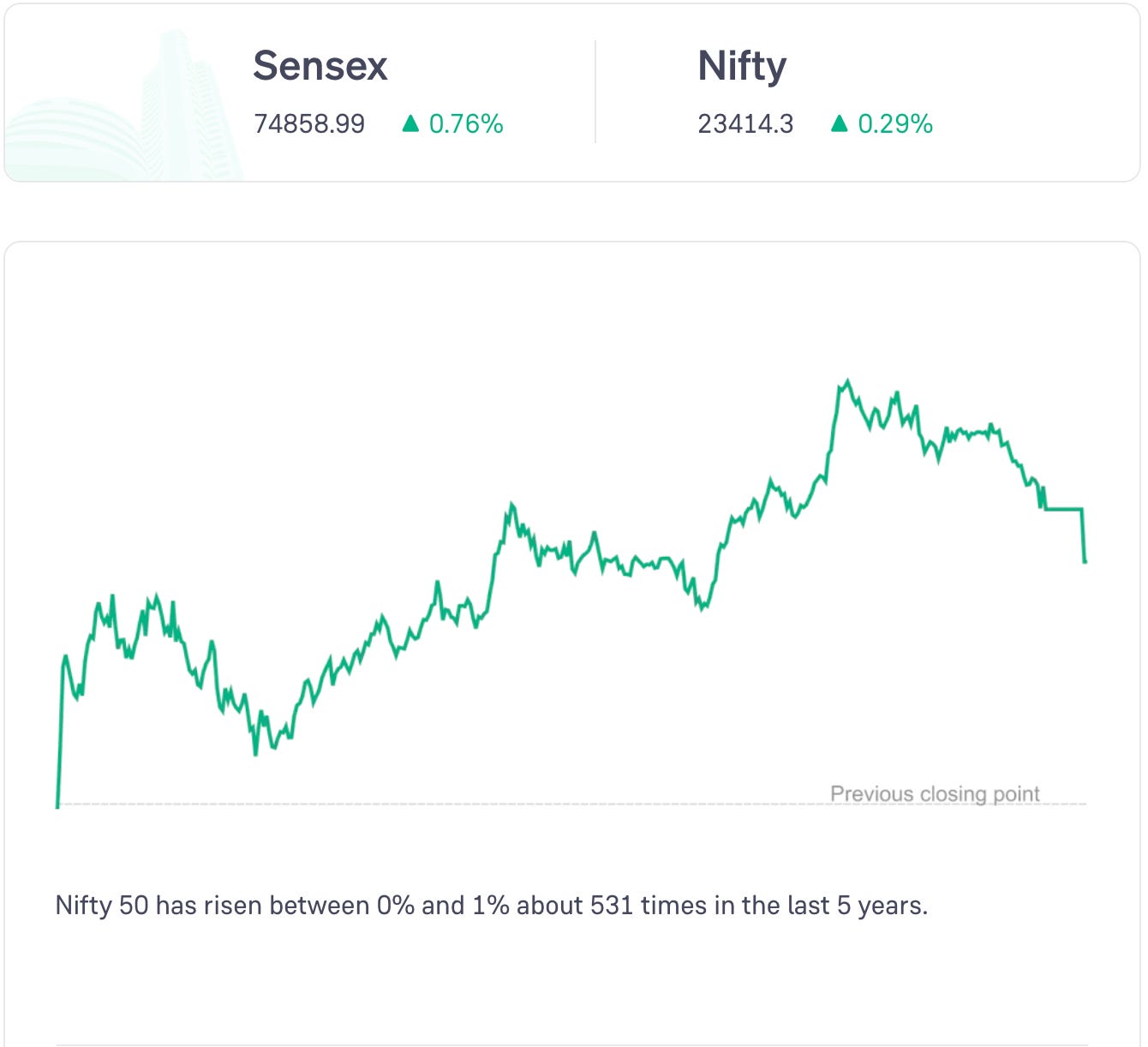
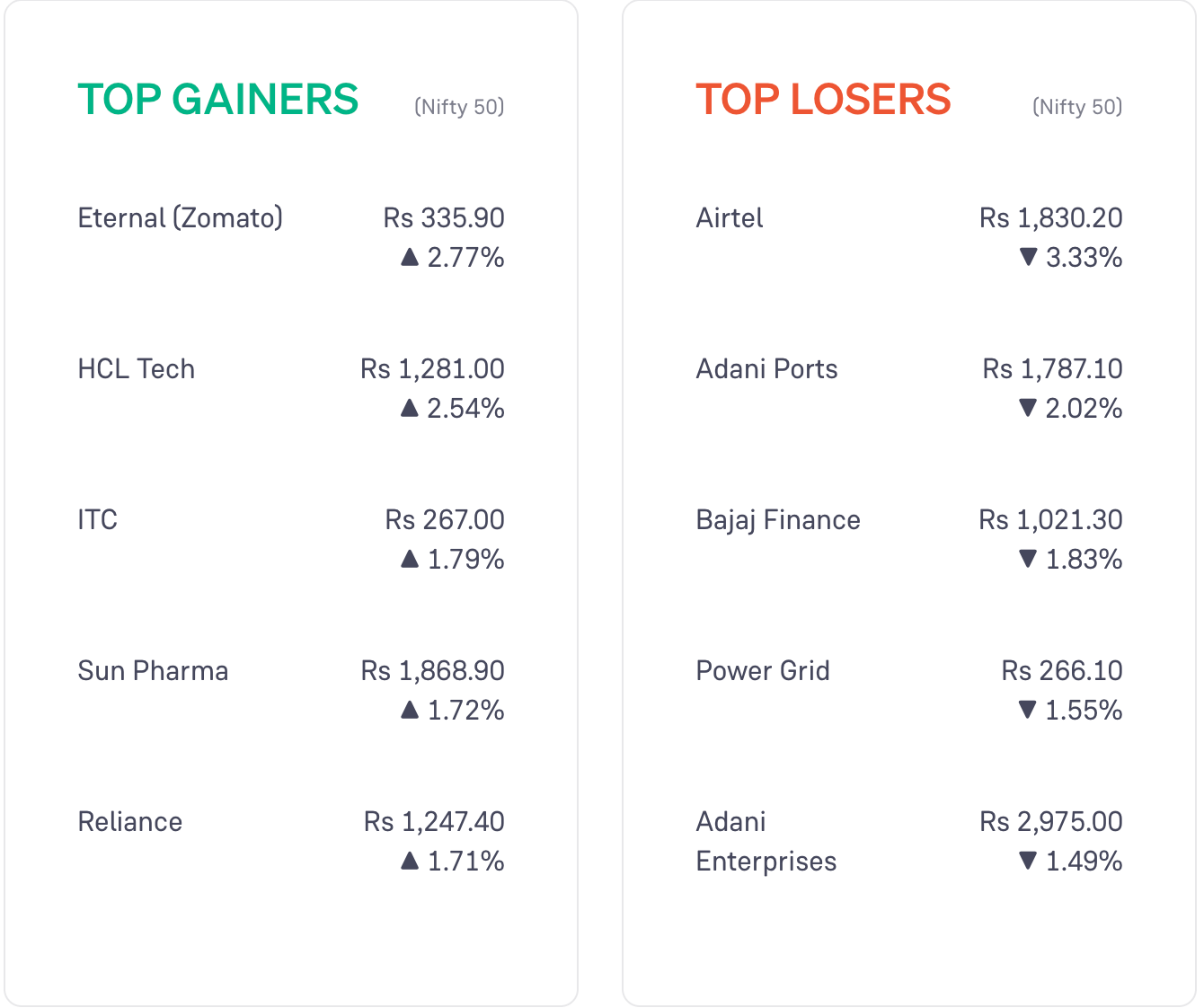
Markets ended higher compared to Friday’s closing point. This could be due to a fall in crude oil prices despite ongoing tensions between the US and Iran.
Pharma stocks and realty stocks rose the most today. Metal stocks fell the most, along with IT stocks.
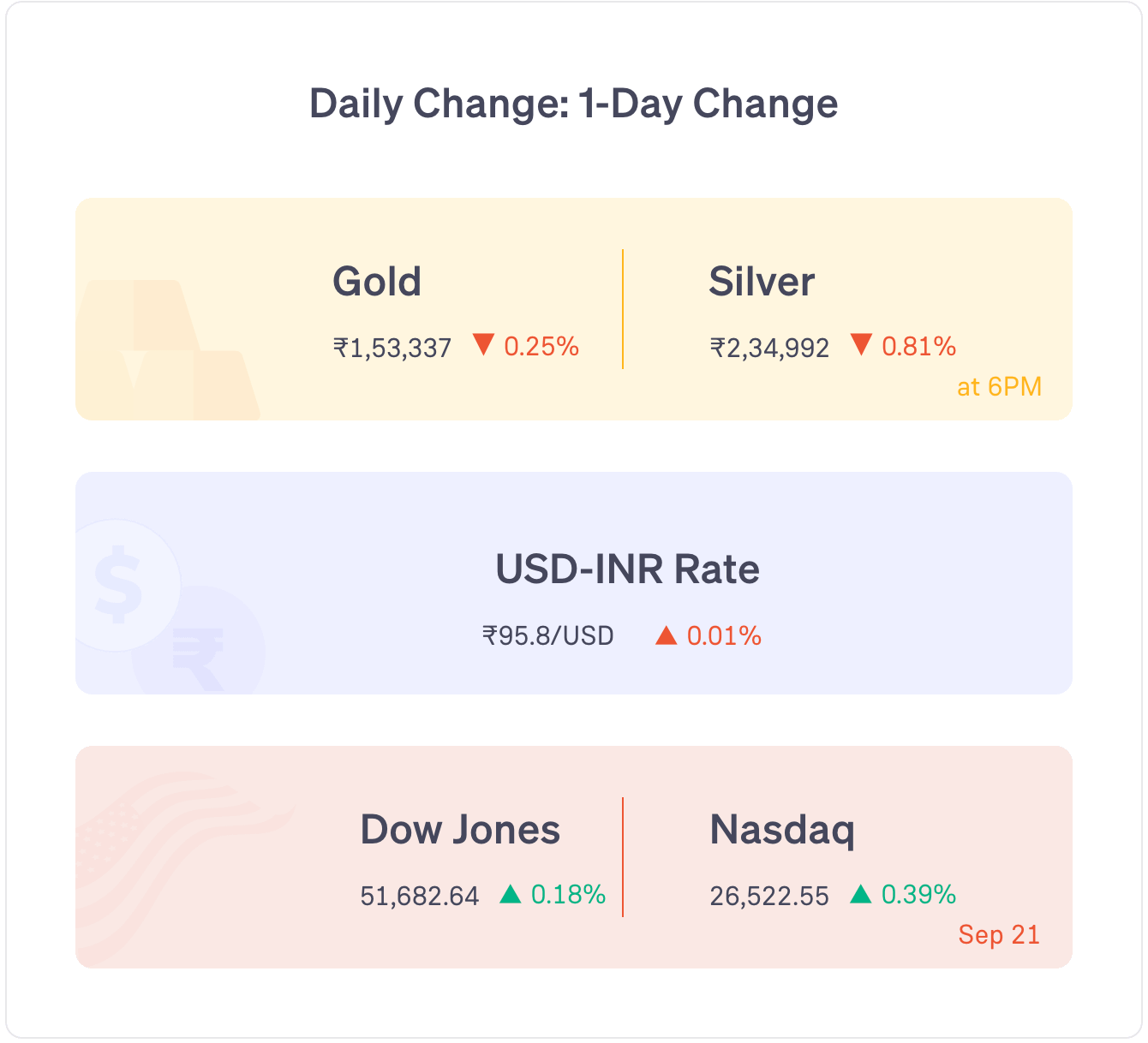
Global markets: US markets ended mixed on Friday. Most Asian markets rose on Monday. Most European markets traded in green(as of 6 pm IST).
News
India’s Core Industrial Output rose 4.8% in August, as per provisional data compared to 5.4% in July. Out of the 9 sectors, coal, natural gas, crude oil, and fertilizers fell.
The India-New Zealand Free Trade Agreement (FTA) will come into effect from 20 Oct. It provides duty free access for 100% of Indian exports to New Zealand.
The government signed a contract worth Rs 586 crore with Accurate Industrial Controls to purchase auxiliary power units for T-72 and T-90 tanks.
NSE’s Rs 22,562 crore IPO was subscribed 5.70 times on day 3. Retail subscription: 1.37 times. The IPO closed for subscription.
Stock Updates
NTPC: declared 68.22 MW of its Dahod solar project and 9.45 MW of its Vanki wind project commercially operational.
ONGC: discovered gas in a deepwater well in the Mahanadi Offshore Basin, around 43 km from Konark. The size and commercial value of the discovery are still being assessed.
Indian Oil: approved Rs 2,448.70 crore to build a 424.65-km Kochi-Kanyakumari-Thoothukudi natural gas pipeline.
Canara Bank: raised Rs 2,042 crore through AT1 bonds at an 8.10% interest rate. The base issue was Rs 2,000 crore, with a greenshoe option to raise up to another Rs 2,500 crore if there was enough demand.
Samvardhana Motherson: subsidiary Samvardhana Motherson Adsys Tech will acquire a 50.1% stake in Rotary Connectors Pvt Ltd, which makes military-grade connectors used in aerospace and defence. The deal values the business at Rs 500.40 crore.
Shriram Finance: offered to buy back up to $460 million of its overseas bonds from investors. Bonds bought back will be cancelled.
Billionbrains (Groww): Sequoia Capital Global Growth Fund sold 1.55 crore shares, reducing its holding from 1.57% to 1.32%.
Word of the Day
Basis Points
It is a way of quantifying a change in percentage
1 basis point = 0.01%
Therefore, 100 basis points = 1%
Basis points are also abbreviated as ‘bp’. Sometimes, they are also written as ‘bps’ and even ‘bips’.
When the percentages are changed, it can be confusing.
Example:
The current interest rate is 5%. The interest rate was increased by 0.5%.
Does this mean the interest rate was increased from 5% to 5.5%?
Or does this mean 0.5% of 5%? That is, it went from 5% to 5.025%?
Using basis points clears this up as we can simply say, the interest rate was increased by 50 basis points (5% to 5.5%).
6 Day Course
Theme: how fund managers handle money
Day 1: Monday
The moment we invest in a mutual fund and are allocated units in the mutual fund, our investment has taken place.
The money is effectively invested in the mutual fund’s entire holding. We will get all the benefits of portfolio appreciation.
But, how is the money received by mutual funds handled? What are the strategies used by fund managers?
In this week’s course, we will explore how fund managers handle cash.
One of the first things to notice is that nearly all mutual funds keep some cash.
This can be seen in the mutual funds’ holding.
This could be as small as less than 1% of the total value or even be in double-digit percentages.
The fund manager can keep this portion in cash based on various factors like to pay investors who are withdrawing their money, markets being overvalued, waiting for a good opportunity, etc.
————
What If
Sometimes, a stock lists after an IPO and ends up moving well above its issue price.
Then, months or even years later, it falls back close to that original IPO price.
When that happens, it can feel like a second chance to buy. Especially if you remember that the stock had once traded much higher.
But just because a stock is back near its issue price does not necessarily mean it is cheap or that it will go back up.
So we wanted to know what actually happens when investors get this “second chance”.
In today’s What If, we looked at mainboard IPOs from 2015 to 2025 and studied what happened when a stock first rose and came back to the original IPO price. We then checked how those stocks performed after that point.
Did you like this edition?
Leave a feedback here!