
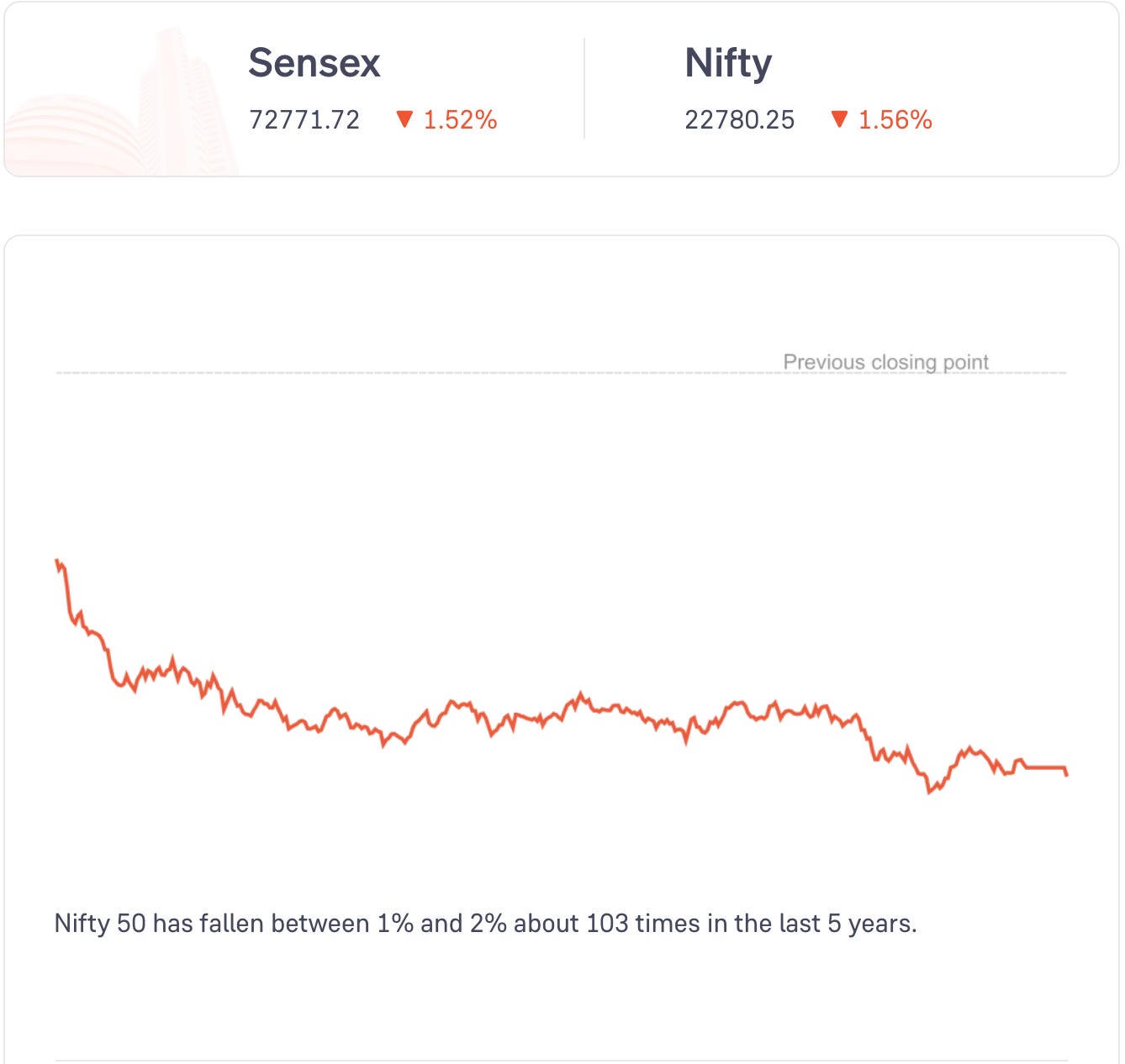
Markets ended lower compared to Friday’s closing point.
Brent crude oil prices jumped up to $106 on Friday after US President Trump rejected Iran’s proposal to reopen the Strait of Hormuz. This led to markets opening significantly lower and closing in red.
All sectors’ stocks fell today. PSU Bank stocks and realty stocks fell the most.
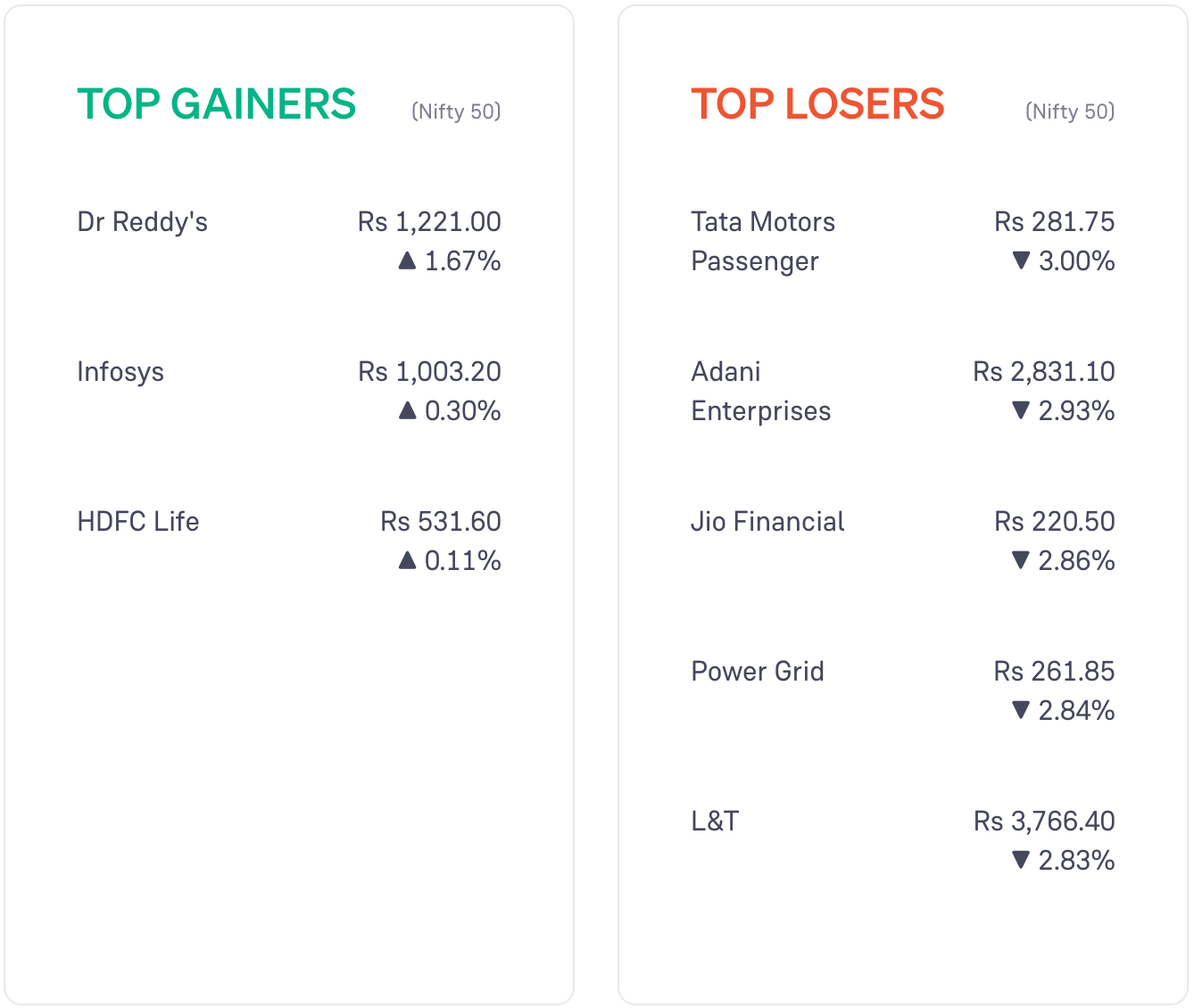
Only 3 stocks in Nifty 50 rose today. Hence there are only 3 stocks in the top gainers section.
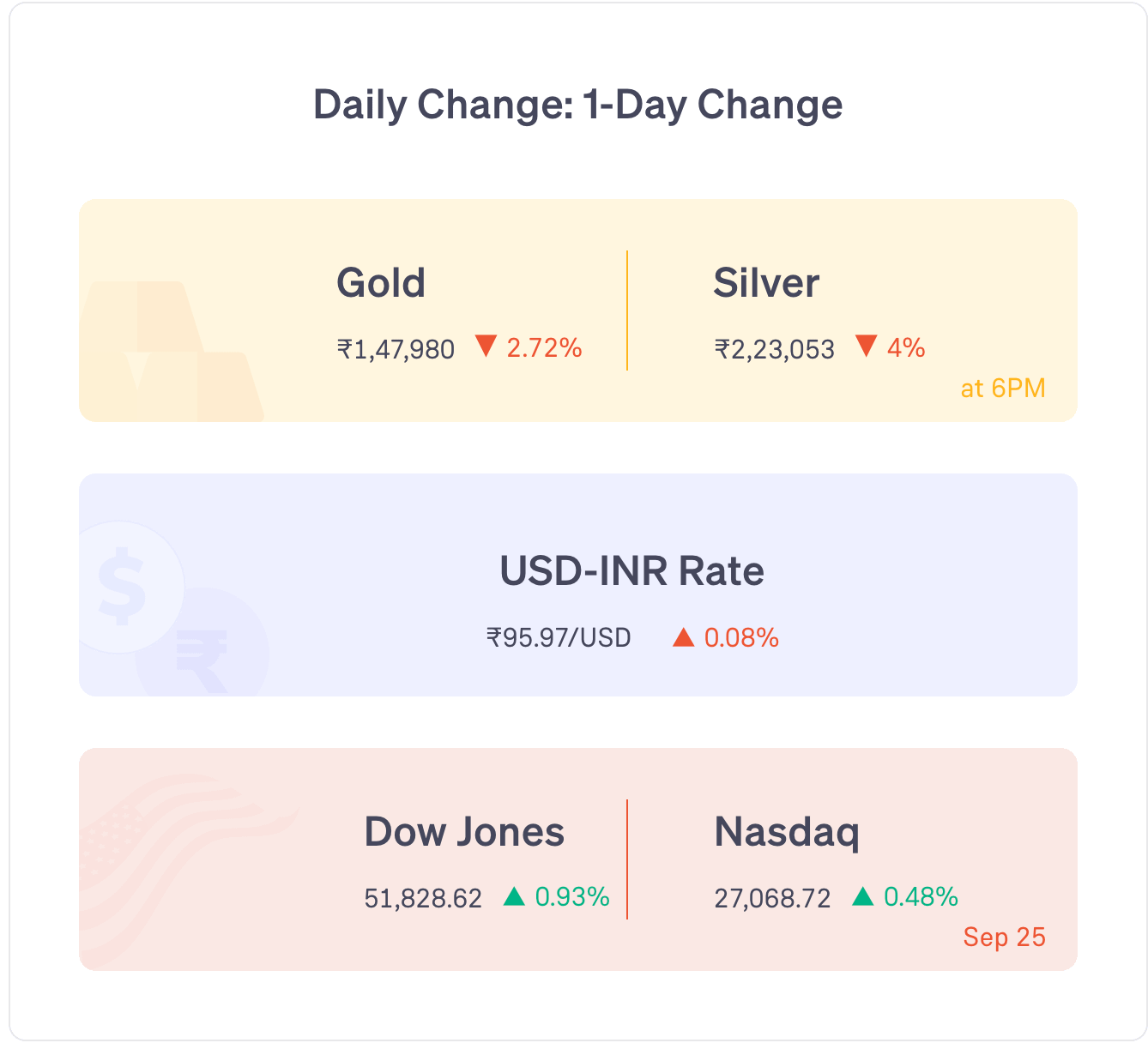
Global markets: US markets rose on Friday. Most Asian markets ended in red on Monday. Most European traded higher (as of 6 pm IST).
News
India’s industrial production rose 8% in August from 6.7% in July. The growth was led by electricity & gas supply and manufacturing sectors.
The government extended the due date for providing income return for AY 26-27 for persons subject to audit to 21 Nov from 31 Oct.
The government approved Rs 223 crore for Kavach 4.0, an Automatic Train Protection (ATP) system in the Varanasi division and Rs 122 crore separately, for an additional 6 km stretch in Odisha.
Tonbo Imaging India Ltd, Pioneer Fil-med Ltd, and Functional & Innovative Foods Ltd received SEBI approval for IPO.
IPO Corner
Moneyview’s Rs 1,091.68 crore IPO was subscribed 98.46 times on day 3.Retail subscription: 19.57 times. The IPO is closed for subscription.
Orient Cables’ Rs 552 crore IPO was subscribed 8.32 times on day 2.Retail subscription: 9.16 times. The IPO will close for subscription on 29 Sep.
Runwal Enterprises’ Rs 500 crore IPO was subscribed 0.71 times on day 2. Retail subscription: 0.42 times. The IPO will close for subscription on 29 Sep.
Stock Updates
IRFC: signed a Rs 4,200 crore term-loan agreement with Damodar Valley Corporation (DVC) to finance solar and battery-storage projects in Jharkhand and West Bengal.
Sun Pharma: signed an exclusive agreement with LIB Therapeutics to manufacture and sell cholesterol-lowering drug lerodalcibep outside the US and China. The drug is already approved in the EU.
Power Grid: won a transmission project in Maharashtra with annual transmission charges of Rs 430.67 crore.
Samvardhana Motherson: raised Rs 300 crore through 64-day commercial paper at a 6.25% interest rate.
Pidilite: partnered with South Korea’s Hwaseung Chemical to introduce advanced footwear adhesives in India.
Zydus Lifesciences: a USFDA inspection of its New Jersey drug-safety system ended with zero observations. A separate inspection of its SEZ II manufacturing plant in Ahmedabad ended with one observation.
PFC: Malegaon Power Transmission Ltd as an SPV for a proposed 400/220 kV substation at Malegaon in Nashik, Maharashtra.
Canara Bank: paid Rs 377 crore of annual interest on its Rs 5,000 crore long-term bonds.
NTPC: subsidiary NTPC Green Energy started commercial operations of the first 81.34 MW of its 650 MW Kalasar solar project in Rajasthan.
Lloyds Metals: invested Rs 606.76 crore in subsidiary Thriveni Earthmovers and Infra, increasing its holding to 71.89%.
Aditya Birla Capital: raised Rs 500 crore through secured NCDs that will mature in September 2029.
REC: subsidiary RECPDCL transferred Ranipur Chunar Power Transmission Ltd to HG Infra Engineering and Balsane Power Transmission to Resonia.
Word of the Day
Risk-free Return
This is the return against all other returns that end up getting compared.
It tells us if a risk is worth taking. If the returns of a risky investment are similar to or only slightly higher than the risk free return, then the investment is not a good one.
Technically speaking, nothing is risk-free. “Risk-free return” is usually an extremely low-risk investment option.
The returns given by the USA government bonds are deemed the least-risky returns in the world.
Similarly, the returns given by government bonds of other major and stable economies are also deemed risk-free (example: UK and Japan).
Returns given by government bonds of major economies like China and India are also deemed quite low-risk though not as much as the USA’s.
6 Day Course
Theme: US Fed rate changes
Day 1: Monday
Why does so much start happening when the US Fed (central bank of the USA) changes its rates?
This week, we will understand this in greater detail.
The rates offered by the US Fed influence the interest of all loans and deposits in the US.
The USA’s markets are very open which means many investors from across the world also invest in USA’s bonds and stock markets and vice versa.
Investors use these bonds to store money safely while investing in more risky options to get higher returns.
Every investor allocates different percentages.
Example: 20% in US govt bonds, 60% in US stocks, 20% in emerging markets stocks.
Most investors don’t keep these percentages constant. They change and tweak it based on the returns offered by different investments.
————
What If
When property prices rise, real-estate-linked investments are expected to do well.
In India, investors can bet on this theme in two ways. Realty stocks are developers; companies that build and sell homes.
The other option is Real Estate Investment Trusts (REITs), which own properties like office buildings and malls, rent them out, and pass most of the income to investors.
Both are listed as real estate. But do they work the same way? And do they actually move with house prices?
In today’s What If, we compared three office REITs and three developer stocks from March 2021 to March 2025.
We tested whether they moved with the RBI’s house price index, how they reacted when interest rates rose and fell, and what their total returns looked like.
Did you like this edition?
Leave a feedback here!