
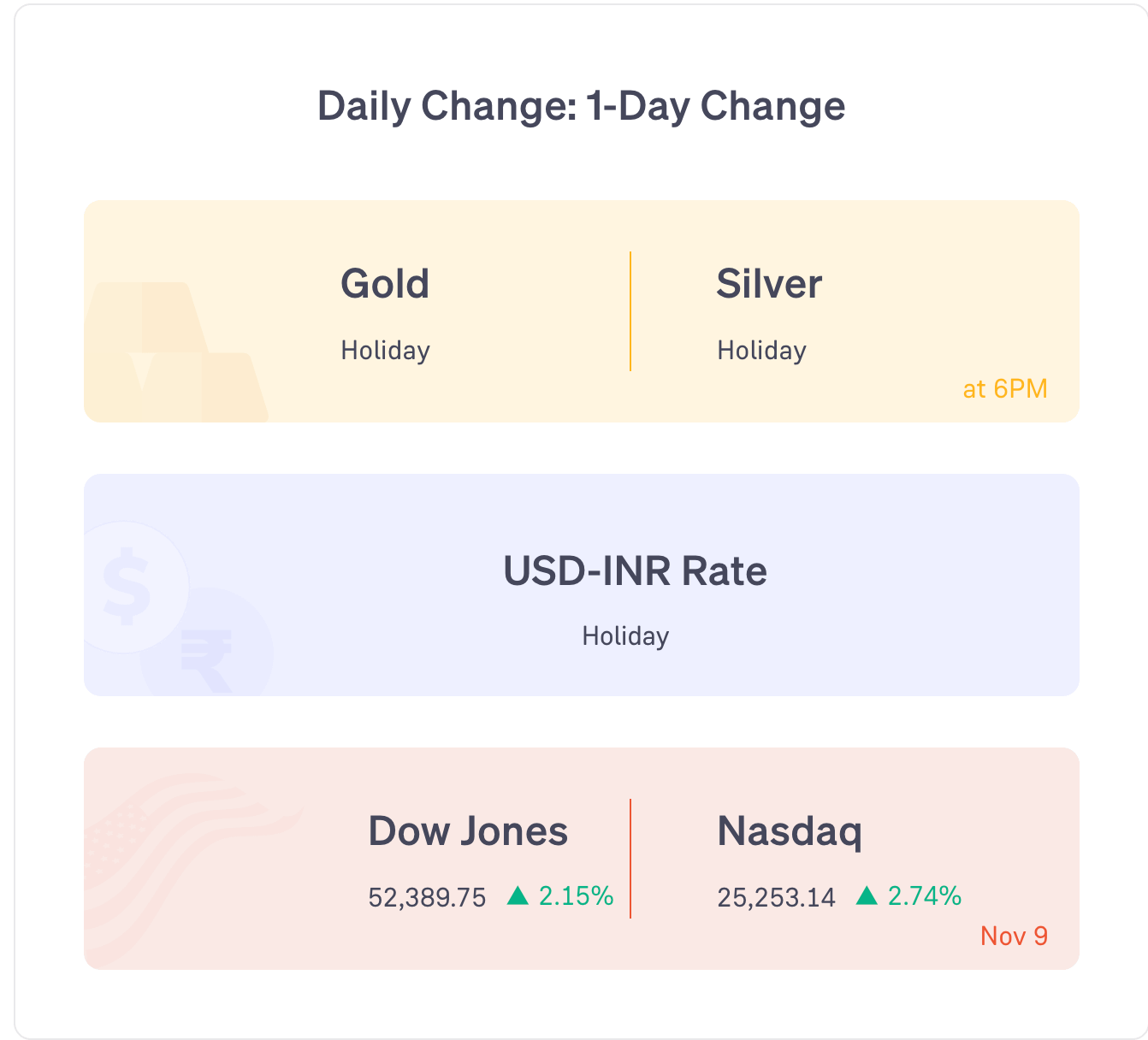
The Indian stock markets were closed today on account of Diwali-Balipratipada.
Hence, there won’t be any updates on the Nifty 50, Sensex, Top Gainers, and Top Losers sections today.
Global markets: US markets rose on Monday. Most European and Asian markets rose (as of 6 pm IST).
News
India’s oilmeal exports that are used for animal feed and organic fertilisers fell 28.51% year-on-year to 12.82 lakh tonnes in the April-August FY27 period, as per the industry body, the Solvent Extractors’ Association of India (SEA).
The government has extended the deadline for its Rs 84,084 crore deepwater exploration blocks for OALP rounds X and XI to 10 Dec. This marks the 7th time of extension for OALP-X and the 3rd for OALP-XI.
Stock Updates
Bajaj Finance: allotted warrants worth about Rs 5,800 crore to parent Bajaj Finserv at Rs 1,010 each. The warrants can be converted into shares within 18 months.
Cholamandalam Finance: sought shareholder approval to raise up to Rs 5,000 crore through a QIP.
Word of the Day
Portfolio Overlap
It is the similarity of two different mutual funds’ investments
Mutual fund investors often invest in different mutual funds for diversification.
But it is possible for two mutual funds to have similar holdings (same stocks or bonds).
In such a case, the diversification benefit is lower.
This phenomenon is called portfolio overlap.
Just holding the same assets is not portfolio overlap. The quantity of overlap matters too.
Example: if mutual fund A has 30% of its AUM invested in a stock and mutual fund B has 33% of its AUM, we can say they both have a significant portfolio overlap.
6 Day Course
Theme: stocks order matching
Day 2: Tuesday
Continuing from yesterday:
The changing price while an order is being executed is why we speak about average buying or selling price.
But what happens when the stock price changes too much while buying or selling?
This could potentially be an unfavourable situation for an investor.
So a limit order helps in such a case.
In limit orders, an investor determines the price at which (or better) they want to buy/sell.
Example: a limit buy order would look like: buy 20,000 shares of XYZ company if the price is Rs 533 or below.
So the buying would take place only when the stock price falls to or below Rs 533.
Likewise, for a sell limit order, the selling would happen at or above the trigger price.
Tomorrow, we’ll see how these different orders are matched by the exchange.
————
What If
In last week’s What If, we studied whether companies with faster profit growth saw better stock returns.
We found that the connection wasn’t very strong, especially over shorter periods.
But that study left out cases where a company had made a loss a year earlier, because profit growth can’t be calculated from a loss.
There are also cases where companies move from a loss to a profit or from a profit to a loss, while some continue making losses.
That got us wondering what happens to their stock prices in these cases. Is there a consistent pattern?
So, to complete the picture, this week we studied 160 such cases and compared their stock returns with the Nifty 50 before and after the results and over the following months and year.
We wanted to see whether these changes in profits and losses could tell us anything about how a stock might perform.
The information presented in this post has been compiled and prepared by Groww Invest Tech Pvt Ltd and is intended solely for informational purposes. It is not tailored to any specific investment objectives, financial situations, or needs of any individual investor. The content should not be construed as investment, financial, legal, or tax advice and should not be relied upon as a substitute for professional consultation.
Investing in securities markets involves inherent risks. Investors are advised to carefully review all relevant documents and consider their own risk tolerance before making any investment decisions.
Mutual fund investments are subject to market risks; please read all scheme-related documents carefully. Past performance of financial instruments, schemes, or markets is not indicative of future results.
SEBI Reg Name: Groww Invest Tech Pvt Ltd | SEBI Reg No: INZ000301838 | RA No: INH200008662
Groww Invest Tech Pvt Ltd is registered with the Securities and Exchange Board of India (SEBI) under Registration No: INZ000301838, as a Research Analyst under No: INH200008662, as a Depository Participant under No: IN-DP-417-2019, and with the Association of Mutual Funds in India (AMFI) under ARN-111686.
SEBI registration details: View registered name and registration numbers
Did you like this edition?
Leave a feedback here!