

Everything that is built around the chips
In 2008, an old paper mill in Hamina, Finland, stopped operating. A year later, Google bought the site and began turning it into a data centre.
At first, an abandoned paper mill may seem like an unusual place to build a data centre. But Google was interested in more than just the building.
In the first part of this series, we looked at the biggest cost, the chips and servers themselves. The reason Google chose this site will help explain the second-biggest cost: the infrastructure needed to keep those chips running.
The mill already had the kind of infrastructure that a large data centre needed.
It had access to electricity, large tanks and pipes, and a 450-metre tunnel carved through granite that brought seawater in from the Gulf of Finland.
Instead of starting from scratch, Google could reuse and adapt much of what was already there.
That is what made the old mill valuable, not the building itself, but the power connection, pumps, pipes, water access and space for large industrial equipment.
A data centre works in much the same way. Most of the money does not go into the walls and roof but into the systems that bring in electricity, distribute it to thousands of chips, provide backup power during outages and continuously cool the equipment.
Together, the building and its supporting systems account for about 40% of the total build cost, making them the second-largest expense after the chips and servers, which account for roughly 60%.
This cost is usually measured per megawatt, or MW, of IT load. Basically, it tells how much money is needed to build the facility and supporting systems required to run 1 MW of computing equipment continuously.
In 2026, building this infrastructure is estimated to cost around $11.3 million per MW, up from $7.7 million in 2020.
AI data centres are more expensive because powerful GPUs do much more computing work and require much more electricity in each rack (a server cabinet that holds computing equipment). For example, NVIDIA’s GB200 NVL72 rack uses about 120 kW, while a normal server rack only uses around 5-10 kW.
At this point, regular cables and power systems are not enough anymore. A future 1 MW AI rack using today’s 54-volt setup would need around 18,500 amps, up to 200 kg of copper-based hardware, and almost a full rack of power equipment just to supply the electricity.
As a result, data centres need larger transformers, thicker cables, higher-capacity switchgear, and more powerful backup systems. Transformer prices have risen by about 77-95% since 2019, while the electrical systems for a 50 MW facility can cost around $40-80 million. All of this also increases cooling costs, and with better cooling, these changes can push the cost of an AI-ready data centre to over $20 million per MW.
There are many other infrastructure challenges beyond these core components that further add to complexity and expense.
And that still does not include the chips.
After adding GPUs, servers and other computing hardware, the total cost can reach around $30-40 million for every MW of computing capacity.
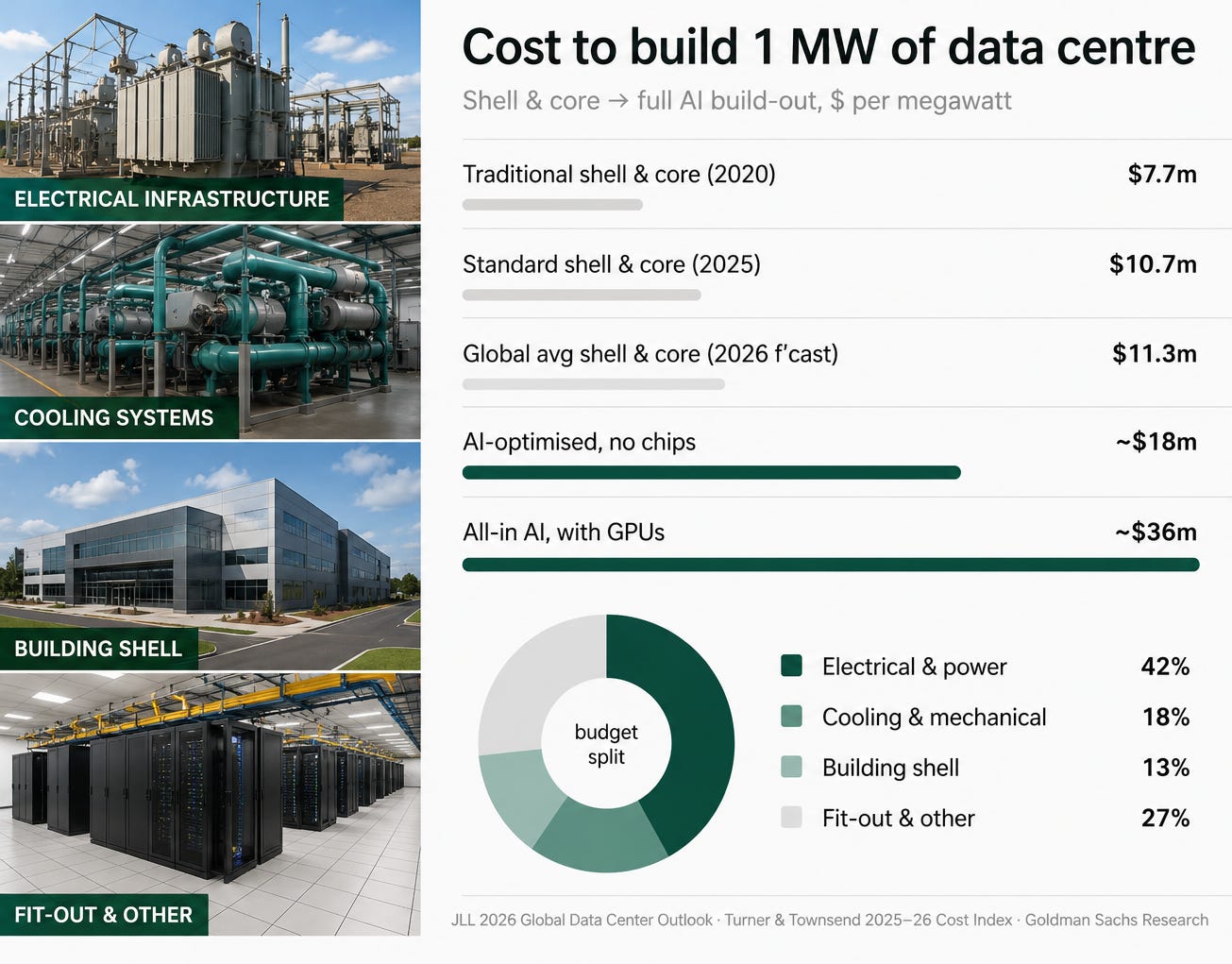
Although each MW costs millions, the building structure (walls, roof, concrete) is only 10-15% of the non-IT build cost.
Most of the money goes into the electrical and cooling systems needed to run the servers.
Electrical systems are usually the largest single expense, accounting for roughly 40-45% of the non-IT construction cost. Cooling systems make up another major part of the cost.
The electrical system is expensive because electricity from the grid cannot be sent directly to the servers. It must pass through transformers, switchgear and other equipment that lowers the voltage, controls the flow and protects the machines.
Around 55% of the total cost of the power system is used for this equipment. The other 45% is used for backup systems like UPS units, batteries, and generators, which keep the servers running when the main power supply fails.
These power systems are becoming even more expensive as AI servers use more electricity. A traditional server rack used around 5-10 kW of power, while a new AI rack can use 70-100 kW. This requires larger transformers, thicker cables, stronger backup systems and more advanced cooling.
At the same time, this equipment is becoming harder to obtain. Five years ago, a large transformer could often be delivered within about a year. Today, some can take 3 to 4 years.
The reason is that demand is growing much faster than manufacturers can increase production. The supply chain was built when electricity demand was rising slowly, not for the sudden construction of large AI data centres.
Some estimates suggest that data centres could account for up to 40% of US demand for electrical equipment by 2030, compared with less than 5% in 2020.
As a result, technology companies are now competing with utilities, factories and renewable-energy projects for the same transformers, switchgear and other equipment.
Manufacturers such as GE Vernova, ABB and Eaton are receiving new orders faster than they can complete old ones. As waiting lists grow, prices are also rising. Large transformers now cost roughly 80% more than they did five years ago (about 1.8x higher).
But buying and installing this power equipment is only the upfront cost. Once the data centre starts operating, it must keep paying for the electricity flowing through these systems every second of every day.
Because AI servers use far more power than traditional servers, electricity becomes the data centre’s biggest ongoing expense.
Electricity
The chips may be the biggest thing a data centre company buys, but electricity is the biggest thing it keeps paying for.
A data centre runs all day and night. The servers cannot be switched off when demand is low, and the cooling systems must keep running as long as the chips are producing heat.
Let’s say a 100 MW data centre is running continuously.
That means it is using 100 megawatts of power every hour, 24 hours a day, 365 days a year. Over a full year (8,760 hours), this adds up to around 876,000 MWh of electricity. At a price of $50-80 per MWh, the annual electricity bill would be around $44-70 million.
And 100 MW is considered relatively small on today’s date. New data-centre campuses are being planned at the gigawatt scale.
1 GW (1,000 MW) is roughly the electricity produced by one large nuclear reactor.
Meta’s Hyperion data centre campus in Louisiana, for example, could eventually require as much as 5 GW of power (output of about 5 large nuclear reactors).
A 1 GW data centre running throughout the year would consume around 8.76 million MWh of electricity. At current industrial power prices, its annual electricity bill could exceed half a billion dollars.
Across the US, the numbers are even bigger.
Data centres used about 5.9% of the country’s electricity in 2026. Bloomberg estimates this could rise to around 12% by 2030 and 20% by 2035.
By 2035, data centres might need around 194 gigawatts of power. That’s almost the same as the electricity made by about 200 big nuclear power plants running at the same time.
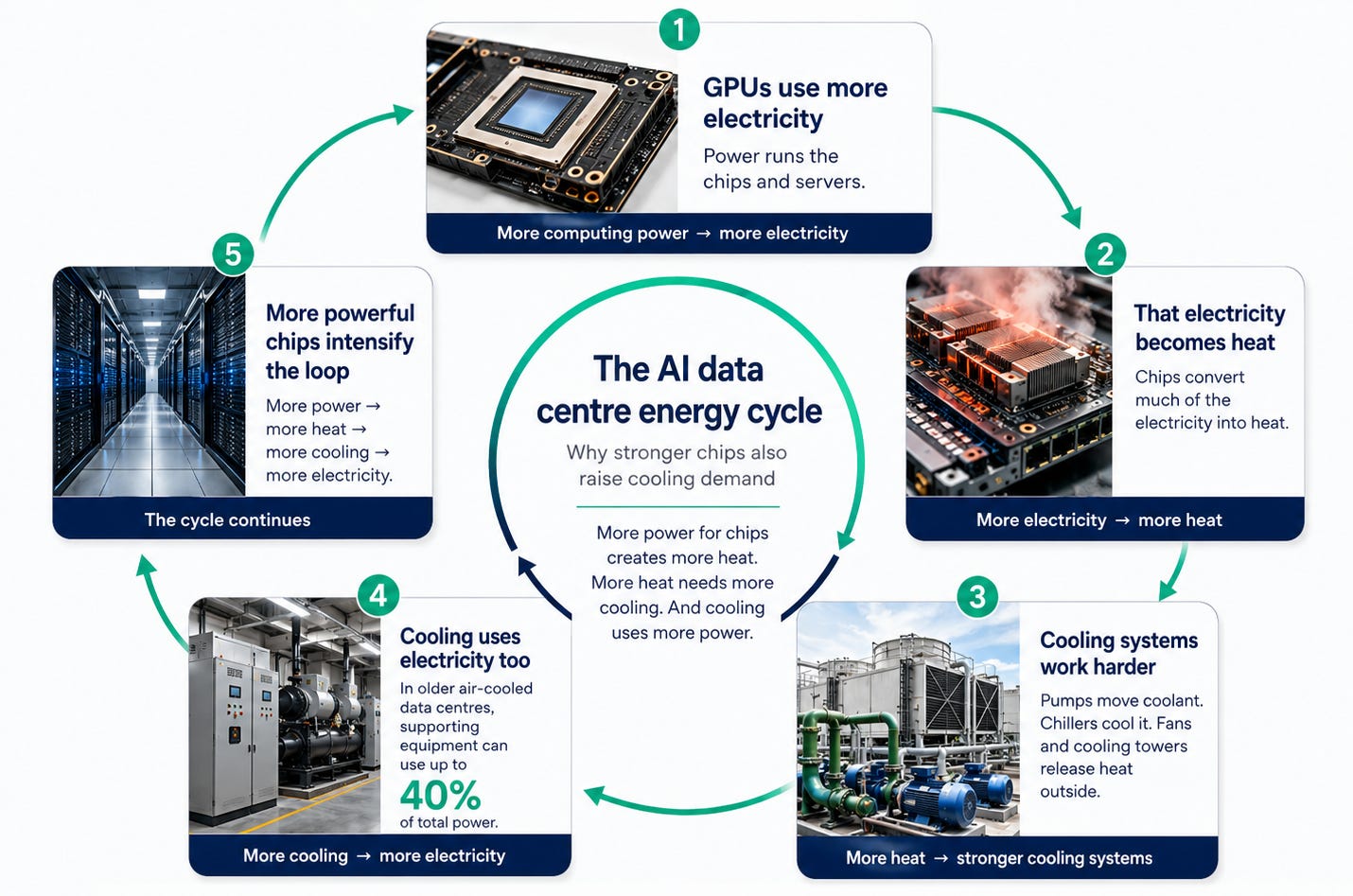
But not all this electricity is used directly for computing. GPUs consume huge amounts of power, and much of it eventually turns into heat. That heat must be removed continuously, which requires even more electricity.
Pumps move liquid through the building to carry heat away, machines called chillers cool that liquid, and fans and cooling towers then push the heat out into the air outside.
But all this cooling equipment also needs electricity to run. In older air-cooled data centres, cooling can consume as much as 40% of the facility’s total power. This is one reason companies are moving towards liquid cooling, which can remove heat more efficiently.
It creates a continuous cycle. More powerful chips use more electricity. More electricity produces more heat. More heat requires stronger cooling systems, and those systems use still more electricity.
This is why large technology companies no longer treat electricity as just another monthly bill. They now treat it like a critical raw material and are securing supplies many years in advance.
The clearest example is the rush towards nuclear power we talked about in our previous report. By the middle of 2026, technology companies had announced around 13 nuclear deals covering more than 9.8 GW of capacity for AI and data centres.
But securing enough electricity is only one part of the problem. The power supply also needs to be reliable and continuous.
Even a short power outage can stop thousands of GPUs working together during an AI training run, wasting valuable time and work worth millions of dollars.
This is why data centres need lots of backup power, and it gets very expensive.
When the main power grid goes down, batteries and UPS systems kick in for a few minutes while big diesel generators start up. These generators are huge, usually producing 2-3 MW each, and can cost between $500,000 and $2 million. A large data centre may need 50 or more, taking the total generator cost to around $25-100 million.
In Virginia, the world’s largest data centre hub, each site has about 54 diesel generators on average.
But generators are only one part of the backup system. Operators also need fuel storage, electrical switchgear, protective enclosures and exhaust systems. Together, these can add another $10-23 million, while the generator area itself can take up two to five acres.
UPS systems are another big cost. For a 50 MW facility, they can range from about $50-150 million depending on how much backup power is needed.
All together, generators, UPS systems, and other backup equipment can make up around 45% of the total power equipment cost.
Companies are willing to spend this much because downtime is extremely expensive. At the biggest facilities, even a single minute of downtime can cost tens of thousands of dollars.
This is what makes electricity so expensive for a data centre. Companies must first spend millions building the systems that bring in, distribute and back up the power. Once the facility opens, they must keep paying for the electricity it uses every second of every day.
But the cost does not end there. Almost all the electricity used by the chips eventually turns into heat. Removing that heat requires another expensive layer of pumps, chillers, pipes and cooling systems.
That brings us to the next major cost of an AI data centre: cooling.
That is the next cost we will explore in this series.