
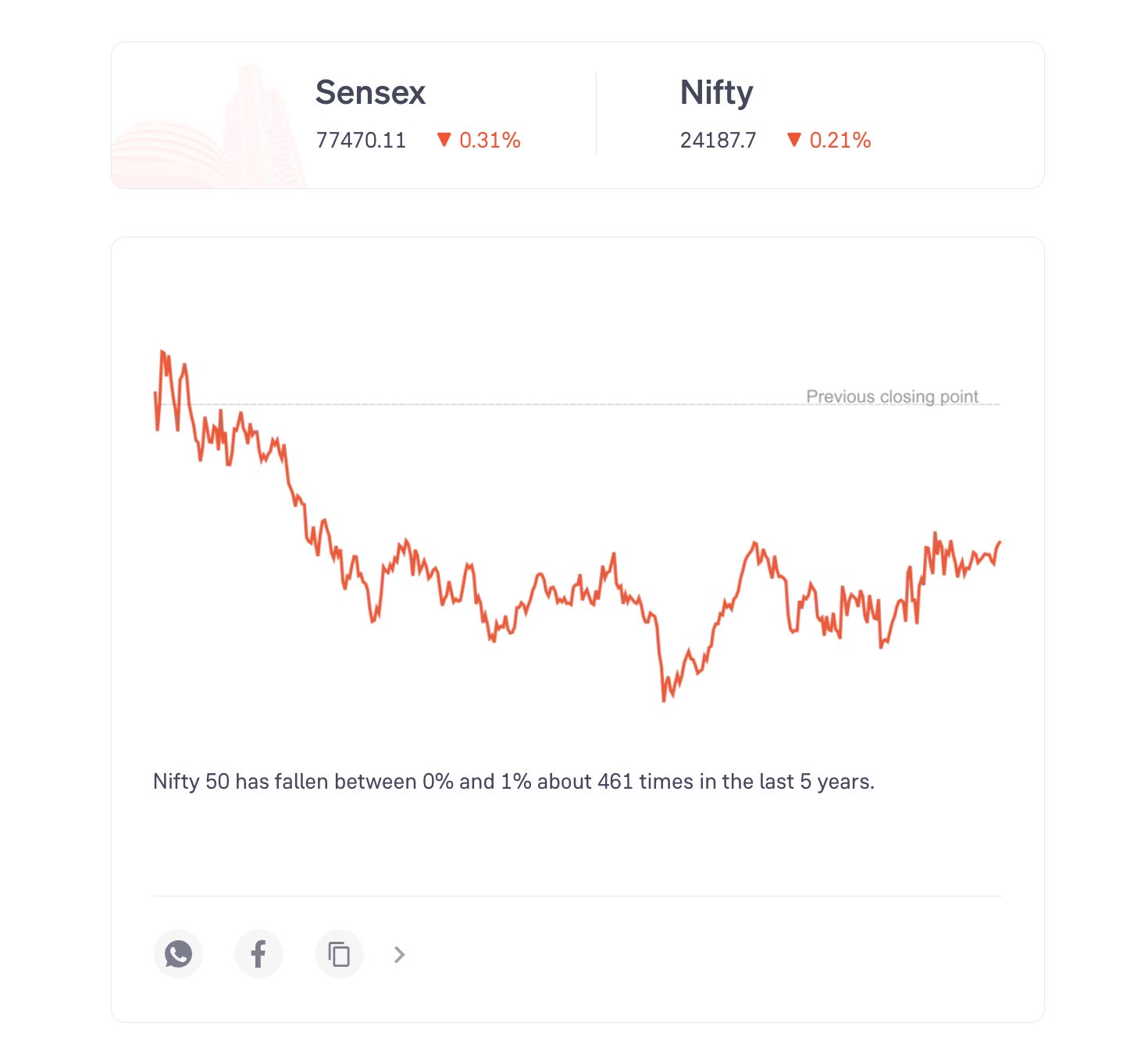
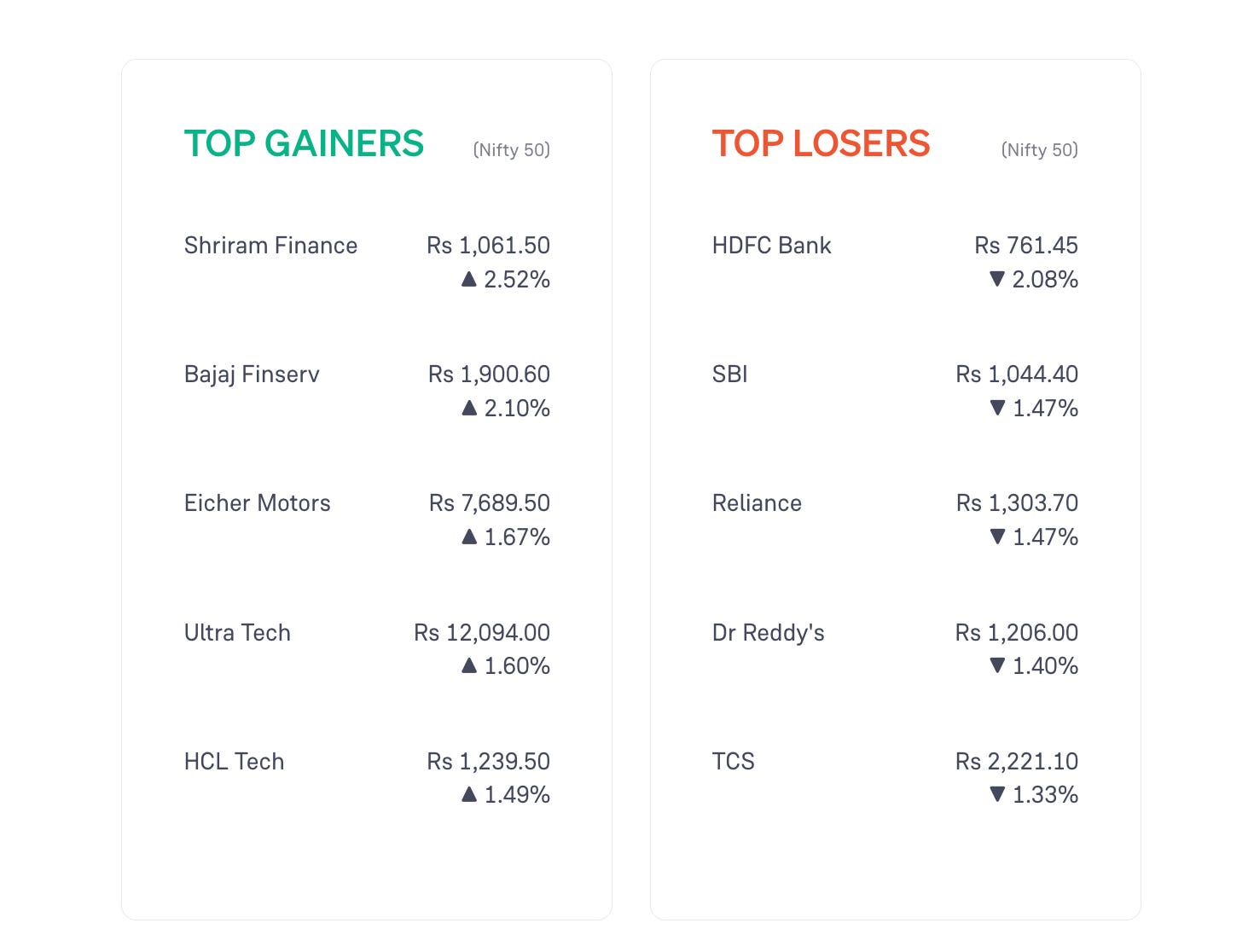
Markets closed lower than yesterday’s closing point.
Chemicals stocks and cement stocks rose the most today. PSU bank stocks and IT stocks fell the most.
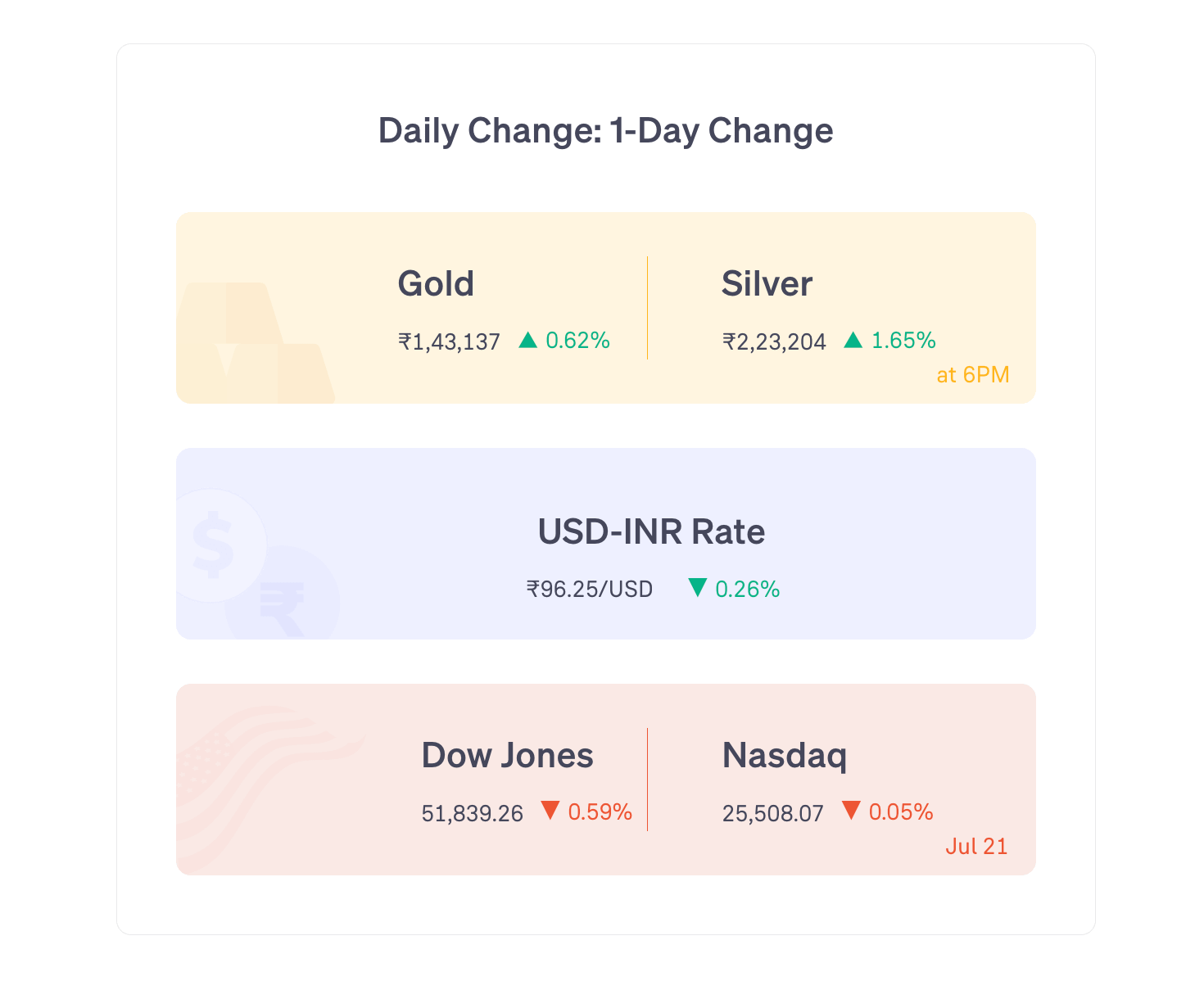
Global markets: US markets fell on Monday. Most Asian and European markets rose (as of 6 pm IST).
News
The government will sign an Implementation Agreement with Germany on 22 July to strengthen institutional capacity, facilitate knowledge sharing and foster technical cooperation. The agreement will be signed during the release of ‘AAROH-Annual Report on Mine Closure’.
Sebi directed depositories to issue operational guidelines for freezing promoter holdings at the ISIN level during buybacks by 1 August.
SBI Funds Management listed at Rs 613.3 on NSE, a premium of 6.85% over its issue price and closed 6.23% higher at the end of the day.
Stocks Updates
Maruti Suzuki: will increase prices across its model portfolio by up to Rs 30,000 with effect from August 2026 due to higher input costs. The exact increase will vary by model.
Bajaj Auto: net profit rose 45.93% year-on-year to Rs 3,225.63 crore in the Apr-June quarter.
Adani Energy: net profit rose 124.22% year-on-year to Rs 1,149 crore in the Apr-June quarter.
InterGlobe (IndiGo): signed an MoU with CFM International for 1,000+ engines. The MoU also covers support for IndiGo’s upcoming engine MRO facility.
TVS Motor: net profit rose 67.11% year-on-year to Rs 1,019.43 crore in the Apr-June quarter.
Lupin: subsidiary Lupin Inc U.S.A. granted an exclusive perpetual license for two oncology programs to Kaveri Therapeutics, Inc. in exchange for an 82.2% equity stake valued at $1.6 million.
Aditya Birla Capital: invested Rs 123.89 crore in associate Aditya Birla Health Insurance through a rights issue to meet solvency margin requirements. Its stake remains unchanged at 45.89%.
Indian Hotels (IHCL): net profit rose 20.76% year-on-year to Rs 357.90 crore in the Apr-June quarter.
JSW Energy: completed acquisition of additional equity shares in Toshiba JSW Power Systems Pvt Ltd from Toshiba Corporation, Japan for Rs 150 crore, raising its stake to 20.7% from 4.6% on a non-diluted basis.
Aurobindo Pharma: subsidiary CuraTeQ Biologics Pvt Ltd received ANVISA approval from Brazil’s national health surveillance agency for its biosimilars manufacturing facility in Hyderabad.
One 97 (Paytm): net profit rose 78.86% year-on-year to Rs 220 crore in the Apr-June quarter.
Word of the Day
Leverage
In finance, leverage refers to investing using borrowed money or debt.
Many traders and investors use leverage, they try to amplify their returns since the money they borrowed has a fixed interest rate.
Example: you have Rs 10,000 and you borrow another Rs 10,000 (total Rs 20,000). This money is invested in a stock.
In a day, this stock gains 5%.
So, the total amount invested has grown from Rs 20,000 to Rs 21,000.
But since you used borrowed money, you actually made Rs 1,000 using only Rs 10,000 of your own money. So your actual return was 10%, not 5%.
This is called a leveraged trade.
It is extremely risky since if the stock falls, the entire debt/borrowed money would have to be paid back using your own money.
6 Day Course
Theme: understanding PEG
Day 2: Tuesday
Before going ahead to understand what PEG ratio aims to address, let’s understand the flaw in PE ratio.
The PE ratio was explained in yesterday’s course.
What does a high PE ratio tell us?
It tells us that a stock’s current share price is too high compared to its current earnings. And vice versa.
We know that investors tend to be willing to pay a price not based on current earnings but future earnings.
This means that despite current earnings, companies with a bright future attract more investors.
This pushes its PE ratio up.
Conversely, fewer investors want shares of a company with poor future prospects.
This causes its PE ratio to dip.
So in effect, poor companies’ PE ratio becomes lower (thus making them seem undervalued and a better investment option).
Good companies’ PE ratio becomes higher (thus making them seem overvalued and a poorer investment option).
But this is the opposite of what is actually happening.
So, what PEG ratio tries to do is compare PE ratio but also factor in the growth of the company.
————




We explored the question “"What if you invested in the biggest IPOs of the year?"
Check out the full report here.
The information presented in this post has been compiled and prepared by Groww Invest Tech Pvt Ltd and is intended solely for informational purposes. It is not tailored to any specific investment objectives, financial situations, or needs of any individual investor. The content should not be construed as investment, financial, legal, or tax advice and should not be relied upon as a substitute for professional consultation.
Investing in securities markets involves inherent risks. Investors are advised to carefully review all relevant documents and consider their own risk tolerance before making any investment decisions.
Mutual fund investments are subject to market risks; please read all scheme-related documents carefully. Past performance of financial instruments, schemes, or markets is not indicative of future results.
Groww Invest Tech Pvt Ltd is registered with the Securities and Exchange Board of India (SEBI) under Registration No: INZ000301838, as a Research Analyst under No: INH200008662, as a Depository Participant under No: IN-DP-417-2019, and with the Association of Mutual Funds in India (AMFI) under ARN-111686.
SEBI registration details: View registered name and registration numbers
Research Analyst Disclaimer: View Research Analyst disclaimer
Did you like this edition?
Leave a feedback here!
insights are aptly described and for me its always knowing new every day about the terms used in stocks and trading areas.